Mutual Funds

Flexi Cap vs Multi Cap Funds

Marisha Bhatt · 28 Jul 2026 · 7 mins read · 0 Comments

flexi-cap-vs-multi-cap-funds

When it comes to long-term wealth creation, equity investments are often among the most preferred choices for investors. Mutual funds make it easier to access the equity market, offering options tailored to different risk appetites and investment goals. However, for investors seeking a diversified equity portfolio without having to choose between large-cap, mid-cap, and small-cap stocks, two categories often stand out, i.e., Flexi Cap Funds and Multi Cap Funds. While both fund types invest across market capitalisations, they follow different investment approaches that can significantly influence returns, risk, and portfolio allocation. So, how do Flexi Cap Funds and Multi Cap Funds differ, and which one may be better suited to your financial goals? Check out this blog where we break down the key differences, benefits, and considerations of each to help investors make a more informed investment decision.

What are Flexi Cap Funds?

What are Flexi Cap Funds

Flexi Cap Funds are equity mutual funds that have the flexibility to invest across companies of all market capitalisations, i.e., large-cap, mid-cap, and small-cap stocks. Unlike some other equity fund categories that have fixed allocation requirements, Flexi Cap Funds allow the fund manager to dynamically adjust investments based on market conditions, valuations, and growth opportunities. For example, if large-cap stocks appear more stable during uncertain markets, the fund manager may increase exposure to them. Conversely, when mid-cap or small-cap companies show stronger growth potential, the fund manager can allocate a larger portion of the portfolio to those segments. This flexibility enables the fund to adapt to changing market environments while aiming to balance risk and return. As a result, Flexi Cap Funds are often considered a suitable core portfolio holding for investors seeking diversified equity exposure through a single fund.

Key SEBI Rules for Flexi Cap Funds

SEBI introduced Flexi Cap Funds as a separate equity fund category in November 2020 to provide fund managers with greater investment flexibility. The key regulations include, 

  • Minimum 65% equity allocation - At least 65% of the fund's total assets must be invested in equity and equity-related instruments.

  • No market-cap restrictions - There is no mandatory allocation to large-cap, mid-cap, or small-cap stocks. Fund managers can decide the allocation based on their market outlook.

  • Open-ended equity scheme - Investors can buy or redeem units on any business day, providing liquidity and flexibility.

  • Dynamic portfolio management - Fund managers can shift allocations across market-cap segments without being bound by minimum exposure requirements for any specific segment.

What are Multi Cap Funds?

What are Multi Cap Funds

Multi Cap Funds are equity mutual funds that invest in companies across all market capitalisation segments, i.e., large-cap, mid-cap and small-cap stocks. The objective of these funds is to provide investors with diversified exposure to different segments of the stock market through a single investment. Large-cap stocks can offer relative stability, mid-cap stocks can provide a balance of growth and risk, while small-cap stocks have the potential to deliver higher growth, albeit with greater volatility. By investing across all three segments, Multi Cap Funds aim to capture opportunities from different parts of the market and reduce the dependence on the performance of any one category. This diversified approach makes them suitable for investors seeking long-term wealth creation while maintaining exposure to a broad range of companies and growth opportunities. However, unlike Flexi Cap Funds, Multi Cap Funds follow a structured allocation framework laid down by SEBI, which limits the fund manager's flexibility in shifting investments between market-cap segments.

Key SEBI Rules for Multi Cap Funds

SEBI has prescribed specific investment requirements for Multi Cap Funds to ensure true diversification across market-cap categories. These requirements include, 

  • Minimum 75% investment in equities - At least 75% of the fund's total assets must be invested in equity and equity-related instruments.

  • Mandatory 25% allocation to each market-cap segment - A minimum of 25% of the fund's total assets must be invested in large-cap stocks, 25% in mid-cap stocks, and 25% in small-cap stocks.

  • Balance 25% can be allocated flexibly - After meeting the mandatory allocation requirements, the balance portion of the portfolio can be invested according to the fund manager's strategy.

  • Open-ended equity scheme - Investors can purchase or redeem units on any business day, subject to the scheme's terms and conditions.

  • Structured diversification - The allocation rules ensure that the fund maintains exposure to all three market-cap segments at all times, preventing excessive concentration in any one category.

What are the Differences between Flexi Cap and Multi Cap Funds?

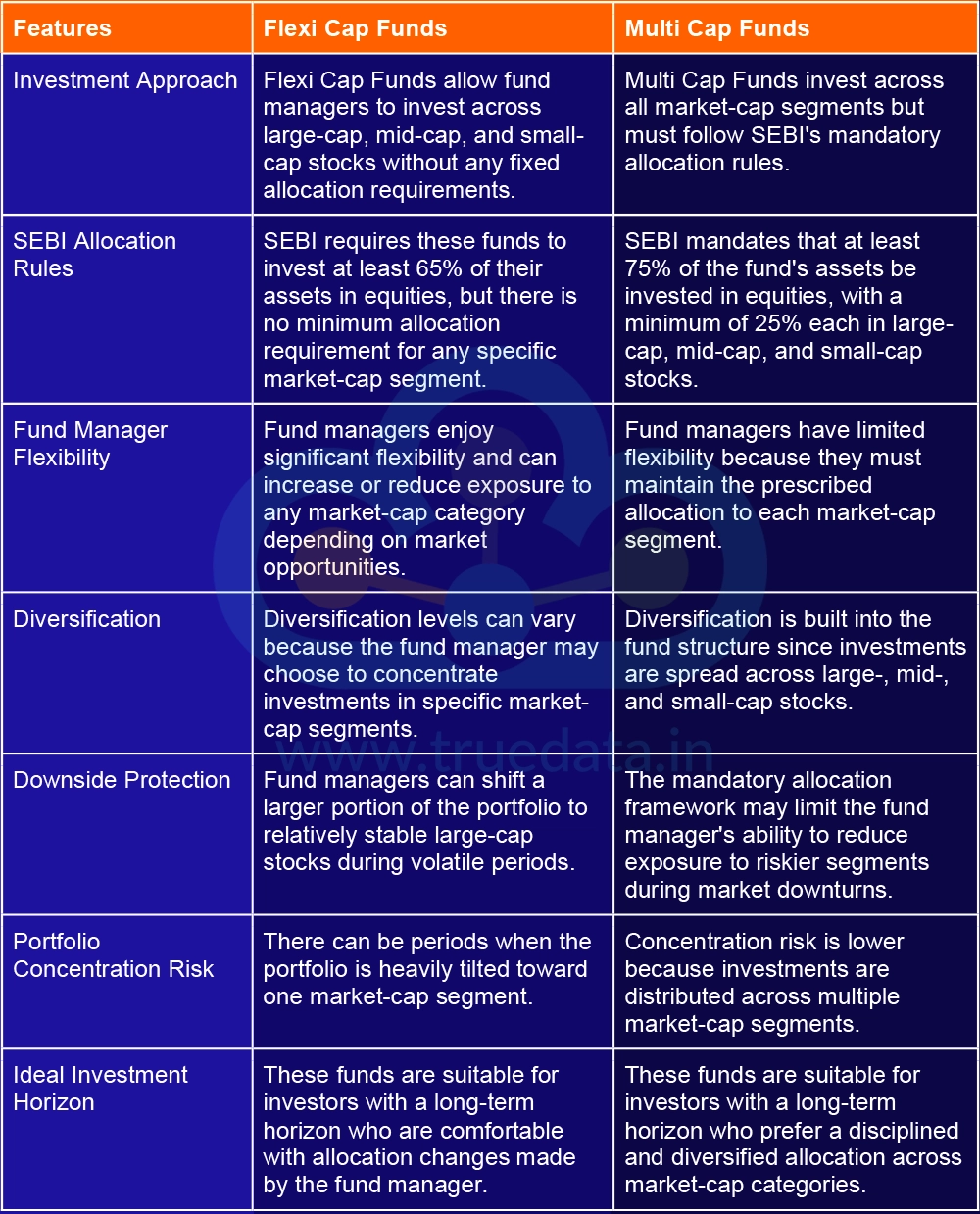
Flexi cap funds and Multi cap funds belong to the equity mutual funds category and are also taxed in line with the same. However, there are a few core differences between the two that make them unique for investors. These differences are tabled below. 

What are the Differences between Flexi Cap and Multi Cap Funds

Features 

Flexi Cap Funds

Multi Cap Funds

Investment Approach

Flexi Cap Funds allow fund managers to invest across large-cap, mid-cap, and small-cap stocks without any fixed allocation requirements.

Multi Cap Funds invest across all market-cap segments but must follow SEBI's mandatory allocation rules.

SEBI Allocation Rules

SEBI requires these funds to invest at least 65% of their assets in equities, but there is no minimum allocation requirement for any specific market-cap segment.

SEBI mandates that at least 75% of the fund's assets be invested in equities, with a minimum of 25% each in large-cap, mid-cap, and small-cap stocks.

Fund Manager Flexibility

Fund managers enjoy significant flexibility and can increase or reduce exposure to any market-cap category depending on market opportunities.

Fund managers have limited flexibility because they must maintain the prescribed allocation to each market-cap segment.

Diversification

Diversification levels can vary because the fund manager may choose to concentrate investments in specific market-cap segments.

Diversification is built into the fund structure since investments are spread across large-, mid-, and small-cap stocks.

Downside Protection

Fund managers can shift a larger portion of the portfolio to relatively stable large-cap stocks during volatile periods.

The mandatory allocation framework may limit the fund manager's ability to reduce exposure to riskier segments during market downturns.

Portfolio Concentration Risk

There can be periods when the portfolio is heavily tilted toward one market-cap segment.

Concentration risk is lower because investments are distributed across multiple market-cap segments.

Ideal Investment Horizon

These funds are suitable for investors with a long-term horizon who are comfortable with allocation changes made by the fund manager.

These funds are suitable for investors with a long-term horizon who prefer a disciplined and diversified allocation across market-cap categories.

What are the Pros and Cons of Investing in Flexi Cap and Multi Cap Funds?

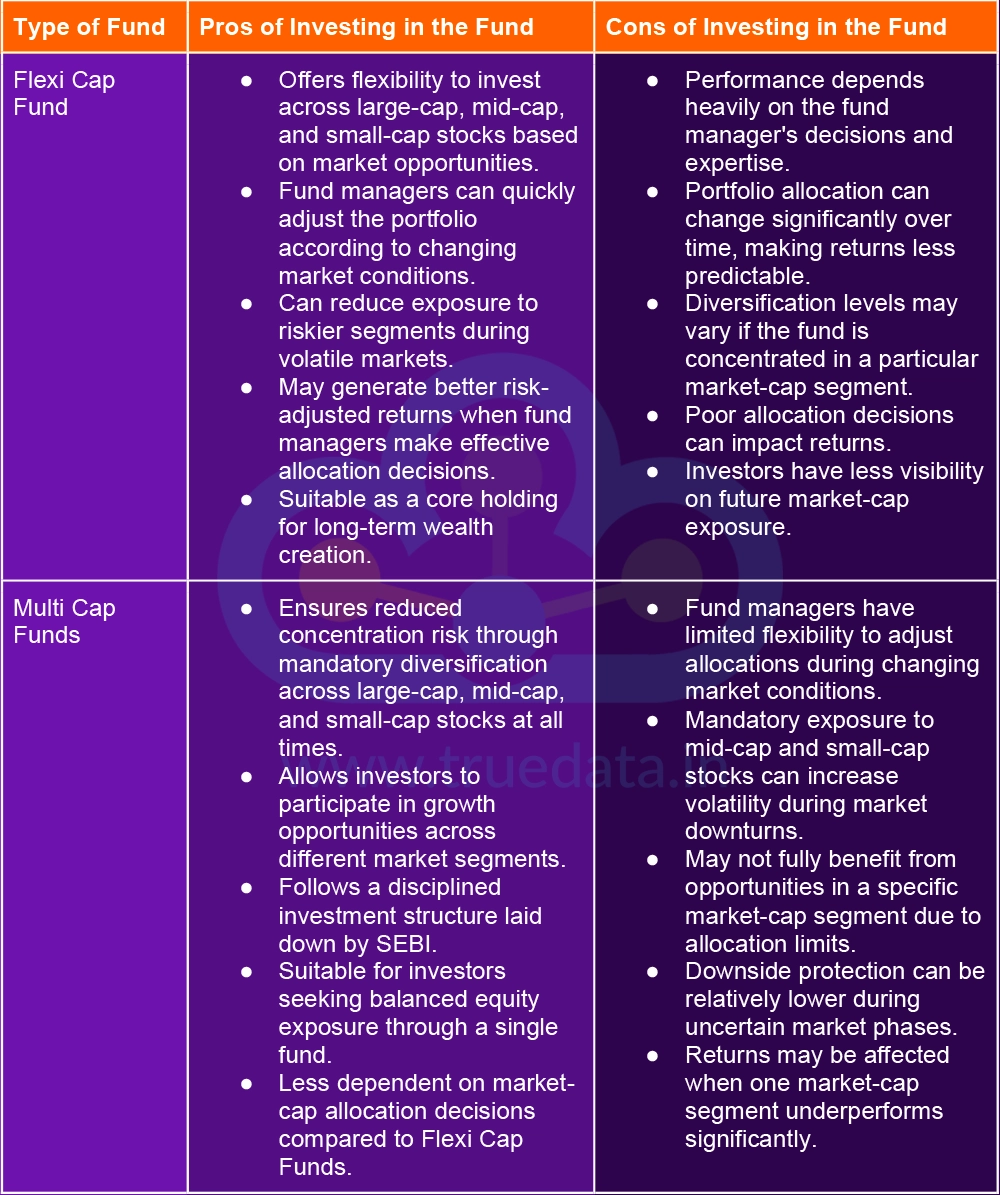
While flexi cap and multi cap funds are quite popular among investors, understanding the pros and cons of investing in them can help investors choose the option that better suits them. 

What are the Pros and Cons of Investing in Flexi Cap and Multi Cap Funds

Type of Fund 

Pros of Investing in the Fund 

Cons of Investing in the Fund

Flexi Cap Fund

  • Offers flexibility to invest across large-cap, mid-cap, and small-cap stocks based on market opportunities.

  • Fund managers can quickly adjust the portfolio according to changing market conditions.

  • Can reduce exposure to riskier segments during volatile markets.

  • May generate better risk-adjusted returns when fund managers make effective allocation decisions.

  • Suitable as a core holding for long-term wealth creation.

  • Performance depends heavily on the fund manager's decisions and expertise.

  • Portfolio allocation can change significantly over time, making returns less predictable.

  • Diversification levels may vary if the fund is concentrated in a particular market-cap segment.

  • Poor allocation decisions can impact returns.

  • Investors have less visibility on future market-cap exposure.

Multi Cap Funds

  • Ensures reduced concentration risk through mandatory diversification across large-cap, mid-cap, and small-cap stocks at all times.

  • Allows investors to participate in growth opportunities across different market segments.

  • Follows a disciplined investment structure laid down by SEBI.

  • Suitable for investors seeking balanced equity exposure through a single fund.

  • Less dependent on market-cap allocation decisions compared to Flexi Cap Funds.

  • Fund managers have limited flexibility to adjust allocations during changing market conditions.

  • Mandatory exposure to mid-cap and small-cap stocks can increase volatility during market downturns.

  • May not fully benefit from opportunities in a specific market-cap segment due to allocation limits.

  • Downside protection can be relatively lower during uncertain market phases.

  • Returns may be affected when one market-cap segment underperforms significantly.

What Should Investors Choose?

What Should Investors Choose

The choice between Flexi Cap Funds and Multi Cap Funds depends on an investor's preferences, risk appetite, and investment goals. Investors who prefer flexibility and want the fund manager to actively adjust allocations based on market conditions may consider Flexi Cap Funds. On the other hand, investors who want consistent exposure to large-cap, mid-cap, and small-cap stocks through a disciplined allocation framework may find Multi Cap Funds more suitable. Neither category is inherently better than the other, as both have the potential to create wealth over the long term. Investors should, therefore,  evaluate their financial goals, risk tolerance, and investment horizon before making a decision, and ensure that the chosen fund aligns with their overall portfolio strategy.

Conclusion

Flexi cap and multi cap funds are two important categories of equity mutual funds that can be instrumental in long-term wealth creation. However, investors should focus on individual financial goals before investing in either of the funds. This can help them maximise the profit potential of their portfolio and achieve their investment goals in due time. 

This article focuses on two important categories of equity mutual funds and their nuances. Let us know your thoughts on the topic or if you need further information on the same, and we will address it soon.

Till then, Happy Reading!


Read More: Difference Between Active Mutual Funds and Passive Mutual Funds 

Frequently Asked Questions

Yes, a Flexi Cap Fund can significantly increase its allocation to small-cap stocks if the fund manager believes they offer the best opportunities. However, most fund managers maintain a diversified portfolio to balance potential returns with risk.

Generally, Flexi Cap Funds can be more aggressive with small-cap exposure because fund managers have the flexibility to allocate a larger portion of the portfolio to small-cap stocks when they see attractive opportunities. Multi Cap Funds must maintain a balanced allocation, so their small-cap exposure is usually more consistent and less aggressive.

Flexi Cap Funds may be more suitable for risk-averse investors because fund managers can increase exposure to relatively stable large-cap stocks during uncertain market conditions. In contrast, Multi Cap Funds must maintain a fixed allocation to mid-cap and small-cap stocks, which can increase volatility.

Yes, expense ratios can differ between Flexi Cap Funds and Multi Cap Funds, but the difference depends on the specific fund and fund house rather than the category itself. Investors should compare expense ratios along with performance, risk, and fund strategy before investing.

The fund house and fund manager's track record are important because they reflect how consistently the fund has been managed across different market conditions. A strong track record can indicate good investment processes, though past performance does not guarantee future returns.

Before investing, investors should check the fund's investment strategy, risk level, past performance, expense ratio, and the fund manager's track record. Also, it is important to ensure that the fund aligns with individual financial goals, risk appetite, and investment horizon.
Marisha Bhatt

Marisha Bhatt is a financial content writer @TrueData.

She writes with the sole aim of simplifying complex financial concepts and jargon while attempting to clarify technical and fundamental analysis concepts of the stock markets. The ultimate goal is to spread vital knowledge and benefit the maximum audience. Her Chartered Accountant background acts as the knowledge base to help clarify crucial concepts and create a sound investment portfolio.

0 Comments

Related Articles

SEE ALL
Mutual Funds
Mutual Funds
How to Complain About Mutual Funds?

Mutual fund investments have simplified greatly with just a tap on your smartpho...

Investing / Trading
Investing / Trading
Stocks or mutual funds? Which is better?

Introduction For the longest time, investment in stock markets was thought to b...

Mutual Funds
Mutual Funds
PE Ratio in Mutual Funds

Every investor knows that the stepping stones to a good investment in thestock m...

Relevant Tags