When investing in mutual funds, it is natural to be drawn towards funds that deliver the highest returns. However, a fund that performs well today may not always maintain the same performance in the future. On the other hand, a fund that delivers steady returns over time may help investors stay on track with their financial goals. So, should you choose a fund with consistently stable performance or one that offers higher returns? Let’s understand the key differences between consistency and high returns and how to choose a fund that suits your investment goals.

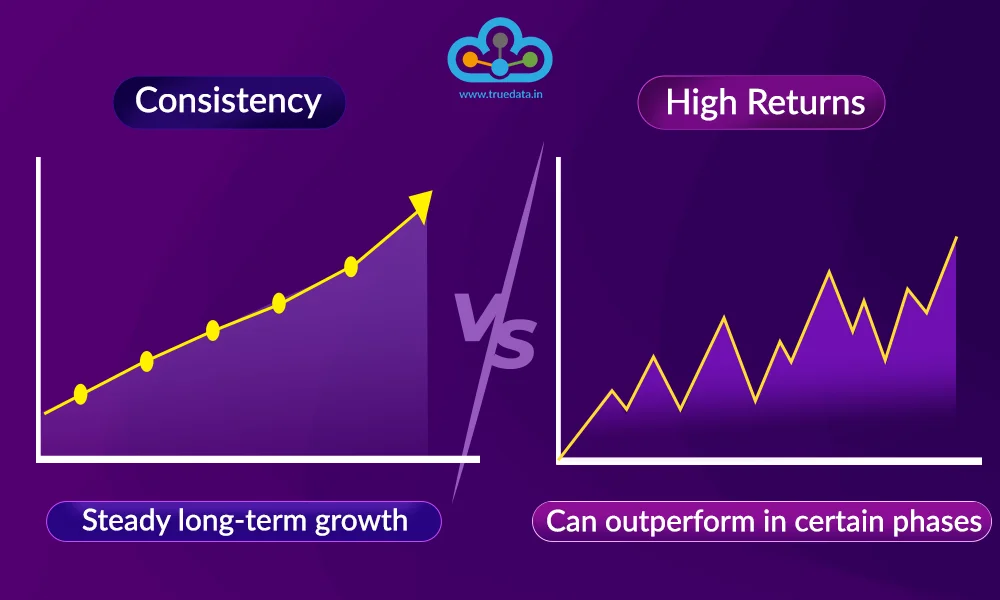
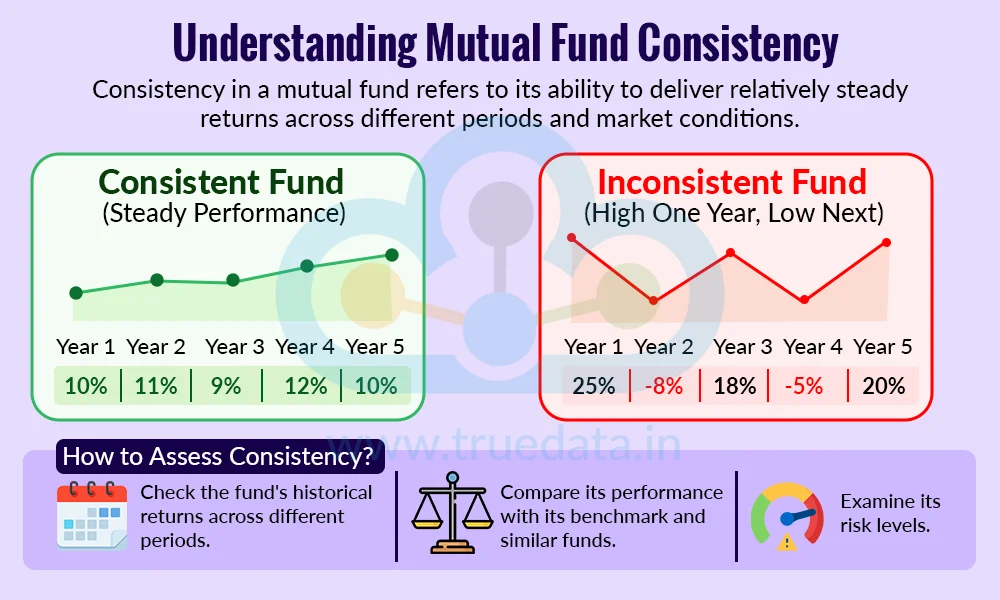
Consistency in a mutual fund refers to its ability to deliver relatively steady performance over different periods and market conditions. Instead of generating exceptionally high returns in one year and poor returns in the next, a consistent fund aims to perform steadily over the long term. For example, a fund that delivers reasonable returns across several years, including periods of market ups and downs, may be considered more consistent than a fund that performs exceptionally well in one year but struggles in the following years. However, consistency does not mean that a fund will always generate positive returns or remain unaffected by market fluctuations. Its performance depends on factors such as market conditions, the fund’s investment strategy, portfolio holdings and the fund manager’s decisions. Investors can assess consistency by checking the fund’s historical returns across different periods, comparing its performance with its benchmark and similar funds, and examining its risk levels. A consistent fund may help investors make more informed long-term investment decisions, but past consistency does not guarantee future returns.
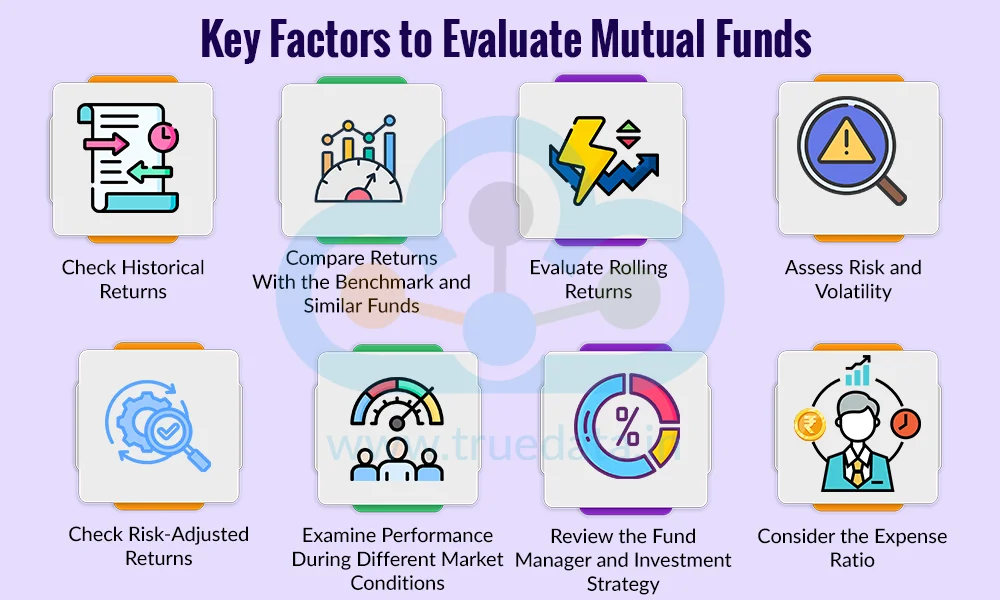
Investors can evaluate consistency and high returns in a mutual fund by looking beyond its recent performance. Here are some important factors to consider:

Check Historical Returns - Review the fund’s returns over different periods, such as 1 year, 3 years and 5 years. A fund that performs reasonably well across several periods may demonstrate greater consistency than one that delivers exceptionally high returns in just one year.
Compare Returns With the Benchmark and Similar Funds - Compare the fund’s performance with its benchmark index and other funds in the same category. This helps investors understand whether the fund has consistently performed well or delivered high returns only during favourable market conditions.
Evaluate Rolling Returns - Rolling returns show how a fund has performed across multiple overlapping periods. For example, 3-year rolling returns help investors assess whether the fund has delivered relatively consistent returns across different market conditions rather than performing well only during a specific period.
Assess Risk and Volatility - High returns may come with higher risks. Investors can check measures such as standard deviation, which indicates how much returns fluctuate, and maximum drawdown, which shows the largest peak-to-trough decline in the fund’s value. These measures help investors understand the risks associated with a fund’s performance.
Check Risk-Adjusted Returns - Risk-adjusted returns help investors understand how much return a fund has generated relative to the risk taken. Measures such as the Sharpe Ratio can help compare similar funds and identify those that have delivered better returns for the level of risk involved.
Examine Performance During Different Market Conditions - Check how the fund performed during market rallies, downturns and periods of high volatility. A fund that has performed reasonably well across different market conditions may demonstrate greater resilience than one that depends heavily on a rising market.
Review the Fund Manager and Investment Strategy - The fund manager’s decisions and investment strategy can influence performance. Check the manager’s track record, the fund’s investment approach and any significant changes in management or strategy to understand whether its past performance remains relevant.
Consider the Expense Ratio - The expense ratio represents the annual cost of managing a mutual fund and is reflected in its NAV. Compare the expense ratios of similar funds, as higher expenses can reduce the returns investors receive, all else being equal.
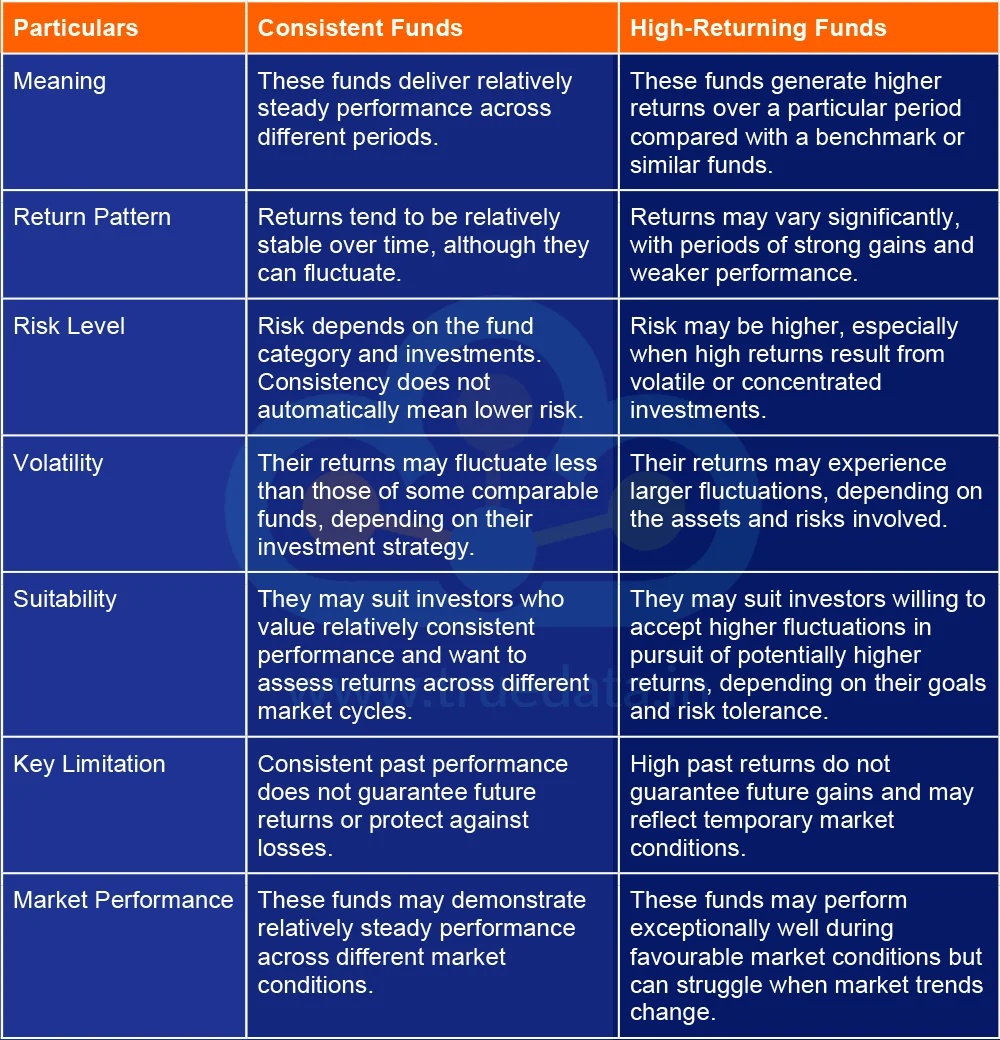
Consistent funds and high-returning funds differ in their return patterns, risk levels and performance across market conditions. While consistent funds aim to deliver relatively steady performance over time, high-returning funds attract investors with the potential for higher gains, which may also involve greater risk. The key differences include,


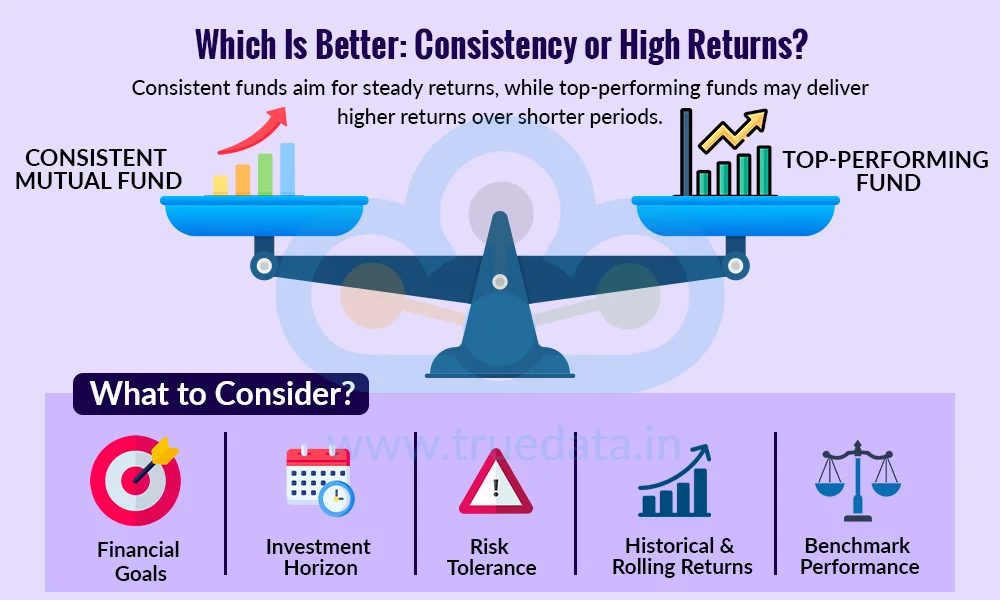
A consistent mutual fund may be a better choice for investors who value relatively steady performance over time rather than funds that deliver exceptionally high returns during a particular period. Such funds may demonstrate more balanced performance across different market conditions, helping investors evaluate their progress towards long-term financial goals. On the other hand, a top-performing fund may generate higher returns than its peers or benchmark over a specific period, but its performance may fluctuate significantly as market conditions change. For example, an equity fund that delivers outstanding returns during a market rally may experience sharper declines when the market falls. However, consistency does not automatically mean lower risk, and a fund that delivers steady but poor returns may not be a suitable investment either.
The better choice depends on an investor’s financial goals, investment horizon and risk tolerance. Rather than selecting a fund solely because it has delivered the highest returns or maintained consistent performance, investors should compare its historical and rolling returns, benchmark performance, risk levels and performance across different market cycles. They should also consider the fund’s investment strategy and expenses before investing. Ultimately, a fund that offers a suitable balance between returns and risk may be more appropriate than one chosen only for its past performance. Past returns, whether consistent or exceptionally high, do not guarantee future results.

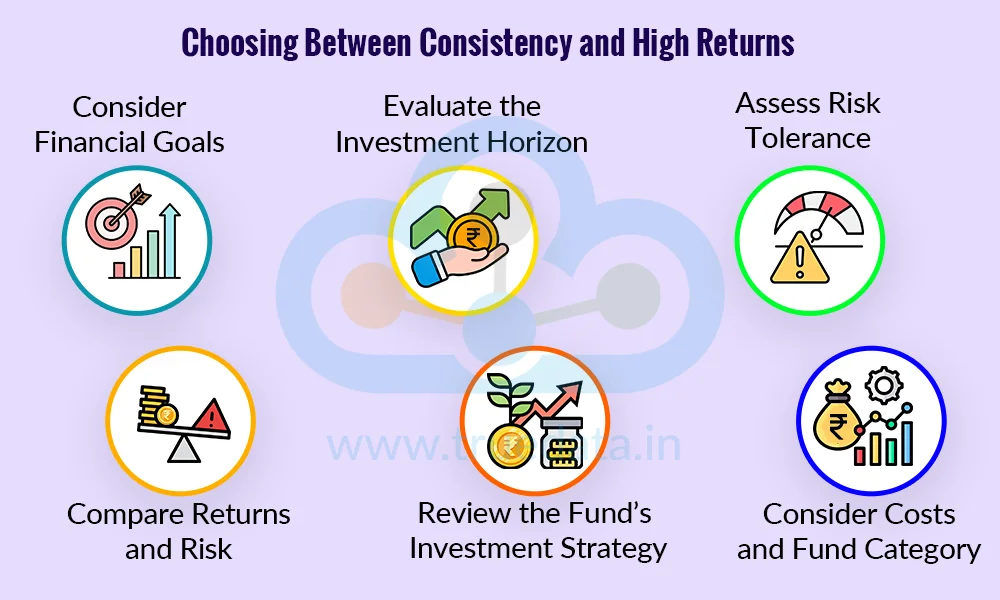
The choice between a consistent fund and a high-returning fund is not a straightforward answer. Investors should consider many factors that can help them make a suitable choice.
Consider Financial Goals - An investor should choose a mutual fund based on their financial goals, such as saving for retirement, a child’s education or buying a house. A fund with relatively consistent performance may suit investors who value stability in returns, while a high-returning fund may appeal to those seeking higher growth and willing to accept greater fluctuations.
Evaluate the Investment Horizon - An investor’s investment horizon plays an important role in fund selection. Long-term investors may consider funds with strong performance across different market cycles, while those with short-term goals should pay closer attention to the risk of losses and whether the fund’s investment approach suits their time frame.
Assess Risk Tolerance - An investor should assess their ability and willingness to handle market fluctuations before choosing a fund. High-returning funds may involve greater volatility, depending on their investments, while consistent funds may offer relatively steady performance. However, consistency does not automatically mean lower risk or protection against losses.
Compare Returns and Risk - An investor should evaluate historical returns, rolling returns, benchmark performance and risk measures such as standard deviation and maximum drawdown. This comparison helps determine whether a fund’s returns have been supported by an appropriate level of risk rather than being driven by a short period of strong market performance.
Review the Fund’s Investment Strategy - An investor should examine the fund’s portfolio, investment approach and fund manager’s track record. Understanding how a fund selects investments and responds to changing market conditions can help assess whether its past performance is linked to a clear investment strategy.
Consider Costs and Fund Category - An investor should compare expense ratios and ensure that funds belong to the same category before evaluating their performance. For example, a small-cap fund and a large-cap fund have different investment approaches and risk profiles, so comparing their returns alone may lead to misleading conclusions.
Choosing between a consistent mutual fund and a top-performing fund depends on an investor’s financial goals, investment horizon and risk tolerance. While a consistent fund may offer relatively steady performance across different market conditions, a top-performing fund may deliver higher returns but can also involve greater fluctuations. Instead of choosing a fund based only on its past returns, investors should compare its performance, risk levels, benchmark returns and expenses before investing. Ultimately, the better fund is one that aligns with an investor’s financial goals and risk appetite, rather than simply the one that delivers the highest returns.
This article is an attempt to explain a very common question while investing in mutual funds and helping investors make an informed decision. Let us know your thoughts on the topic or if you need further information, and we will address it soon.
Till then, Happy Reading!
Read More: Mutual Fund Myths You Still Believe
Artificial Intelligence (AI) and technology are changing the way people live, wo...
Your mutual fund has delivered impressive returns, but are those the actual retu...
Mutual fund investments have simplified greatly with just a tap on your smartpho...