
Did you know that India's Margin Trading Facility (MTF) book reached an all-time high of Rs. 1.27 lakh crore in May 2026? This represented a remarkable 65.4% year-on-year increase, highlighting the growing participation of retail investors in margin trading. While margin trading can increase your buying power, it also comes with important responsibilities and risks. One of its most important aspects is the pledging of shares, a process that allows investors to use their existing holdings as collateral to access additional funds for trading. While we have discussed margin trading in detail in our previous blog, let us now explore the concept of pledging shares, its importance in margin trading, and understand the key SEBI regulations that every investor should know before using this facility.

Margin trading is a facility that allows traders to buy more shares than they could with their own available funds by borrowing money from their stockbroker. Instead of paying the full purchase amount upfront, the trader contributes a part of the total value, known as the margin, while the broker funds the remaining amount. This enables traders to take larger positions in the stock market with a smaller initial investment. The shares purchased using the borrowed funds act as collateral for the loan until the borrowed amount is repaid.
While margin trading can increase potential profits if share prices move in the trader's favour, it can also magnify losses if prices fall. Therefore, traders should use margin trading carefully, understand the associated costs such as interest charges, and ensure they comply with the margin requirements and regulations prescribed by the broker and the Securities and Exchange Board of India (SEBI).
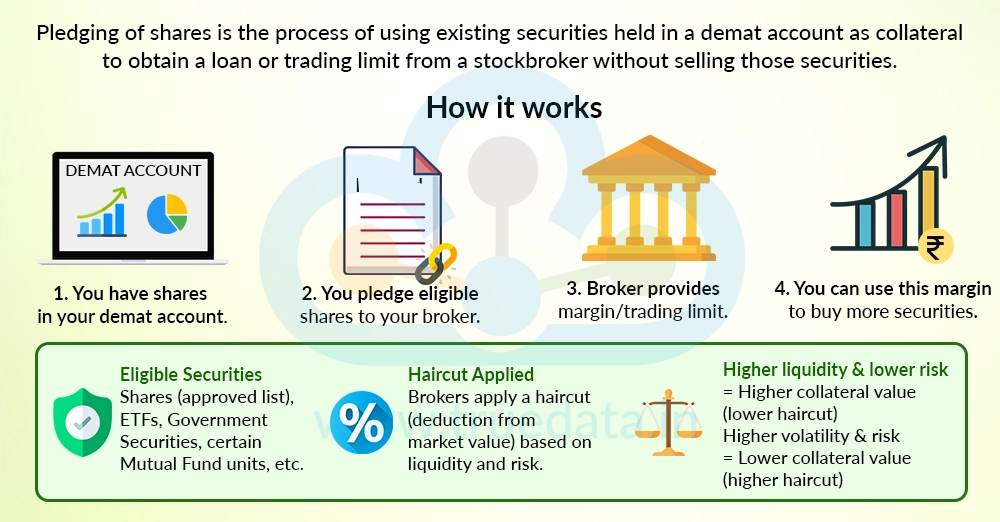
Pledging of shares is the process of using existing securities held in a demat account as collateral to obtain a loan or trading limit from a stockbroker without selling those securities. In margin trading, a trader pledges eligible securities to the broker, who then provides additional margin that can be used to buy more securities. The amount of margin available depends on the type and quality of the security being pledged. Generally, highly liquid securities such as shares included in approved lists, Exchange Traded Funds (ETF), government securities, and certain mutual fund units are accepted as collateral.
Even after the securities are pledged, they continue to remain in the trader's demat account, but a pledge mark is created in favour of the broker through the depository. The trader continues to receive benefits such as dividends, bonus shares, rights issues, and stock splits, wherever applicable, since ownership of the securities remains with them. However, if the trader fails to maintain the required margin or repay the borrowed amount, the broker has the right, in accordance with SEBI regulations and the pledge agreement, to invoke the pledged securities and sell them to recover the outstanding dues. Pledging shares enables traders to unlock the value of their existing investments without selling them, but it should be used carefully as a fall in the value of the pledged securities may result in a margin call or the sale of those securities.
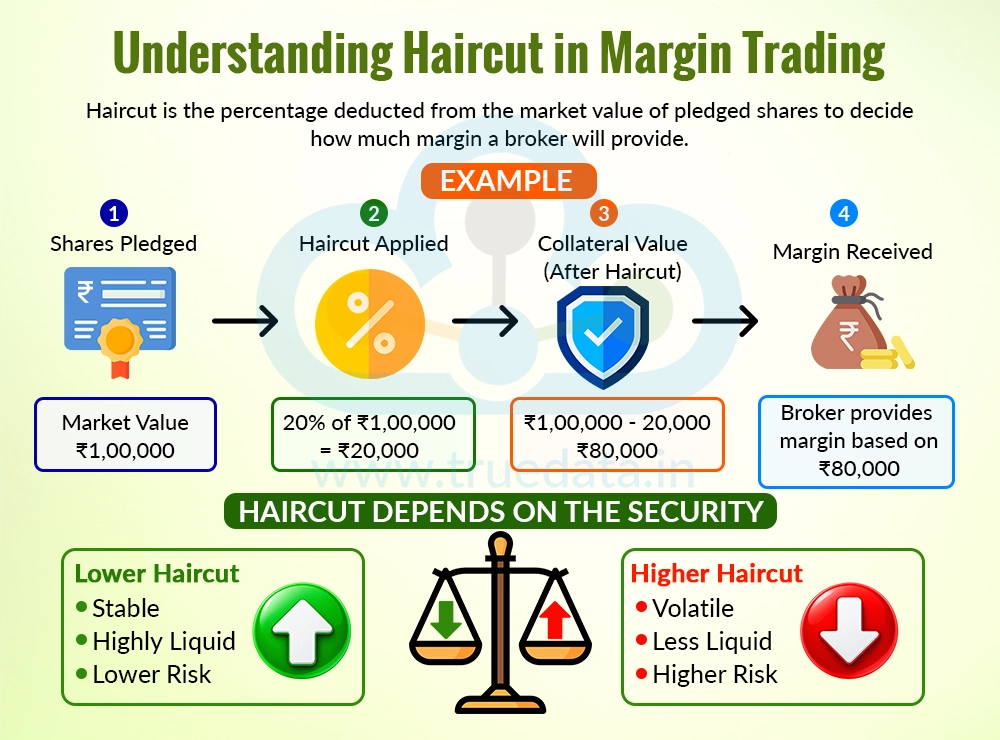
A haircut in margin trading is the percentage by which the market value of a pledged security is reduced to determine the amount of margin that a trader can receive from a broker. A broker does not provide margin against the full value of the pledged shares because their prices can fluctuate. Instead, a certain percentage, known as the haircut, is deducted to protect the broker from potential losses if the value of the security falls. For example, if a trader pledges shares worth Rs. 1,00,000 and the applicable haircut is 20%, the broker will consider only Rs. 80,000 as the collateral value and provide margin based on that amount. Generally, stable and highly liquid securities have lower haircuts, while volatile or less liquid securities have higher haircuts because they carry greater price risk. Haircuts are prescribed by the clearing corporations and may vary depending on the type of security and prevailing market conditions.
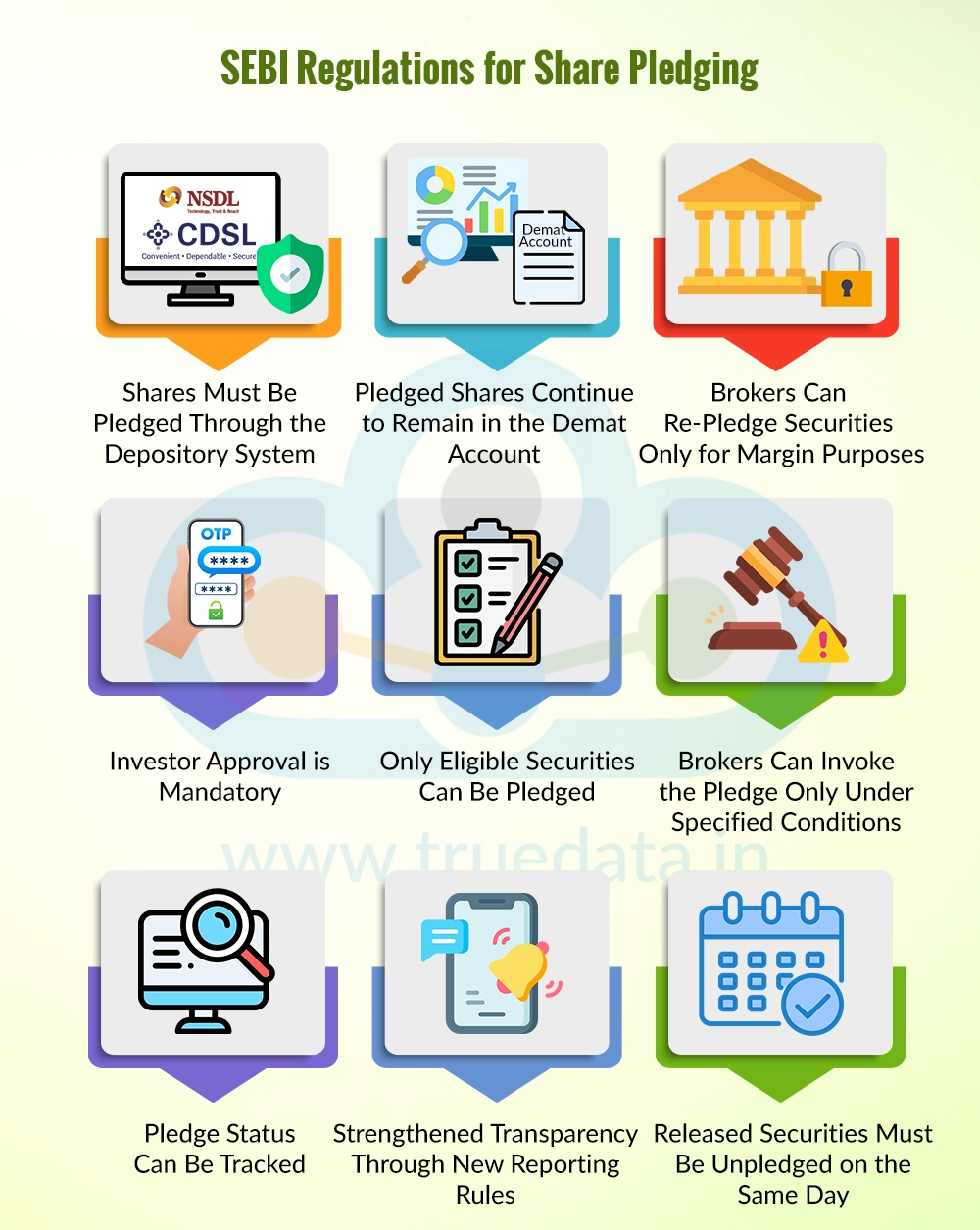
To protect investors and prevent the misuse of client securities, the Securities and Exchange Board of India (SEBI) has introduced a transparent pledge and re-pledge framework for margin trading. Every trader planning to pledge shares should understand the following key regulations.
Shares Must Be Pledged Through the Depository System - SEBI has made it mandatory that securities used as collateral for margin trading must be pledged through the depository system operated by NSDL or CDSL. Brokers cannot collect client securities by simply taking a Power of Attorney (PoA) or transferring the shares to their own accounts. This ensures that the ownership of the securities always remains with the investor until the pledge is invoked.
Pledged Shares Continue to Remain in the Demat Account - When shares are pledged for margin trading, they continue to remain in the trader's demat account. A pledge is only marked in favour of the broker, while the trader continues to be the legal owner of those shares.
Brokers Can Re-Pledge Securities Only for Margin Purposes - Once the trader pledges eligible securities, the broker may re-pledge them only with the clearing corporation or clearing member to meet margin obligations. The securities cannot be used for any other purpose. This creates a clear and traceable chain of custody for pledged securities.
Investor Approval is Mandatory - A broker cannot pledge a trader's shares without the trader's explicit consent. Every pledge request must be authorised by the investor through an OTP or other authentication process provided by the depository. This prevents unauthorised pledging of client securities.
Only Eligible Securities Can Be Pledged - Not every security can be used as collateral for margin trading. Only securities approved by the clearing corporations and stock exchanges, such as selected equity shares, ETFs, mutual fund units and certain debt securities, are eligible. The list of approved securities is reviewed and updated periodically.
Brokers Can Invoke the Pledge Only Under Specified Conditions - If a trader fails to maintain the required margin or does not repay the outstanding dues, the broker has the right to invoke the pledged securities and recover the amount owed. SEBI has laid down a clear framework governing the creation, release and invocation of pledges through the depository system to ensure transparency and investor protection.
Pledge Status Can Be Tracked - The pledge created on securities is reflected in the trader's demat account and can be viewed through the depository or broker's platform. This allows investors to verify that their securities have been pledged correctly and provides greater transparency over their holdings.
Strengthened Transparency Through New Reporting Rules - SEBI introduced additional rules (effective from October 10, 2025) for further investor protection. Under these rules, brokers must provide daily ISIN-level details of all securities pledged by a trader. This enables traders to verify that only the securities they authorised have been pledged. In addition, investors receive real-time SMS and email alerts whenever a pledge, re-pledge, or unpledge transaction takes place in their demat account. This helps them quickly identify any unauthorised activity and improves transparency throughout the pledging process. SEBI has also standardised margin reporting across stock exchanges, making the reporting process more consistent and easier for investors to understand.
Released Securities Must Be Unpledged on the Same Day - When a trader repays the borrowed amount or no longer requires the pledged securities as margin, the broker must ensure that the securities are unpledged on the same day (T+0 basis). Thus, there should be no unnecessary delay in removing the pledge and restoring the trader's full control over the securities. This rule allows investors to regain access to their holdings more quickly and improves the overall efficiency of the margin trading system.
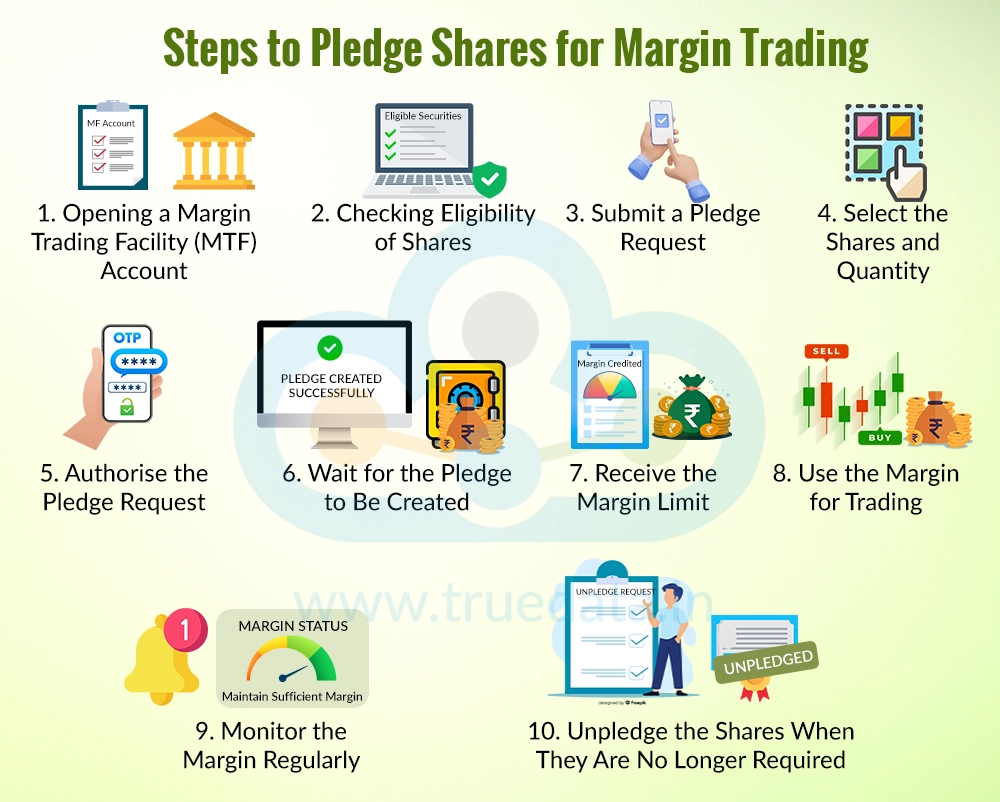
The process of pledging shares for margin trading is simple and is carried out electronically through the broker and the depository. These steps include,
Opening a Margin Trading Facility (MTF) Account - Traders must first have a trading account, a demat account, and an active Margin Trading Facility with a SEBI-registered stockbroker.
Checking Eligibility of Shares - Before creating a pledge, traders should confirm that the shares are included in the list of securities approved by the broker and the stock exchanges for margin trading.
Submit a Pledge Request - Traders can log in to the broker's trading platform or mobile app and select the option to pledge eligible shares held in the demat account.
Select the Shares and Quantity - Traders should choose the securities to be pledged and specify the number of shares to be used as collateral.
Authorise the Pledge Request - After submitting the request, traders must approve it through the authentication process provided by the depository, usually by entering a One-Time Password (OTP) received via SMS or email.
Wait for the Pledge to Be Created - Once the request is successfully authenticated, the depository creates the pledge in favour of the broker, and the pledged status is reflected in the trader's demat account.
Receive the Margin Limit - After the pledge is successfully created, the broker calculates the eligible margin after applying the applicable haircut and credits the available margin to the trader's account.
Use the Margin for Trading - Traders can now use the approved margin to purchase eligible securities under the Margin Trading Facility, subject to the broker's terms and SEBI regulations.
Monitor the Margin Regularly - Traders should keep track of the value of the pledged securities and maintain sufficient margin, as a fall in their value may lead to a margin call.
Unpledge the Shares When They Are No Longer Required - Once the borrowed amount has been repaid or the margin is no longer needed, traders can request the broker to release the pledge. As per SEBI regulations, the securities should be unpledged promptly after all obligations have been fulfilled.
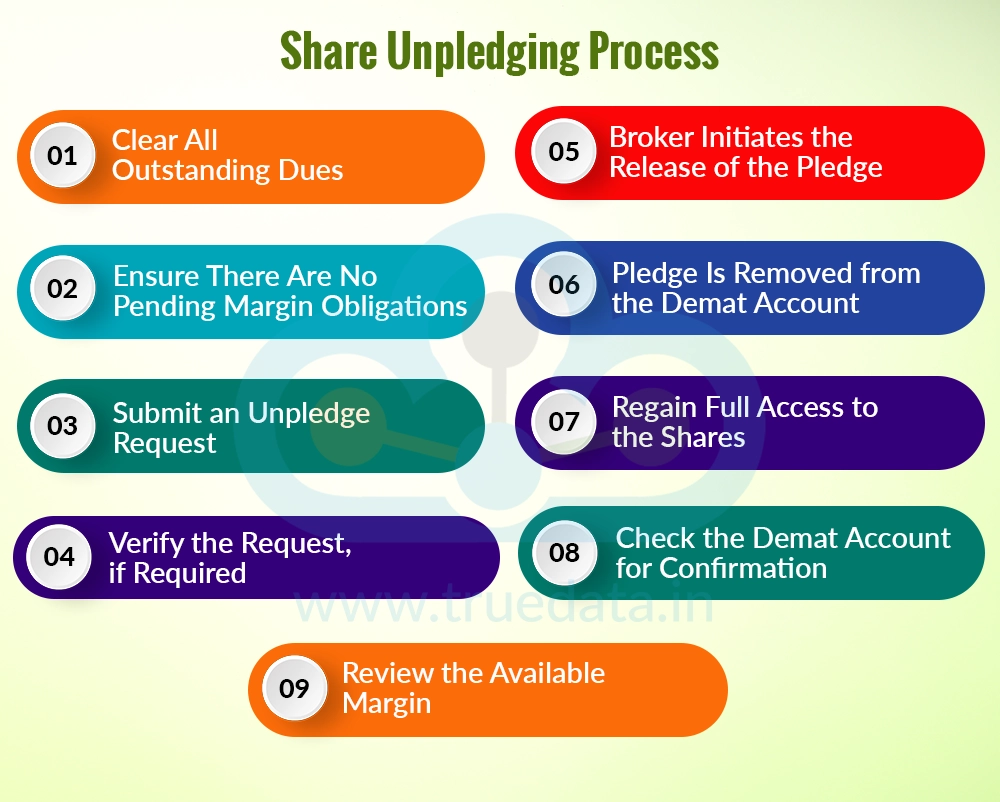
Once the trader no longer requires the margin or has repaid the outstanding amount, the pledged shares can be released through the broker. The steps for the same are,
Clear All Outstanding Dues - Traders should first repay the borrowed amount along with any applicable interest, charges, or other dues owed to the broker.
Ensure There Are No Pending Margin Obligations - Before requesting an unpledge, traders should make sure that all margin requirements have been met and that the pledged shares are no longer needed as collateral.
Submit an Unpledge Request - Traders can log in to the broker's trading platform or mobile app and select the option to unpledge the required shares.
Verify the Request, if Required - Depending on the broker's process, traders may need to confirm the unpledge request through an OTP or another authentication method provided by the depository.
Broker Initiates the Release of the Pledge - After verifying that all obligations have been fulfilled, the broker sends the request to release the pledge through the depository system.
Pledge Is Removed from the Demat Account - Once the depository processes the request, the pledge mark is removed from the trader's demat account, and the shares become free from any lien.
Regain Full Access to the Shares - After the shares are successfully unpledged, traders regain complete control over them and can sell, transfer, or pledge them again if required.
Check the Demat Account for Confirmation - Traders should verify that the pledge has been removed by checking the demat account or the broker's platform. The depository will also send an SMS or email confirming the successful unpledge.
Review the Available Margin - Once the shares are unpledged, the margin that was backed by those securities is withdrawn from the trading account. Traders should ensure that sufficient margin remains available if any open margin trading positions are still active.
The benefits and risks of pledging shares are an integral part of understanding how pledging works. Here are some of the key benefits and risks of pledging shares in margin trading.
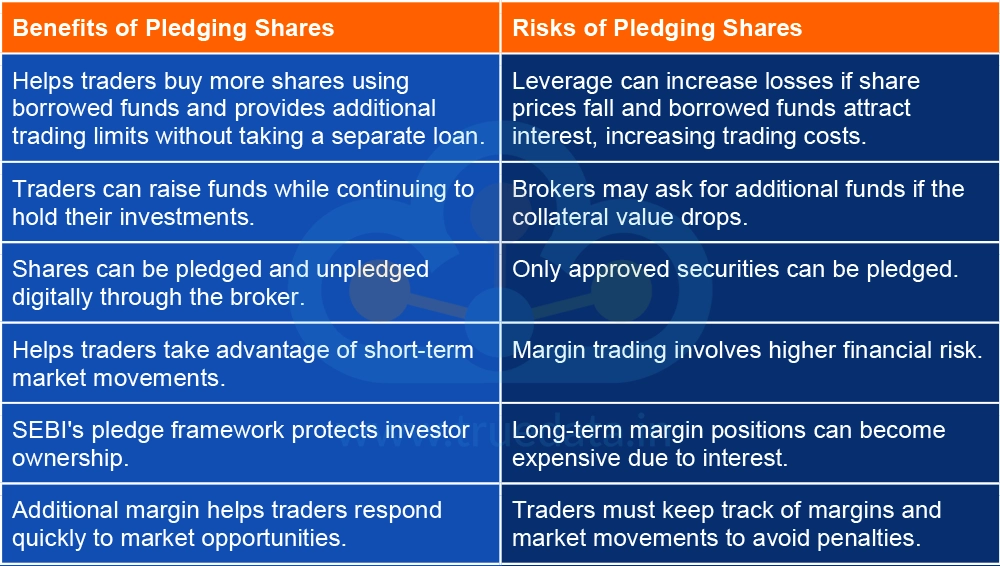
Pledging shares is an important part of margin trading that allows traders to unlock the value of their existing investments without selling them. While it can increase buying power and create more trading opportunities, it also comes with risks such as margin calls, interest costs, and the possibility of pledged shares being sold if obligations are not met. Understanding how the pledge process works, along with the applicable SEBI regulations, and using margin responsibly can help traders make more informed decisions and manage their risks more effectively.
This article highlights an important aspect of trading and aims at helping traders make informed portfolio decisions. Let us know your thoughts on the topic or any queries you have, and we will address them soon.
Till then, Happy Reading!
Read More: SEBI's Revolutionary Ideas to Protect Loss-Making Retail Traders

Marisha Bhatt is a financial content writer @TrueData.
She writes with the sole aim of simplifying complex financial concepts and jargon while attempting to clarify technical and fundamental analysis concepts of the stock markets. The ultimate goal is to spread vital knowledge and benefit the maximum audience. Her Chartered Accountant background acts as the knowledge base to help clarify crucial concepts and create a sound investment portfolio.
NSE Stock Prices in Excel in Real Time - Microsoft Excel is a super software cap...

Remember the first time you tried riding a bicycle? The thrill of moving forward...

Market data is the backbone ofsuccessful trading, but not all market data is the...
