Mutual Funds

Sortino Ratio in Mutual Funds

Marisha Bhatt · 02 Jun 2026 · 10 mins read · 15 Comments

sortino-ratio-in-mutual-funds

Every investor wants to make the right choice in mutual funds to have a profitable portfolio. However, what if the choice is between two profitable funds? How do you decide which fund is a better choice? The answer lies not just in returns but in understanding the risk taken to earn them, especially the downside risk. This is where the Sortino Ratio becomes useful. It helps investors evaluate how well a fund performs while focusing only on harmful volatility. Curious to know more? Check out this blog to understand the meaning of Sortino Ratio and its importance in making informed portfolio decisions.

What is Sortino Ratio in Mutual Funds?

What is Sortino Ratio in Mutual Funds

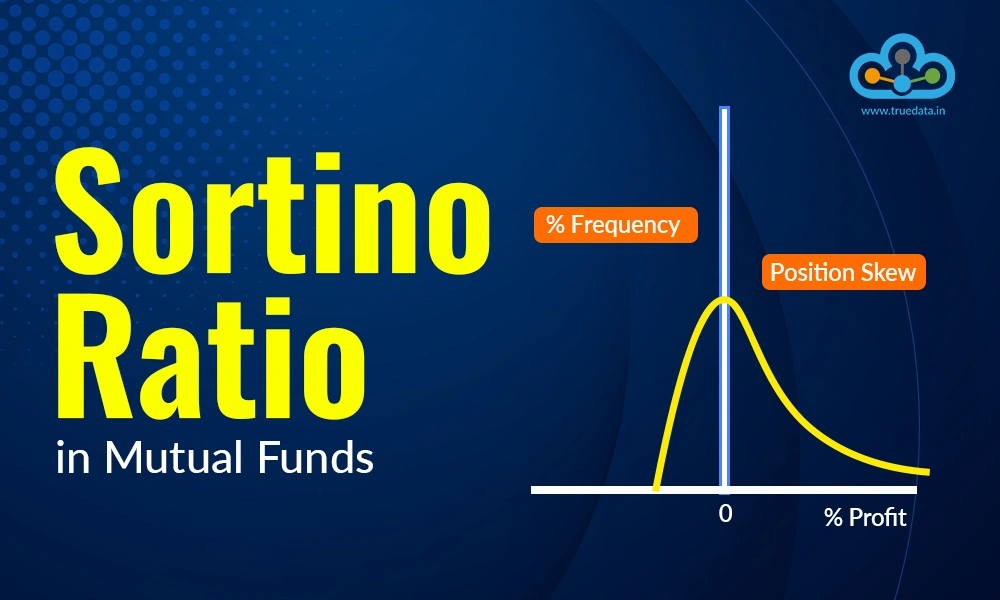
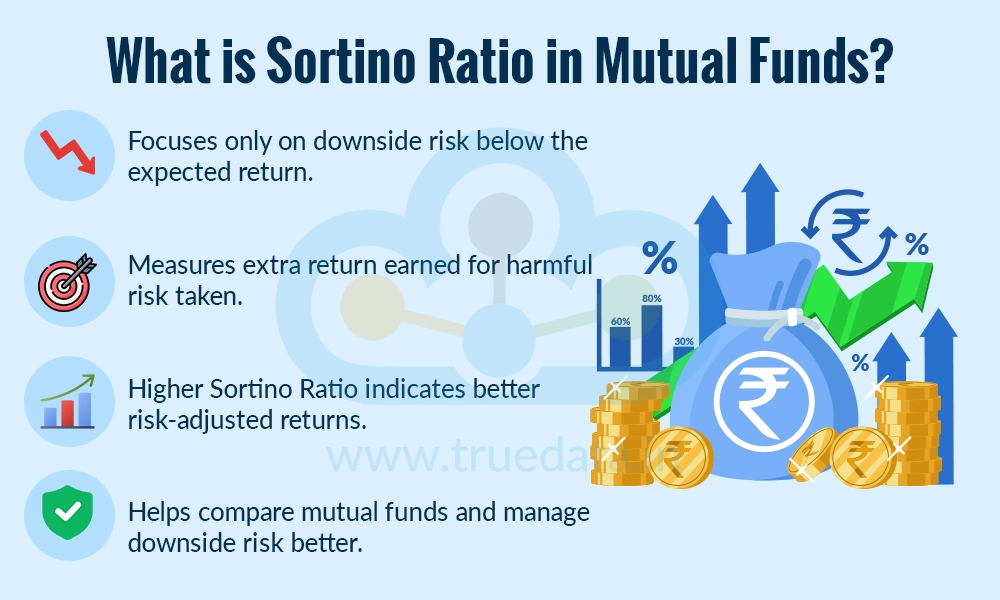
The Sortino Ratio is a financial measure used to assess how well a mutual fund performs relative to the risk it takes; however, it focuses only on downside risk. Unlike some other ratios that consider all types of volatility, the Sortino Ratio looks specifically at downside risk, which means the chances of the fund giving returns below a minimum expected level (like a target return or risk-free rate). Thus, it tells investors how much extra return a fund is generating for every unit of harmful risk it takes. A higher Sortino Ratio means the fund is delivering better returns without exposing investors to too much downside fluctuation. This is especially useful when comparing mutual funds, as it helps identify options that not only perform well but also protect your investments better during market falls.

How to Calculate Sortino Ratio?

How to Calculate Sortino Ratio

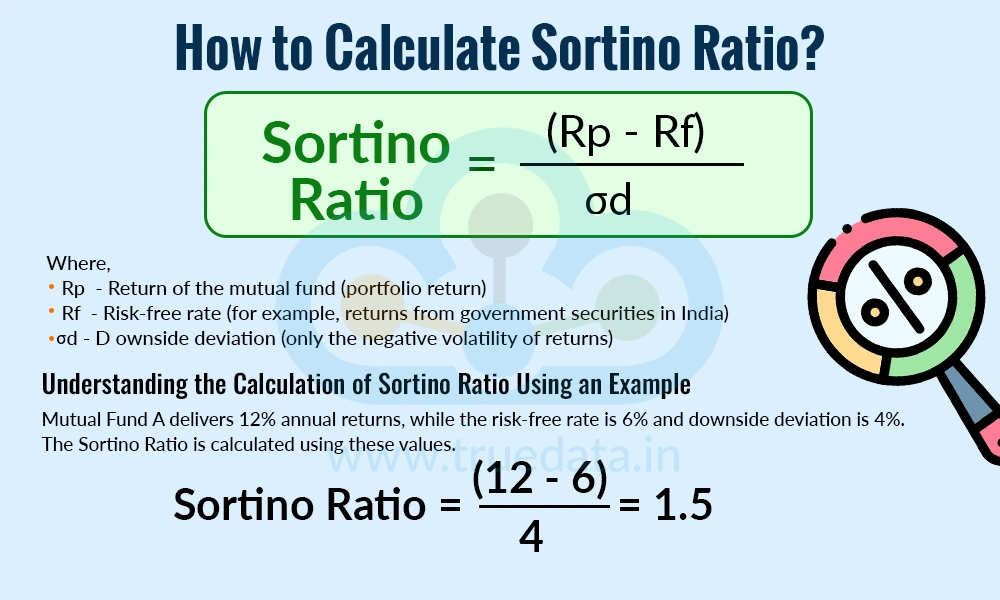
The Sortino Ratio calculates the excess return above a minimum acceptable return (MAR) or risk‑free rate, relative to downside volatility (i.e., the standard deviation of negative returns). The formula for calculating the Sortino Ratio is explained below. 

Sortino Ratio =  (R𝗉 - R𝖿) / 𝜎𝑑

Where,

  • R𝗉 - Return of the mutual fund (portfolio return)

  • R𝖿 - Risk-free rate (for example, returns from government securities in India)

  • 𝜎𝑑 - Downside deviation (only the negative volatility of returns)

Understanding the Calculation of Sortino Ratio Using an Example

Consider Mutual Fund A that gives a return of 12% per annum. The risk-free rate (return from Government Bonds) is 6% per annum. The downside deviation is 4%. The Sortino Ratio for this fund is calculated as follows. 

Sortino Ratio =  (R𝗉 - R𝖿) / 𝜎𝑑

Sortino Ratio =  (12 - 6) / 4 = 1.5 

Thus, Mutual Fund A has a Sortino Ratio of 1.5, which means it generates 1.5 units of extra return for every unit of downside risk it takes. 

How to Interpret Sortino Ratio?

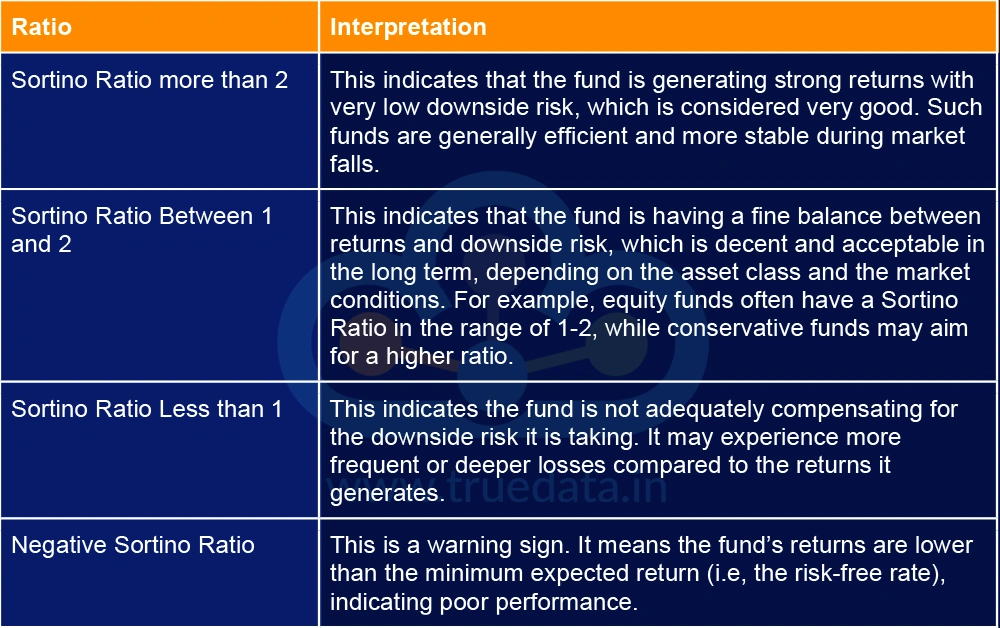
Interpreting the Sortino Ratio is all about understanding how well a mutual fund rewards its investors for the risk of losses it takes. Unlike many other ratios, the Sortino Ratio focuses only on downside risk. Thus, it provides a clearer picture of how safely a fund is generating returns, especially during market declines. A higher Sortino Ratio indicates the fund is delivering returns more safely, with fewer damaging losses. A low or negative ratio signals that the risk of losses outweighs the reward.

The interpretation of the Sortino Ratio is explained hereunder. 

How to Interpret Sortino Ratio

Ratio

Interpretation

Sortino Ratio more than 2

This indicates that the fund is generating strong returns with very low downside risk, which is considered very good. Such funds are generally efficient and more stable during market falls.

Sortino Ratio Between 1 and 2

This indicates that the fund is having a fine balance between returns and downside risk, which is decent and acceptable in the long term, depending on the asset class and the market conditions. For example, equity funds often have a Sortino Ratio in the range of 1-2, while conservative funds may aim for a higher ratio.

Sortino Ratio Less than 1

This indicates the fund is not adequately compensating for the downside risk it is taking. It may experience more frequent or deeper losses compared to the returns it generates.

Negative Sortino Ratio

This is a warning sign. It means the fund’s returns are lower than the minimum expected return (i.e, the risk-free rate), indicating poor performance.

Why is Sortino Ratio Important?

Why is Sortino Ratio Important

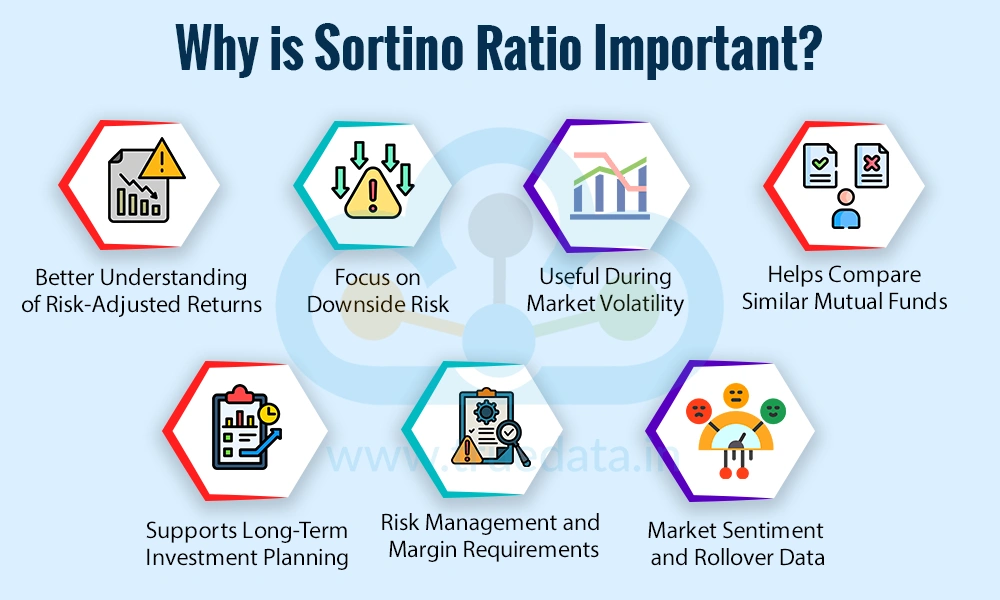
Sortino Ratio is an important ratio in the mutual fund factsheet. The use of Sortino Ratio and its importance in making informed decisions are explained below.

  • Better Understanding of Risk-Adjusted Returns - The Sortino Ratio helps investors look beyond just returns and focus on how those returns are achieved. Many mutual funds may show similar returns, but the level of risk taken to generate those returns can be very different. The Sortino Ratio specifically measures how much return a fund earns for the downside risk it takes. This makes it easier for investors to identify funds that are not only profitable but also efficient in managing risk.

  • Focus on Downside Risk - One of the biggest advantages of the Sortino Ratio is that it considers only downside volatility, i.e., the risk of losses. Unlike other measures that treat all volatility (both upward and downward) as risk, the Sortino Ratio focuses only on negative movements that can hurt your investment. This is extremely useful, especially for risk-conscious investors or those nearing financial goals, as it highlights how well a fund protects capital during market downturns.

  • Useful During Market Volatility - Stock markets can be unpredictable, and periods of volatility are common in indices like the Nifty 50 and Sensex. During such times, protecting your investment becomes as important as growing it. The Sortino Ratio helps investors identify funds that have historically handled market declines better. Funds with higher Sortino Ratios tend to fall less during market corrections, making them more suitable for long-term wealth creation.

  • Helps Compare Similar Mutual Funds - Investors often face a situation where multiple mutual funds in the same category (like large-cap or hybrid funds) show similar returns. In such cases, the Sortino Ratio becomes a powerful comparison tool. If two funds deliver similar returns but one has a higher Sortino Ratio, it means that fund has managed downside risk better. This allows investors to make more informed and confident decisions rather than choosing funds based only on returns.

  • Supports Long-Term Investment Planning - Long-term investors investing to meet their needs, like retirement, children’s education, or wealth creation, focus more on the journey rather than the final returns. A fund that gives slightly lower returns but with lower downside risk can be more reliable and less stressful over time. The Sortino Ratio helps investors choose such stable funds, ensuring a smoother investment experience with fewer sharp losses.

  • Improves Portfolio Quality - Using the Sortino Ratio while selecting mutual funds can improve the overall quality of your investment portfolio. By choosing funds that offer better returns for lower downside risk, investors can build a more balanced and resilient portfolio. This reduces the chances of large losses and helps maintain consistency in performance over time.

  • Complements Other Financial Ratios - While the Sortino Ratio is very useful, it works best when used along with other measures like returns, expense ratio, and consistency of performance. However, its unique focus on downside risk makes it an essential addition to any investor’s analysis toolkit. It adds a deeper layer of understanding that simple return-based comparisons cannot provide.

What are the Differences Between Sortino Ratio and Sharpe Ratio?

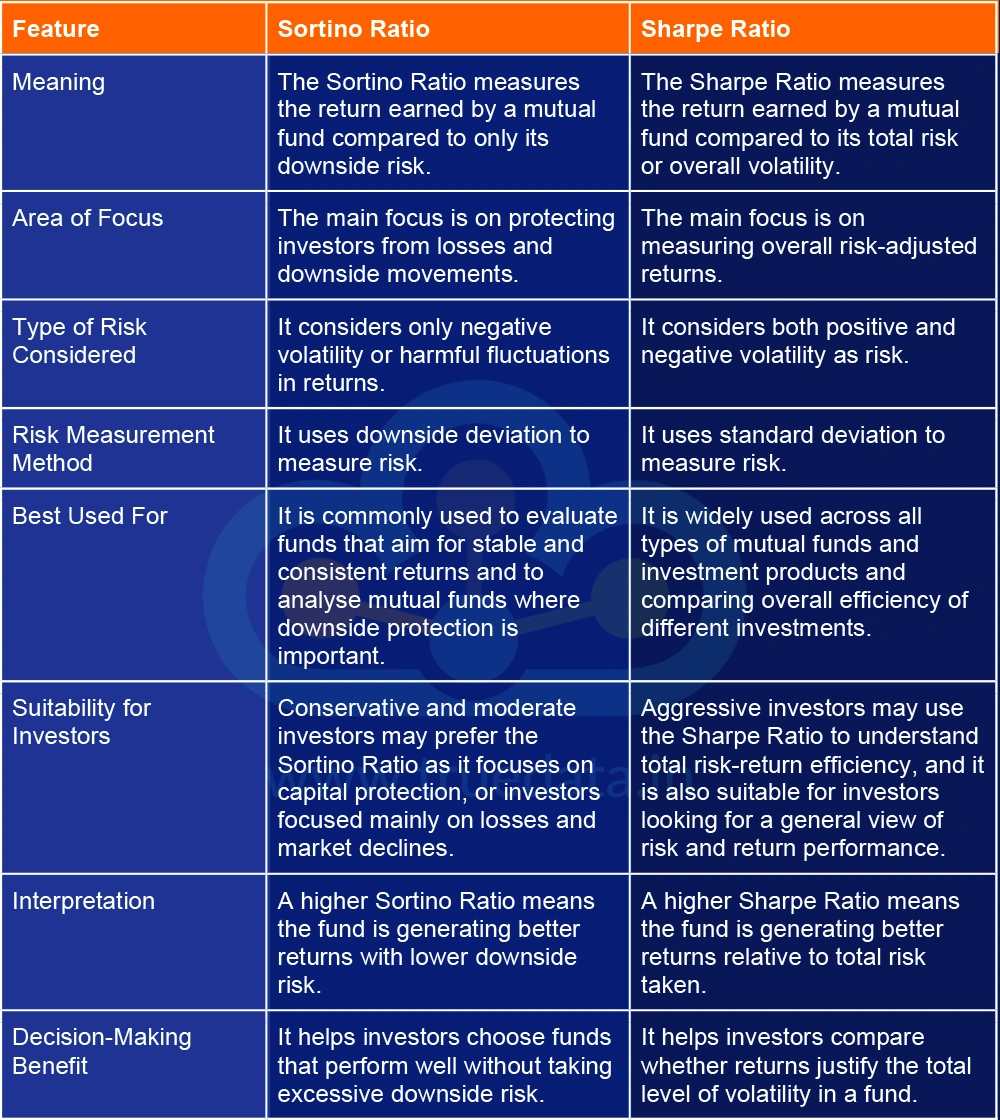
Sharpe ratio and Sortino Ratio are two key parameters of evaluating a mutual fund and are found in the mutual fund factsheet. However, they differ in the degree of risk measurement. Thus, understanding the key difference between these ratios can help investors make sound and informed portfolio decisions.

What are the Differences Between Sortino Ratio and Sharpe Ratio

Feature

Sortino Ratio

Sharpe Ratio

Meaning

The Sortino Ratio measures the return earned by a mutual fund compared to only its downside risk.

The Sharpe Ratio measures the return earned by a mutual fund compared to its total risk or overall volatility.

Area of Focus

The main focus is on protecting investors from losses and downside movements.

The main focus is on measuring overall risk-adjusted returns.

Type of Risk Considered

It considers only negative volatility or harmful fluctuations in returns.

It considers both positive and negative volatility as risk.

Risk Measurement Method

It uses downside deviation to measure risk.

It uses standard deviation to measure risk.

Best Used For

It is commonly used to evaluate funds that aim for stable and consistent returns and to analyse mutual funds where downside protection is important.

It is widely used across all types of mutual funds and investment products and comparing overall efficiency of different investments.

Suitability for Investors

Conservative and moderate investors may prefer the Sortino Ratio as it focuses on capital protection, or investors focused mainly on losses and market declines.

Aggressive investors may use the Sharpe Ratio to understand total risk-return efficiency, and it is also suitable for investors looking for a general view of risk and return performance.

Interpretation

A higher Sortino Ratio means the fund is generating better returns with lower downside risk.

A higher Sharpe Ratio means the fund is generating better returns relative to total risk taken.

Decision-Making Benefit

It helps investors choose funds that perform well without taking excessive downside risk.

It helps investors compare whether returns justify the total level of volatility in a fund.

What are the Disadvantages of Using Sortino Ratio?

What are the Disadvantages of Using Sortino Ratio

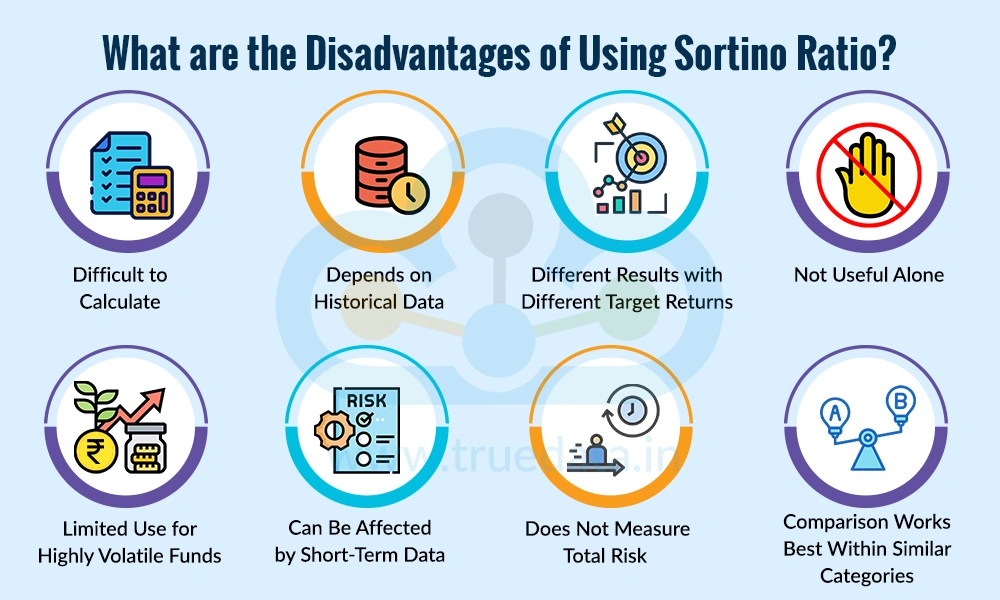
The Sortino Ratio is a useful tool for investors as it helps evaluate how well a mutual fund generates returns while controlling downside risk. Therefore, understanding the disadvantages of using Sortino Ratio can further improve investment decisions by highlighting funds with better risk-adjusted performance. Here is a list of a few limitations or disadvantages of using Sortino Ratio. 

  • Difficult to Calculate - The calculation of downside deviation can be more complex compared to simpler performance measures used in mutual fund analysis.

  • Depends on Historical Data - The Sortino Ratio is based on past performance, which may not guarantee similar results in the future.

  • Different Results with Different Target Returns - The ratio can change depending on the minimum acceptable return or risk-free rate used in the calculation.

  • Not Useful Alone - Investors should not rely only on the Sortino Ratio, as it does not provide complete information about a fund’s overall quality or future potential.

  • Limited Use for Highly Volatile Funds - The ratio may sometimes give misleading interpretations for funds with irregular return patterns.

  • Can Be Affected by Short-Term Data - Using data from a short time period may not give an accurate picture of a mutual fund’s true performance.

  • Does Not Measure Total Risk - The Sortino Ratio ignores positive volatility completely, which means it may not capture the full risk profile of a fund.

  • Comparison Works Best Within Similar Categories - The ratio is most effective when comparing mutual funds from the same category, such as large-cap funds with other large-cap funds.

Conclusion

The Sortino Ratio is an important tool for evaluating a fund and making informed investment decisions. Unlike many traditional risk measures, it focuses only on harmful volatility, making it especially useful for investors who want better protection against losses during market fluctuations. This helps in a better or refined comparison between similar funds and select a suitable option that offers a better balance between return and safety. 

This article explores another key ratio of the mutual fund factsheet and its importance in mutual fund analysis. Let us know your thoughts on the topic or if you need further information on the same, and we will address it soon. 

Till then, Happy Reading!


Read More: Fund Manager Change - Does It Really Impact Fund Performance?

Frequently Asked Questions

The target return (Rt) in the Sortino Ratio is the minimum return an investor expects from an investment. This is often taken as the risk-free rate (such as government bond returns) or a personal expected return goal.

Downside deviation measures how much a mutual fund’s returns fall below a minimum expected return or target return. Thus, it shows the level of harmful volatility or the risk of losses in an investment.

The Sortino Ratio is mainly used in mutual funds, portfolio management, and investment analysis to measure risk-adjusted returns by focusing on downside risk. Investors use it to compare funds and identify investments that provide better returns with lower chances of losses.

The Sortino Ratio measures returns compared to downside risk or harmful volatility, while the Treynor Ratio measures returns compared to market risk (beta). In simple words, Sortino focuses on the risk of losses, whereas Treynor focuses on how sensitive a fund is to overall market movements.

Investors can use the Sortino Ratio instead of the Sharpe Ratio when the need is to focus only on downside risk or the chances of losses. It is especially useful for investors who prefer safer investments and want to ignore positive market volatility while comparing mutual funds.

A rolling Sortino Ratio measures the Sortino Ratio continuously over different time periods, such as monthly or yearly intervals, instead of using only one fixed period. Investors can use it to understand how consistently a mutual fund manages downside risk over time in changing market conditions.
Marisha Bhatt

Marisha Bhatt is a financial content writer @TrueData.

She writes with the sole aim of simplifying complex financial concepts and jargon while attempting to clarify technical and fundamental analysis concepts of the stock markets. The ultimate goal is to spread vital knowledge and benefit the maximum audience. Her Chartered Accountant background acts as the knowledge base to help clarify crucial concepts and create a sound investment portfolio.

15 Comments
P
Pranhas
· June 02, 2026

Good post

·
H
HydBob
· June 02, 2026

Your mutual fund blogs are interesting..keep sharing

·
A
Ashish Tiwari
· June 02, 2026

Very informative article. I had heard of the Sharpe Ratio before, but this is the first time I clearly understood how the Sortino Ratio focuses only on downside risk. The examples made it easy to follow.

·
V
Varun Khanna
· June 02, 2026

Great explanation of a complex topic. Investors often focus only on returns, but understanding risk-adjusted performance is equally important. This blog highlights that well.

·
A
Alexa
· June 02, 2026

The comparison between Sortino and Sharpe Ratios was particularly useful. It helped me understand when each metric should be used while evaluating mutual funds.

·
H
Heyram
· June 02, 2026

Excellent read for mutual fund investors.

·
T
Tanya Bhatia
· June 02, 2026

Risk metrics can be confusing, but this article explains them in a way that beginners can grasp.

·
R
Radhika Mehta
· June 02, 2026

I appreciate how the blog emphasizes downside risk rather than overall volatility.

·
M
Monika Arora
· June 02, 2026

This article reinforces the importance of looking beyond returns. A fund with higher returns isn't always the better choice if it comes with significantly higher downside risk.

·
M
Madhan
· June 02, 2026

The article does a nice job of explaining why downside risk matters and how the Sortino Ratio helps measure it. Keep sharing

·
S
Sandy
· June 02, 2026

Metrics like the Sortino Ratio can help investors compare funds more effectively instead of relying only on past returns.

·
A
Arjun M
· June 02, 2026

I found this excellent blog on Tumblr. One of the better explanations I've seen on the Sortino Ratio.

·
P
Preethy
· June 02, 2026

Understanding risk-adjusted returns can make a big difference in long-term investment decisions, and this article explains that clearly.

·
S
Satish diwari
· June 03, 2026

Your mutual funds topics are interesting mam

·
S
Satish diwari
· June 03, 2026

Your mutual funds topics are interesting mam

·

Related Articles

SEE ALL
Mutual Funds
Mutual Funds
How to Complain About Mutual Funds?

Mutual fund investments have simplified greatly with just a tap on your smartpho...

Corporate Data
Corporate Data
Solvency and Leverage Ratios - Debt and Equity Ratios

Debt and equity together form the total capital of a company. However, when anal...

Investing / Trading
Investing / Trading
Stocks or mutual funds? Which is better?

Introduction For the longest time, investment in stock markets was thought to b...