
Many investors think that mutual fund investing is simply selecting a fund and waiting for the markets to multiply the investment in the long run. However, this is not the whole story. While selecting the right fund is the starting point, it is based on the approach or the investment strategy of the investor. The two main strategies or types of funds that most mutual funds are generally categorised into are active mutual funds and passive mutual funds. So what are the differences between the two fund strategies, and more importantly, what is more suitable to you? Dive into this blog to get answers to these questions and get an edge in mutual fund investing.
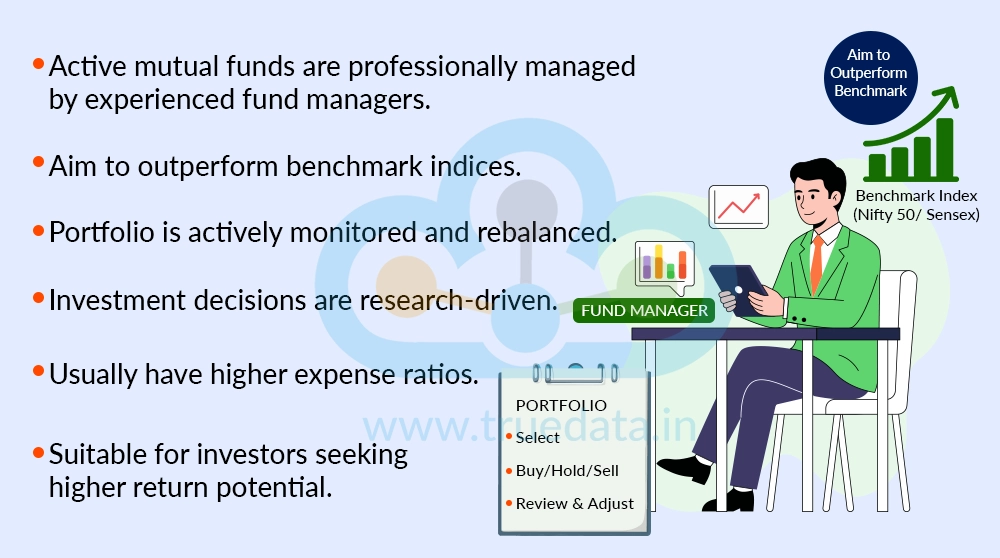
Active mutual funds are mutual fund schemes where a professional fund manager actively selects and manages investments with the aim of generating higher returns than a benchmark index, such as the Nifty 50 or Sensex. Instead of simply tracking an index, the fund manager conducts detailed research, analyses companies, sectors, economic trends, and market conditions, and then decides which securities to buy, hold, or sell. The portfolio is regularly reviewed and adjusted to take advantage of potential opportunities or manage risks.
As active funds involve continuous research and active decision-making, they generally have higher expense ratios than passive funds. The performance of an active mutual fund depends largely on the fund manager's expertise and investment strategy. Active funds can invest across various categories such as large-cap, mid-cap, small-cap, hybrid, and debt funds, making them suitable for investors who seek the potential for market-beating returns and are comfortable relying on the fund managers’ investment decisions.
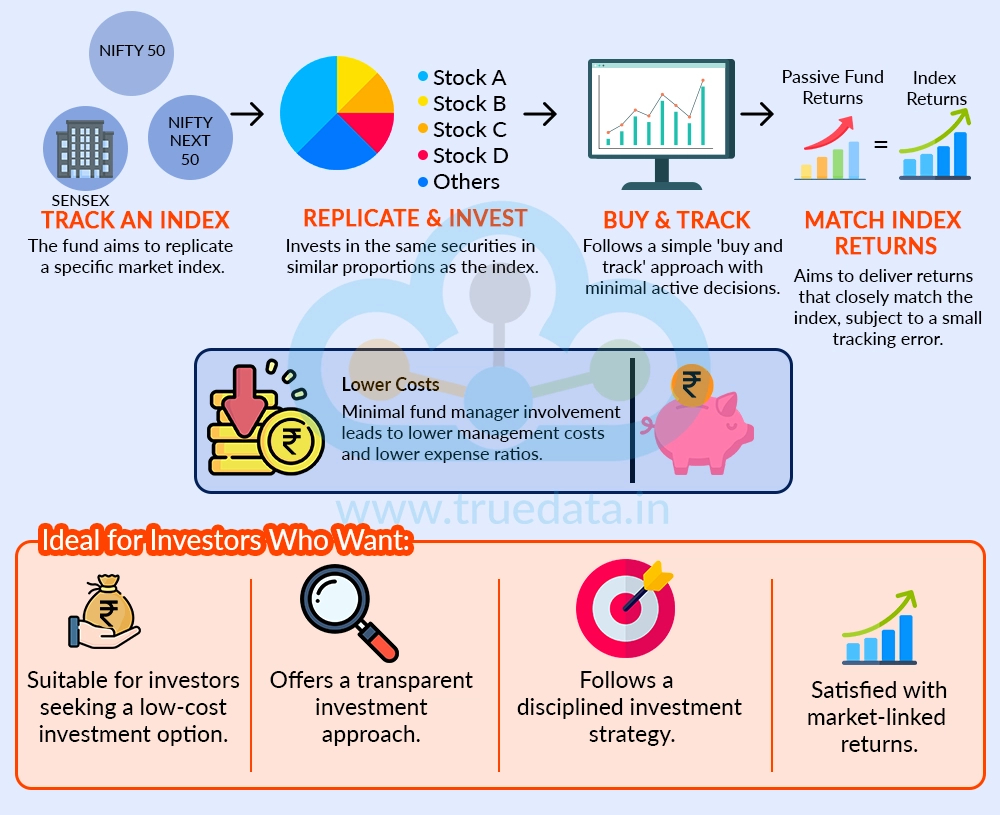
Passive mutual funds are mutual fund schemes that aim to replicate the performance of a specific market index rather than trying to outperform it. Instead of actively selecting stocks or timing the market, these funds invest in the same securities that make up the chosen index, such as the Nifty 50, Sensex, or Nifty Next 50, and in similar proportions. Since there is minimal involvement of a fund manager in selecting investments, passive funds follow a simple ‘buy and track’ approach. This results in lower management costs and generally lower expense ratios compared to active funds.
The returns of a passive fund are designed to closely match the returns of its underlying index, subject to a small difference known as tracking error. Passive mutual funds are suitable for investors who prefer a low-cost, transparent, and disciplined investment approach and are satisfied with earning returns that are broadly in line with the overall market.
Active funds and passive funds are two distinct investment approaches, especially in terms of risk, return and fund manager role. These differences between the two are explained below.
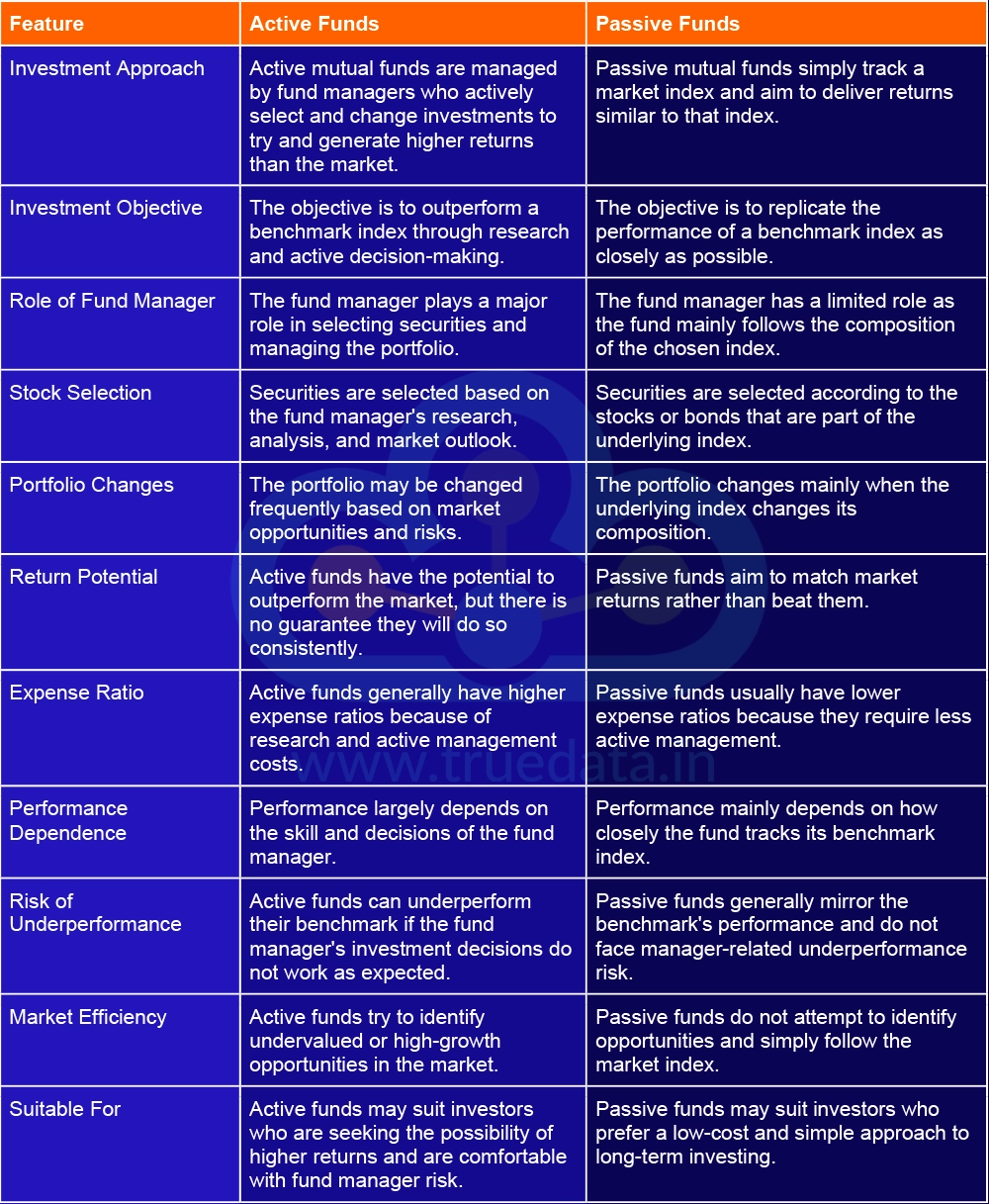
After understanding the differences between active and passive funds, let us now consider the advantages and disadvantages of investing in them for more informed decision-making.
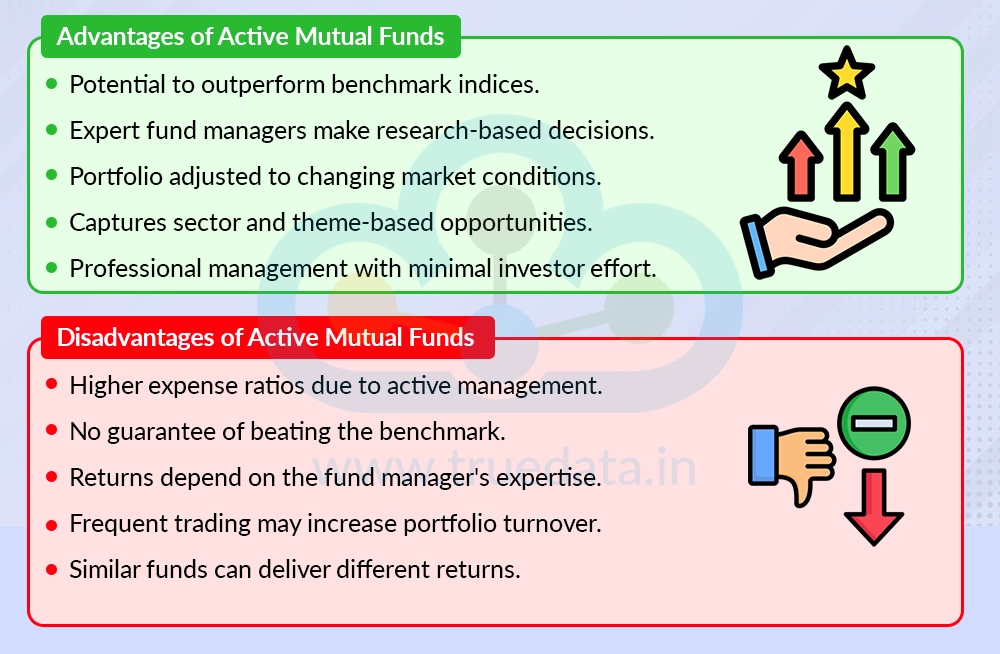
Advantages of Active Mutual Funds
Active mutual funds have the potential to generate returns that are higher than the benchmark index.
Experienced fund managers can identify attractive investment opportunities through detailed research.
Fund managers can adjust the portfolio during changing market conditions to manage risks.
Active funds can take advantage of opportunities in specific sectors, themes, or companies.
Investors benefit from professional management without having to research and track investments themselves.
Disadvantages of Active Mutual Funds
Active funds generally have higher expense ratios due to research and portfolio management costs.
There is no guarantee that the fund will outperform its benchmark index.
Fund performance depends significantly on the fund manager's skill and investment decisions.
Frequent buying and selling of securities may increase portfolio turnover.
Different active funds following the same category can deliver widely different returns.
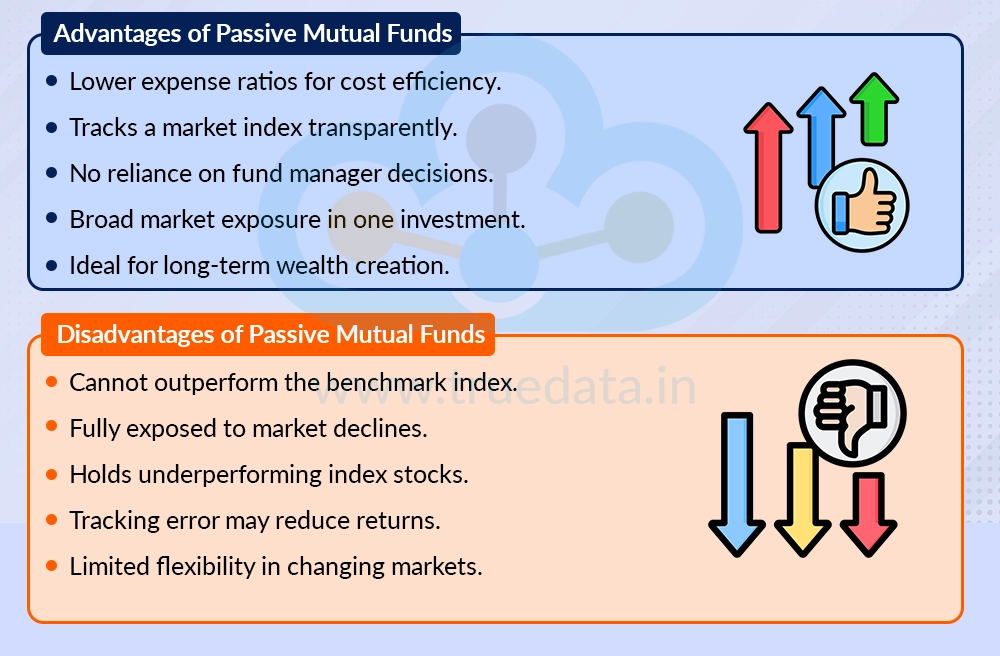
Advantages of Passive Mutual Funds
Passive mutual funds usually have lower expense ratios, which can help improve long-term returns.
They offer a simple and transparent investment approach by tracking a known market index.
Investors are not dependent on the stock-picking ability of a fund manager.
Passive funds provide broad market exposure through a single investment.
They are easy to understand and suitable for long-term wealth creation.
Disadvantages of Passive Mutual Funds
Passive funds cannot outperform the index they track.
Investors remain fully exposed to market declines when the benchmark index falls.
These funds do not actively avoid poorly performing stocks that remain part of the index.
Returns may be slightly lower than the index because of tracking error and fund expenses.
Passive funds have limited flexibility to respond to changing market conditions or emerging opportunities.
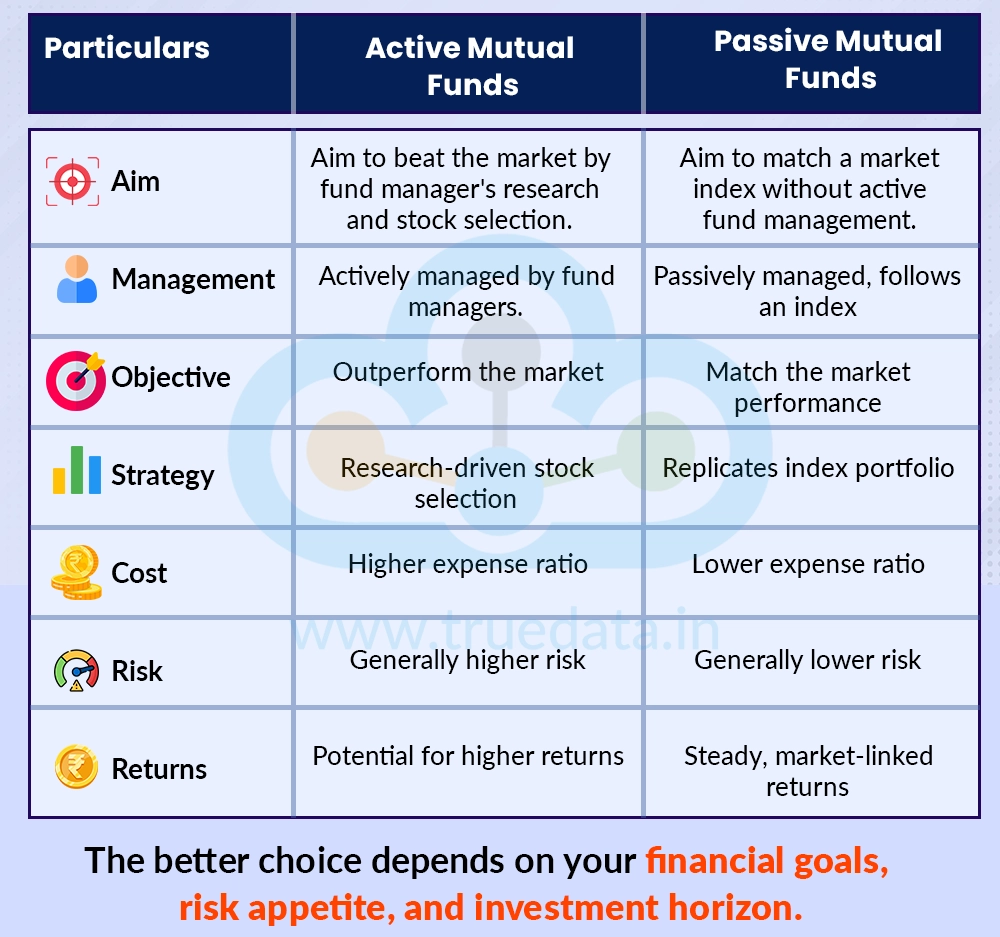
There is no single answer to whether active or passive mutual funds are better, as the right choice depends on an investor's financial goals, risk appetite, investment horizon, and personal preferences. Active mutual funds may be suitable for investors who are willing to take slightly higher risk in the hope of earning returns that are better than the market. They can also be useful in market segments where skilled fund managers have the opportunity to identify undervalued companies and generate additional returns. However, investors should remember that higher returns are not guaranteed, and fund performance can vary based on the fund manager's decisions.
Passive mutual funds may be more suitable for investors who prefer a simple, low-cost, and disciplined approach to investing. These funds aim to match the performance of a market index and do not rely heavily on fund manager expertise. They can be a good choice for long-term investors who want broad market exposure with lower expenses. In practice, many investors choose a combination of active and passive funds to balance the potential for higher returns with the benefits of lower costs and diversification.
Active and passive mutual funds each have their own strengths and limitations, and neither is universally better than the other. While active funds aim to outperform the market through professional management, passive funds focus on delivering market-linked returns at a lower cost. Thus, the right choice depends on individual financial goals, risk appetite, investment horizon, and investment preferences. Understanding these two approaches in detail can help investors make informed decisions and build a mutual fund portfolio that aligns with their long-term wealth creation objectives.
This blog addresses the starting point to mutual fund investing and the nuances of active and passive mutual funds. We hope this blog can answer most of your queries. Let us know your thoughts on the topic or if you need further information on the same, and we will address it soon.
Till then, Happy Reading!
Read More: Mutual Fund Myths You Still Believe

Marisha Bhatt is a financial content writer @TrueData.
She writes with the sole aim of simplifying complex financial concepts and jargon while attempting to clarify technical and fundamental analysis concepts of the stock markets. The ultimate goal is to spread vital knowledge and benefit the maximum audience. Her Chartered Accountant background acts as the knowledge base to help clarify crucial concepts and create a sound investment portfolio.

Mutual fund investments have simplified greatly with just a tap on your smartpho...

Introduction For the longest time, investment in stock markets was thought to b...

Every investor knows that the stepping stones to a good investment in thestock m...
