15-MIN DELAYED
NIFTY 24,536.60 +576.00 (+2.40%) | BANKNIFTY 57,773.65 +1,860.05 (+3.33%) | SENSEX 79,310.01 +2,008.61 (+2.60%) | CRUDEOIL-I 8,369.00 -16.00 (-0.19%) | GOLD-I 1,45,220.00 +1,927.00 (+1.34%) | NIFTY 24,536.60 +576.00 (+2.40%) | BANKNIFTY 57,773.65 +1,860.05 (+3.33%) | SENSEX 79,310.01 +2,008.61 (+2.60%) | CRUDEOIL-I 8,369.00 -16.00 (-0.19%) | GOLD-I 1,45,220.00 +1,927.00 (+1.34%) |
TrueData
Helpline / Support +91 7304-22-44-66
Get started

WORKSPACE

Workspace overview Workspace overview Our flagship product SignalX SignalX web charting for indian market Sheets Sheets streaming spreadsheet Wealth Wealth corporate data and news


Built for India's markets.

Real-time charts, streaming spreadsheets, live corporate announcements — all in one workspace.

Get started free

What Happens to Your Stocks When a Company Is Delisted?

Marisha Bhatt · 05 Nov 2026 · 13 mins read · 0 Comments

what-happens-to-your-stocks-when-a-company-is-delisted

Investors generally think of stocks as long-term investments, but what happens when a company is delisted from the stock exchange? Does delisting mean you lose your entire investment or ownership of the shares? Can you still sell your shares, and is there a way to recover your money? Delisting can leave shareholders with several questions about their investments and what they should do next. In this blog, let us understand what happens to your stock holdings when a company is delisted, how it can affect shareholders, and the options available to investors.

What is Delisting?

Delisting refers to the removal of a company’s shares from a recognised stock exchange, such as the NSE or BSE, which means the shares are no longer available for regular buying and selling on that exchange. A company may be delisted voluntarily, for example, when its promoters decide to take the company private, or compulsorily if it fails to meet certain regulatory or listing requirements. In a voluntary delisting, shareholders may be given an opportunity to sell their shares back to the company or its promoters through the prescribed delisting process. Once the delisting is completed, investors may no longer be able to trade the shares through the stock exchange, which can affect the liquidity and ease of selling their investment. However, delisting does not automatically mean that shareholders lose ownership of their shares or that their investment becomes worthless. The outcome depends on the type of delisting and the process followed by the company.

What are the Types of Delisting?

In India, delisting is broadly classified into two types, i.e., voluntary delisting and compulsory delisting. The options available to shareholders can differ depending on which type of delisting takes place. The provisions under the current SEBI framework are as follows.

what-are-the-types-of-delisting

Voluntary Delisting

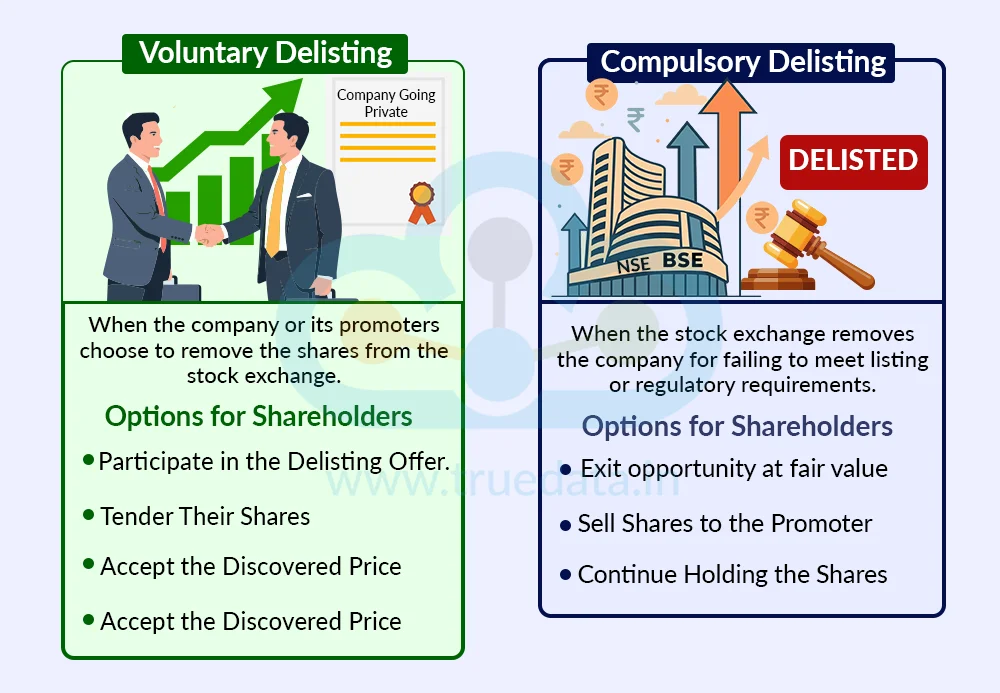
Voluntary delisting happens when a company or its promoters choose to remove the company’s shares from the stock exchange. This may happen when promoters want to take the company private, consolidate their ownership, or no longer want the company to remain listed.

Options For Shareholders -

  • Participate in the Delisting Offer - Public shareholders are generally given an exit opportunity to sell their shares to the acquirer/promoter as part of the delisting process.

  • Tender Their Shares - Eligible shareholders can offer or tender their shares during the specified bidding period. In the reverse book-building process, shareholders can indicate the price at which they are willing to sell, subject to the applicable rules.

  • Accept the Discovered Price - The exit price may be determined through the reverse book-building process. If the acquirer accepts the discovered price and the required conditions are met, shares tendered at or below the accepted price can be purchased as per the delisting process.

  • Continue Holding the Shares - A shareholder may choose not to participate in the offer. However, once the shares are delisted, they will no longer be available for regular trading on the stock exchange. This can make it more difficult to sell them later.

Thus, in voluntary delisting, shareholders generally get an opportunity to exit their investment through the prescribed delisting process, but they should carefully check the offer terms, timelines and applicable price before deciding whether to tender their shares.

Compulsory Delisting

Compulsory delisting occurs when a stock exchange removes a company’s shares from trading because the company has failed to meet applicable listing requirements or falls under the grounds prescribed under the relevant regulations. In this case, the decision is not initiated by the company simply as a choice.

Options For Shareholders -

  • Exit Opportunity at Fair Value - The regulations provide an exit mechanism for public shareholders in cases of compulsory delisting. The fair value of the shares is determined through the prescribed process, including valuation by an independent valuer.

  • Sell Shares to the Promoter - The promoter may be required to acquire shares from public shareholders at the determined fair value, subject to the applicable regulations and process.

  • Continue Holding the Shares - Shareholders may continue to hold their shares, but once the company is compulsorily delisted, the shares are no longer traded on the stock exchange. This can significantly reduce their liquidity and make selling them more difficult.

Thus, in compulsory delisting, shareholders do not simply lose their shares because the company has been removed from the exchange. However, they need to understand the exit mechanism and applicable timelines to determine how they can realise the value of their investment.

What are the Common Reasons for Stock Delisting?

A company’s shares can be delisted for several reasons. Some delistings are initiated by the company or its promoters, while others can happen when the company fails to meet applicable regulatory or listing requirements. Under SEBI’s framework, voluntary and compulsory delisting are treated differently.

What are the Common Reasons for Stock Delisting

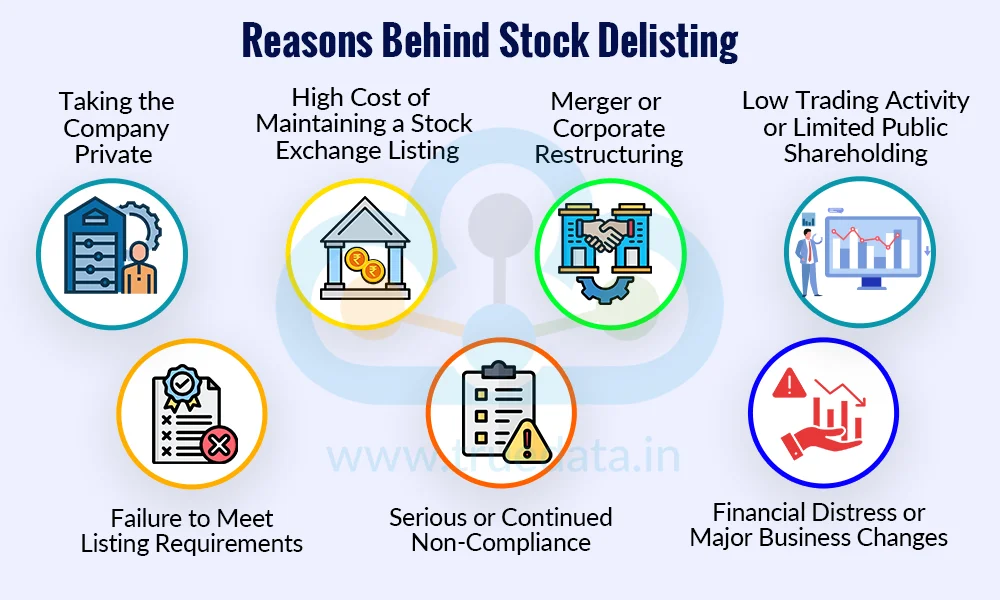
  • Taking the Company Private - Promoters may decide to buy out public shareholders and take the company private. In such cases, the promoters may believe that remaining listed is no longer necessary for the company’s future plans. The delisting process provides an exit opportunity to eligible public shareholders.

  • High Cost of Maintaining a Stock Exchange Listing - Being a listed company involves ongoing costs related to compliance, financial reporting, disclosures, investor relations and other regulatory requirements. For some smaller companies, these costs may become significant compared with the benefits of remaining listed.

  • Merger or Corporate Restructuring - A company may be delisted as part of a merger, acquisition or other corporate restructuring. For example, if a listed company is merged with another company and the resulting entity is not intended to remain listed, its shares may eventually be removed from the stock exchange.

  • Low Trading Activity or Limited Public Shareholding - A company may have very limited trading activity or a relatively small number of public shareholders. In some circumstances, promoters may consider that maintaining a public listing does not provide enough benefit compared with the costs and compliance requirements involved.

  • Failure to Meet Listing Requirements - A company must comply with various stock exchange and regulatory requirements to remain listed. Failure to meet applicable requirements can lead to compulsory delisting. Stock exchanges can initiate the prescribed process when a company does not comply with the relevant conditions.

  • Serious or Continued Non-Compliance - Repeated failures to meet disclosure, reporting or other listing obligations can create grounds for regulatory action. If the company does not address the relevant deficiencies within the prescribed framework, compulsory delisting may follow. The exact grounds and process are governed by the applicable regulations.

  • Financial Distress or Major Business Changes - Significant financial difficulties, insolvency proceedings or major changes in the company's business structure can sometimes result in its shares being removed from a stock exchange. However, financial distress does not automatically mean that a company will be delisted; the outcome depends on the circumstances and the applicable legal and regulatory process.

What is the Impact on Shareholders?

When a company is delisted, shareholders may experience several changes in how they can hold, sell or realise the value of their shares. However, delisting does not automatically mean that shareholders lose ownership of their shares or their entire investment. The impact depends on whether the delisting is voluntary or compulsory and on the exit mechanism available under the applicable rules.

What is the Impact on Shareholders

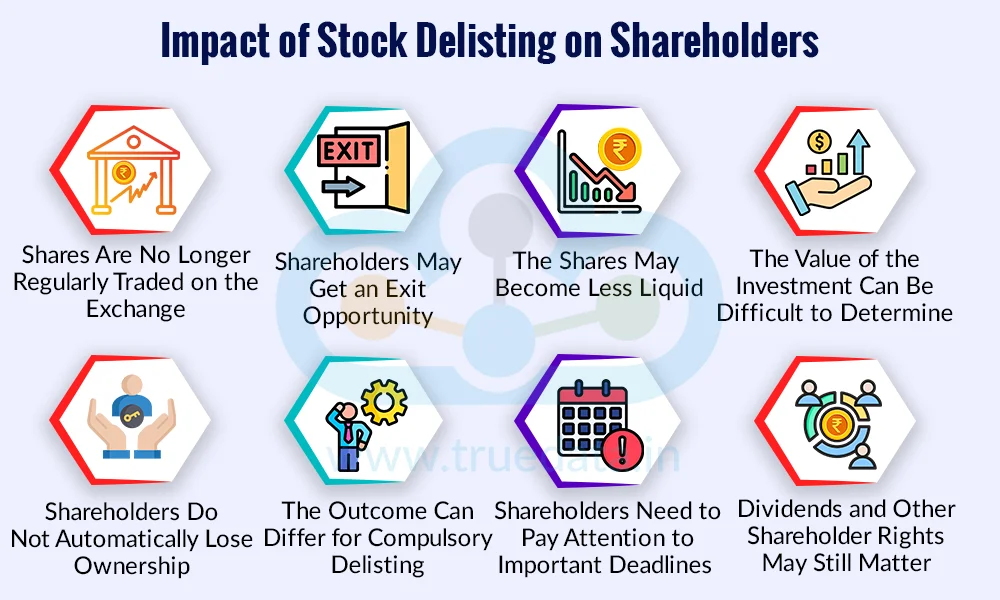
  • Shares Are No Longer Regularly Traded on the Exchange - Once delisting is completed, the company’s shares are removed from the stock exchange and are no longer available for normal buying and selling on that exchange. This means shareholders cannot simply place a regular sell order through their stockbroker as they would for a listed share.

  • Shareholders May Get an Exit Opportunity - In a voluntary delisting, public shareholders are generally provided an exit opportunity under the SEBI delisting framework. Depending on the process, shareholders may tender their shares to the acquirer or promoter at the applicable price. Under the reverse book-building process, shareholders can place bids at or above the applicable floor price, and the exit price is determined through the prescribed mechanism. This gives shareholders an opportunity to exit their investment instead of being left without a mechanism to sell their shares.

  • The Shares May Become Less Liquid - If an investor continues to hold the shares after delisting, finding a buyer can become more difficult because the shares are no longer traded on the stock exchange. Thus, the investment may still belong to the shareholder, but selling it can become more complicated.

  • The Value of the Investment Can Be Difficult to Determine - For a listed stock, the market price provides a readily available reference for its value. After delisting, there may no longer be a regular market price because the shares are not being traded on the exchange. Therefore, shareholders may have greater difficulty determining the current market value of their holdings.

  • Shareholders Do Not Automatically Lose Ownership - Delisting and cancellation of shares are not the same thing. A shareholder does not automatically lose ownership merely because the company's shares have been removed from the exchange. The shareholder may continue to hold the shares, subject to the terms and circumstances of the delisting. However, the ability to trade those shares through the exchange is affected.

  • The Outcome Can Differ for Compulsory Delisting - In a compulsory delisting, the company is removed from the exchange under the prescribed regulatory framework rather than choosing to delist voluntarily. Public shareholders have an exit mechanism under the applicable regulations, and the process for determining the amount payable can differ from a voluntary delisting. Therefore, investors should carefully check the official delisting notice and the applicable terms rather than assuming that the same process applies to every delisting.

  • Shareholders Need to Pay Attention to Important Deadlines - Delisting processes involve specific timelines for shareholders to participate in the applicable exit mechanism. Investors should therefore read the company's stock exchange announcements and offer documents carefully and take action within the prescribed period if they want to participate.

  • Dividends and Other Shareholder Rights May Still Matter - Delisting does not simply erase the shareholder's existing ownership rights. Depending on the company's circumstances and applicable laws, shareholders may continue to have rights associated with their shares. However, the practical process for exercising those rights can be different once the company is no longer listed.

Can a Delisted Company be Listed Again?

Can a Delisted Company be Listed Again

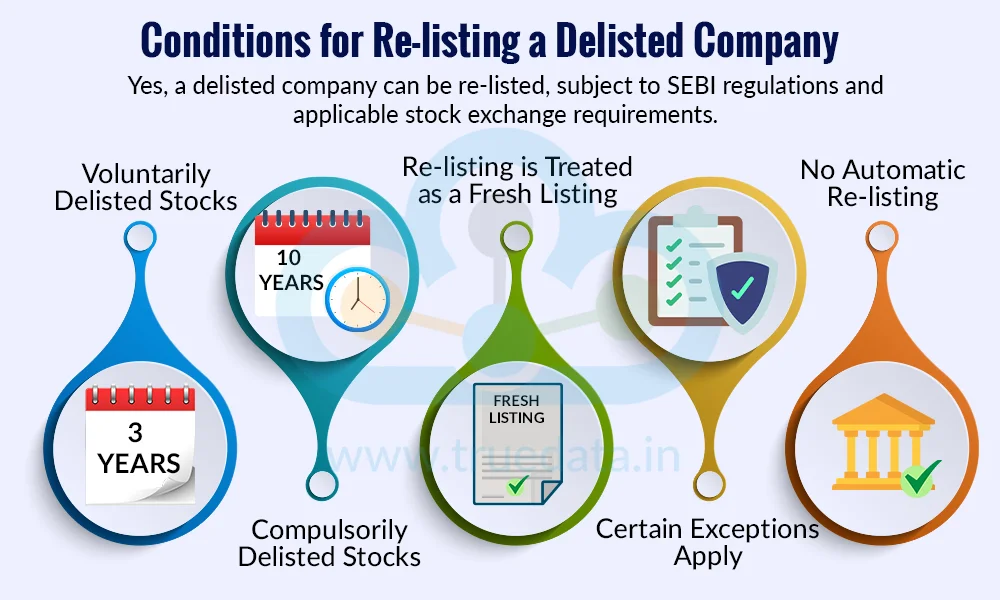
Yes, a delisted company can potentially get its shares listed again, but re-listing is subject to SEBI regulations and the applicable stock exchange requirements. A company cannot simply resume trading on the exchange after being delisted. The waiting period and requirements depend on the manner in which the shares were delisted.

  • Voluntarily Delisted Stocks - Under the current SEBI regulations, an application for listing generally cannot be made for 3 years from the date of delisting when the shares were delisted under the relevant voluntary-delisting provisions. This is different from the earlier five-year period under SEBI regulations.

  • Compulsorily Delisted Stocks - If a company's shares were compulsorily delisted, an application for listing generally cannot be made for 10 years from the date of delisting.

  • Re-listing is Treated as a Fresh Listing - When a company applies to list its shares again after delisting, the application is treated as an application for fresh listing. The company must therefore comply with the applicable legal and listing requirements.

  • Certain Exceptions Apply - The regulations provide exceptions to the waiting-period restrictions in specific situations, including certain companies whose shares are delisted pursuant to a resolution plan under the Insolvency Code and other specified cases.

  • No Automatic Re-listing - Even after the applicable waiting period ends, re-listing is not automatic. The company still needs to meet the relevant requirements and obtain listing approval from the recognised stock exchange.

What Should Shareholders Do?

What Should Shareholders Do

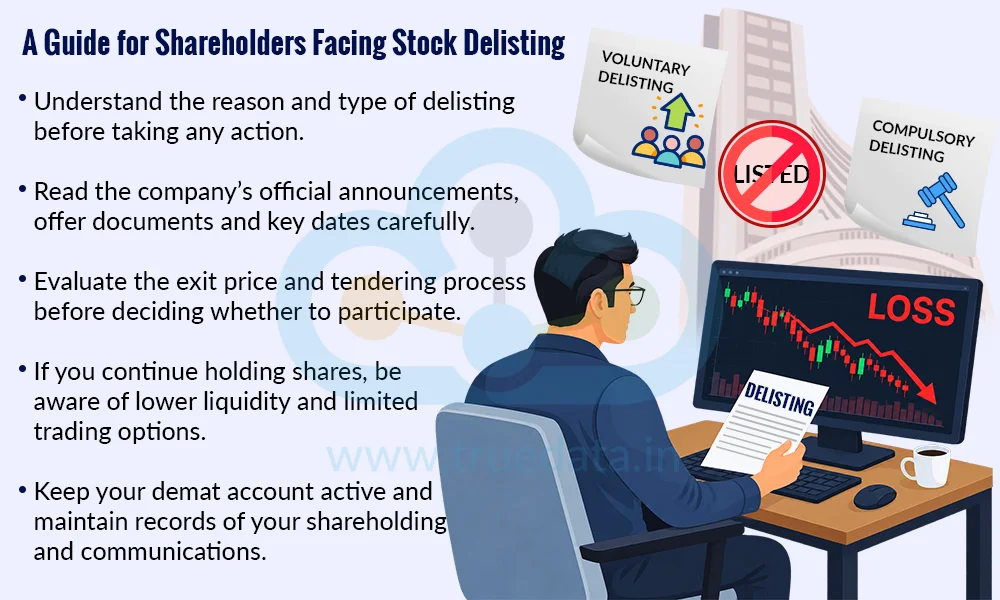
When a company announces delisting, shareholders should first understand why the company is being delisted and what type of delisting is taking place. They should carefully read the company's official announcements, offer documents and important dates to understand the exit opportunity, applicable price and process for tendering their shares. In case of voluntary delisting, shareholders can evaluate whether the offered exit price is suitable for them and decide whether to participate in the delisting process within the specified timeline.

If shareholders choose to continue holding the shares, they should understand that the shares may no longer be regularly traded on the stock exchange after delisting, which can make them difficult to sell. In case of compulsory delisting, shareholders should pay close attention to the prescribed exit mechanism and the applicable valuation or price. They should also keep their demat account active and maintain records of their shareholding and related communications. Most importantly, shareholders should not assume that delisting automatically makes their shares worthless, as the impact and available options depend on the type of delisting and the applicable regulatory process.

What are the Differences Between Delisting, Suspension and Liquidation?

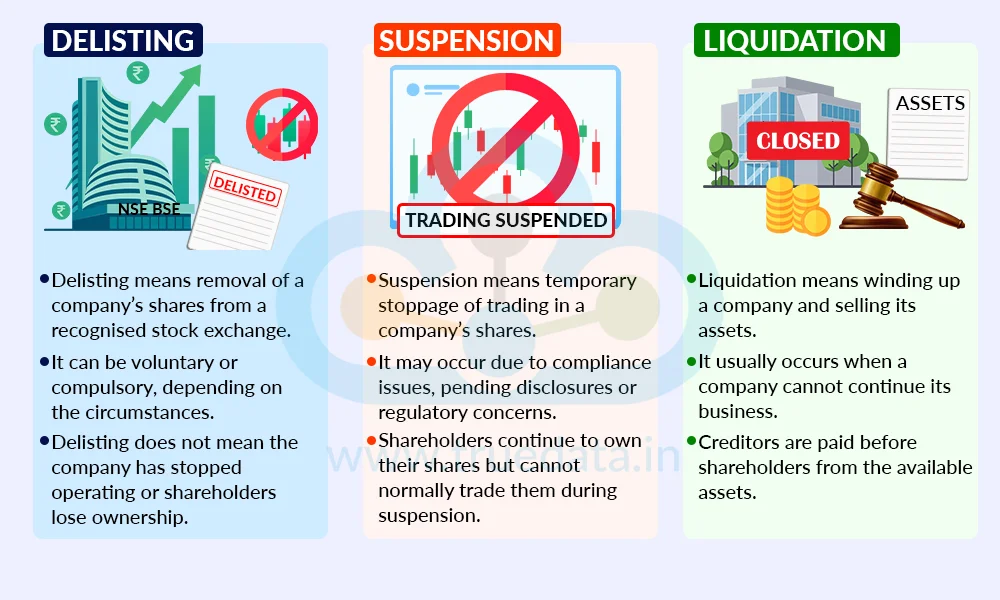
Delisting, suspension and liquidation are three different situations that can affect a company and its shareholders. Although all three can make it difficult for investors to trade or realise the value of their shares, they have different meanings and consequences.

What are the Differences Between Delisting, Suspension and Liquidation

Delisting

Delisting means that a company's shares are removed from a recognised stock exchange such as the NSE or BSE. It can happen voluntarily, when promoters decide to take the company private, or compulsorily when the company fails to meet applicable listing requirements. Delisting does not automatically mean that the company has stopped operating or that shareholders lose ownership of their shares. However, after delisting, the shares are no longer available for regular trading on the exchange, which can make them more difficult to sell. Depending on the type of delisting, shareholders may also receive an exit opportunity under the applicable SEBI rules.

Suspension

Suspension means that trading in a company's shares is temporarily stopped by the stock exchange or regulator. This may happen because of compliance issues, pending disclosures, regulatory concerns or other circumstances requiring trading to be halted. During the suspension, shareholders generally continue to own their shares, but they cannot normally buy or sell them on the exchange. If the company addresses the reasons for the suspension and fulfils the applicable requirements, trading may resume. Therefore, suspension is generally a temporary restriction on trading, rather than the permanent removal of the shares from the exchange.

Liquidation

Liquidation is a process in which a company's affairs are wound up, and its assets are realised to settle its debts and other liabilities according to the applicable legal process. It can occur when a company is unable to continue its business and enters a formal liquidation process, including under applicable insolvency laws. Liquidation can carry a significant risk for shareholders because they are generally entitled to receive any remaining value only after creditors and other higher-priority claims have been settled. If the company's assets are not sufficient to meet these claims, shareholders may receive little or nothing from their investment.

Conclusion

Delisting can raise several questions for shareholders, but it does not automatically mean that their shares become worthless or that they lose ownership. The impact depends on whether the delisting is voluntary or compulsory and the exit options available under the applicable rules. By understanding the delisting process, checking official announcements and timelines, and carefully evaluating the available options, investors can make more informed decisions about their holdings when a company is delisted.

This article discusses a very crucial question related to an investment and portfolio. Let us know your thoughts on the topic, or if you need further information, and we will address it soon. 

Till then, Happy Reading!

Read More: DIY Investing vs Advisor - Should you invest on your own or take help?

Frequently Asked Questions

After a company is delisted, its shares can no longer be sold through normal trading on the stock exchange. However, shareholders may have an exit opportunity under the applicable delisting process or may be able to sell the shares through other permitted means, depending on the circumstances.

Yes, delisted shares can still have value, as investors may continue to own them after the company is delisted. However, selling them can be difficult because they are no longer traded regularly on the stock exchange.

If a company is delisted due to bankruptcy or liquidation, shareholders may lose some or all of their investment after the company’s assets are used to settle creditors and other higher-priority claims. The actual recovery, if any, depends on the amount left after these claims are settled under the applicable insolvency process.

Yes, investors can generally continue to hold delisted shares in their Demat account as long as the shares remain valid and have not been cancelled or extinguished. However, the shares will no longer be available for regular trading on the stock exchange, which can make them harder to sell.

Delisting does not automatically cancel a shareholder’s right to receive dividends if the company declares a dividend and the shareholder is eligible. However, dividend payments depend on the company’s financial position, decisions and applicable rules after delisting.

Investors can check the company’s official announcements, stock exchange filings on NSE or BSE, and SEBI updates for information about a proposed delisting. Companies are required to disclose important developments related to delisting, including relevant dates and the process for shareholders.
Marisha Bhatt

Marisha Bhatt is a financial content writer @TrueData.

She writes with the sole aim of simplifying complex financial concepts and jargon while attempting to clarify technical and fundamental analysis concepts of the stock markets. The ultimate goal is to spread vital knowledge and benefit the maximum audience. Her Chartered Accountant background acts as the knowledge base to help clarify crucial concepts and create a sound investment portfolio.

0 Comments

Related Articles

SEE ALL
Investing / Trading
Investing / Trading
Understanding Pledging of Shares in Margin Trading

Did you know that India's Margin Trading Facility (MTF) book reached an all-time...

Corporate Data
Corporate Data
The Role of Promoter Holding and Pledged Shares in Company Analysis

Every company has a core group of people who believe in its vision from day one,...

Corporate Data
Corporate Data
Can You Buy and Sell Unlisted Shares?

Investing inshares listed on stock exchanges has become an integral part of many...