Corporate Data

Private Equity vs Venture Capital - What is the Difference?

Marisha Bhatt · 21 May 2026 · 8 mins read · 0 Comments

private-equity-vs-venture-capital-what-is-the-difference

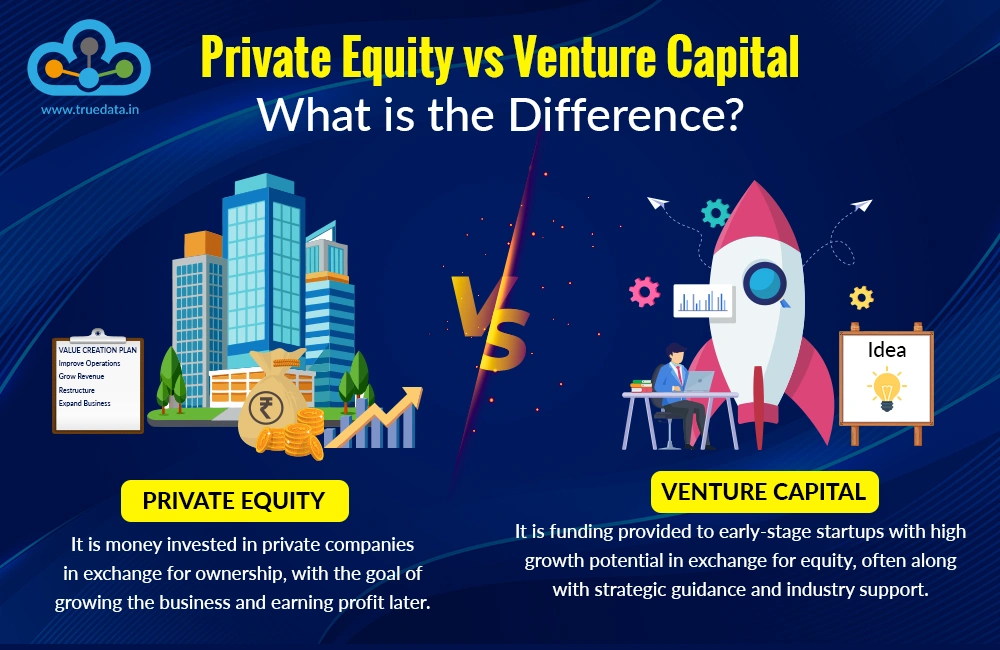
Private equity and venture capital are two of the most talked-about sources of startup funding, but they are often confused or used interchangeably. In reality, they serve very different purposes and come into play at different stages of a company’s journey. So how do they actually differ, and which one is the right fit for a startup? Dive into this blog as we break down these concepts in simple terms to help you understand where each fits in the startup ecosystem.

What is Private Equity?

What is Private Equity

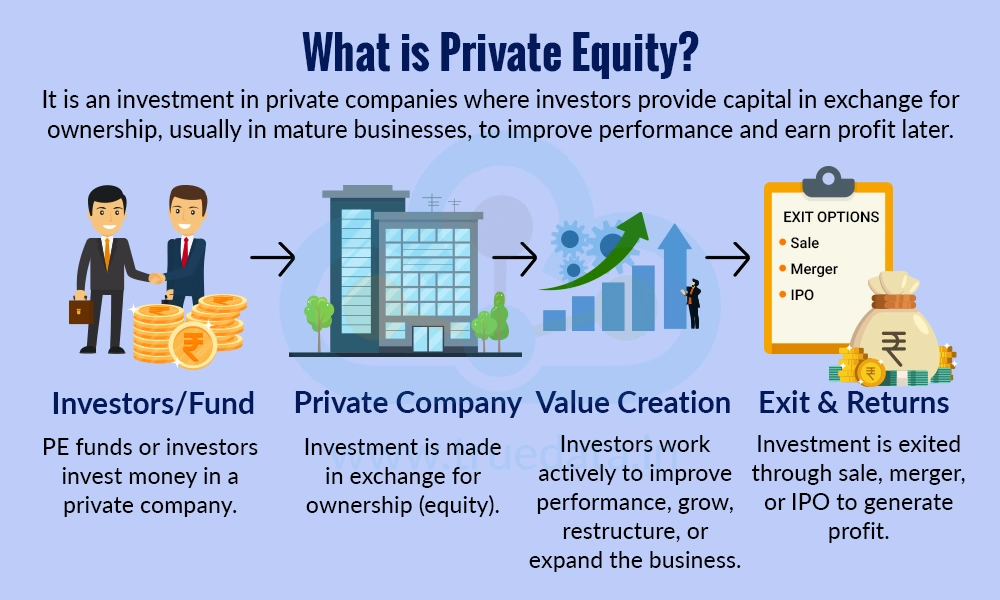
Private equity (PE) refers to investments made in companies that are not listed on the stock exchange. It is money invested by funds or investors into a business in exchange for ownership (equity), usually with the aim of improving the company’s performance and selling it later at a profit. Private equity investors typically invest in more mature businesses that already have stable revenues, unlike early-stage startups. They may also take an active role in decision-making, helping the company grow, restructure, or expand before exiting through a sale, merger, or IPO.

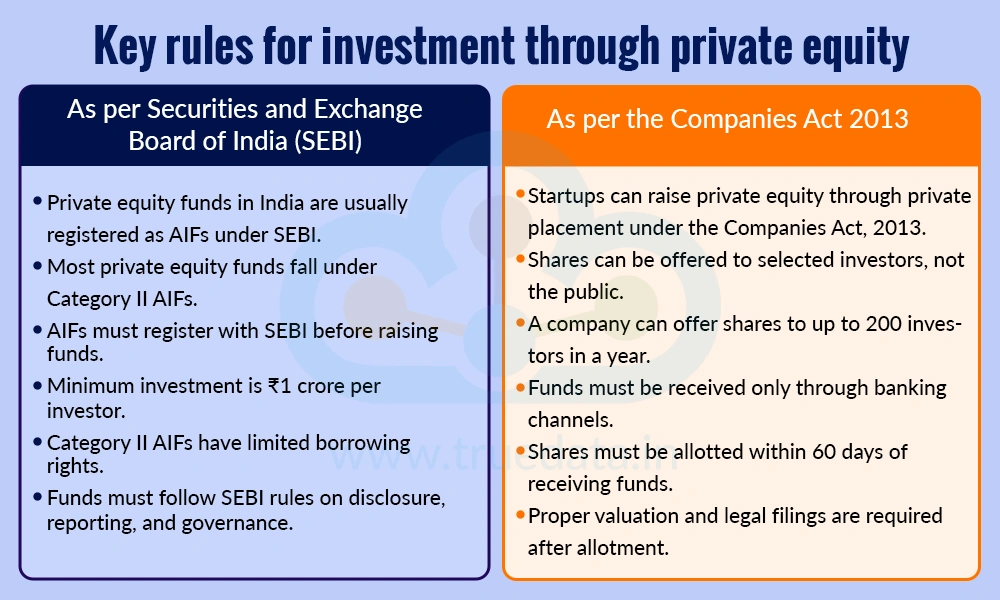
The key rules under SEBI and the Companies Act 2013 for investment through private equity include,

The key rules under SEBI and the Companies Act 2013 for investment through private equity

  • As per the Securities and Exchange Board of India (SEBI) - 

    • Private equity funds in India are usually registered as Alternate Investment Funds (AIFs) under SEBI regulations.

    • They mostly fall under Category II AIFs, which include private equity and debt funds.

    • AIFs must register with SEBI before raising money from investors.

    • There is a minimum investment limit of Rs. 1,00,00,000 per investor (Rs. 25,00,000 for employees/directors of the fund).

    • Category II AIFs cannot borrow money except for short-term needs (up to 30 days, not exceeding 10% of investable funds).

    • Funds must follow rules on disclosure, reporting, and transparency to protect investors.

    • There are restrictions on how funds can be raised and deployed, ensuring proper governance.

  • As per the Companies Act 2013 -

    • Startups can raise private equity through private placement of shares, i.e, shares offered to a select group of investors (not the public), under section 42 of the Companies Act, 2013.

    • A company can offer shares to a maximum of 200 investors in a financial year (excluding qualified institutional buyers and employees under ESOPs).

    • The company must issue a private placement offer letter (PAS-4) to investors.

    • Funds must be received through banking channels only (no cash allowed).

    • Shares must be allotted within 60 days of receiving money, failing which, funds must be refunded.

    • Proper valuation of shares must be done to ensure fair pricing.

    • Companies must file the necessary forms (PAS-3) with the Registrar of Companies after allotment.

What is Venture Capital?

What is Venture Capital

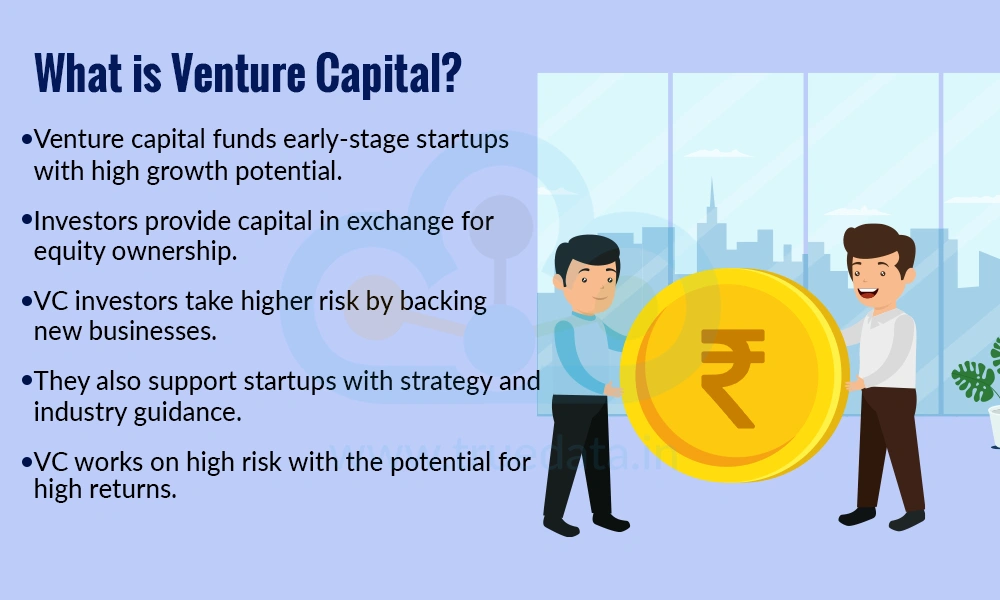
Venture capital (VC) is a type of funding where investors provide money to early-stage startups that have high growth potential but may not yet be profitable. Venture capitalists take higher risk by investing in new or emerging businesses, often at the idea, seed, or early growth stage, in exchange for equity (ownership). Unlike traditional funding, VC investors do not just provide money, they often guide founders with strategy, connections, and industry expertise to help the business scale faster. Since many startups can fail, venture capital works on the idea that a few successful investments can generate very high returns and make up for the losses.

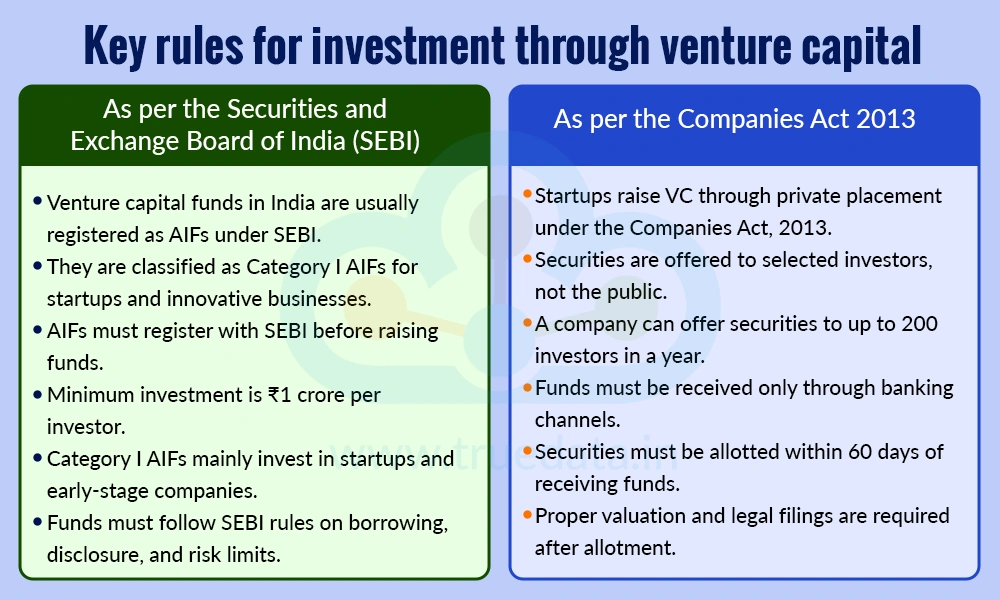
The key rules under SEBI and the Companies Act 2013 for investment through venture capital include,

The key rules under SEBI and the Companies Act 2013 for investment through venture capital

  • As per the Securities and Exchange Board of India (SEBI) - 

    • Venture capital funds are generally registered as Alternative Investment Funds (AIFs) under SEBI.

    • They are classified under Category I AIFs, which focus on startups, SMEs, and innovative businesses.

    • AIFs must register with SEBI before raising funds from investors.

    • There is a minimum investment of Rs. 1,00,00,000 per investor (Rs. 25,00,000 for employees/directors of the fund).

    • Category I AIFs must invest a large portion (generally at least 75%) of their funds in startups or early-stage companies.

    • Category I AIFs cannot borrow except for short-term needs (up to 30 days, capped at 10% of investable funds). 

    • Funds must follow strict disclosure and reporting norms to ensure transparency.

    • There are rules on diversification and how much can be invested in a single company to manage risk.

  • As per the Companies Act 2013 - 

    • Startups raise VC funding through private placement of shares or convertible instruments (like CCPS or CCDs) under Section 42 of the Companies Act 2013.

    • Shares/securities are offered to a select group of investors (not public).

    • A company can offer securities to a maximum of 200 investors in a financial year (excluding certain categories).

    • A private placement offer letter (PAS-4) must be issued.

    • Money must come through banking channels only (no cash transactions allowed).

    • Securities must be allotted within 60 days of receiving funds, or the money must be refunded.

    • Valuation of shares must be done by a registered valuer or as per accepted methods.

    • Required filings (like PAS-3) must be submitted to the Registrar of Companies after allotment.

What are the Differences Between Private Equity and Venture Capital?

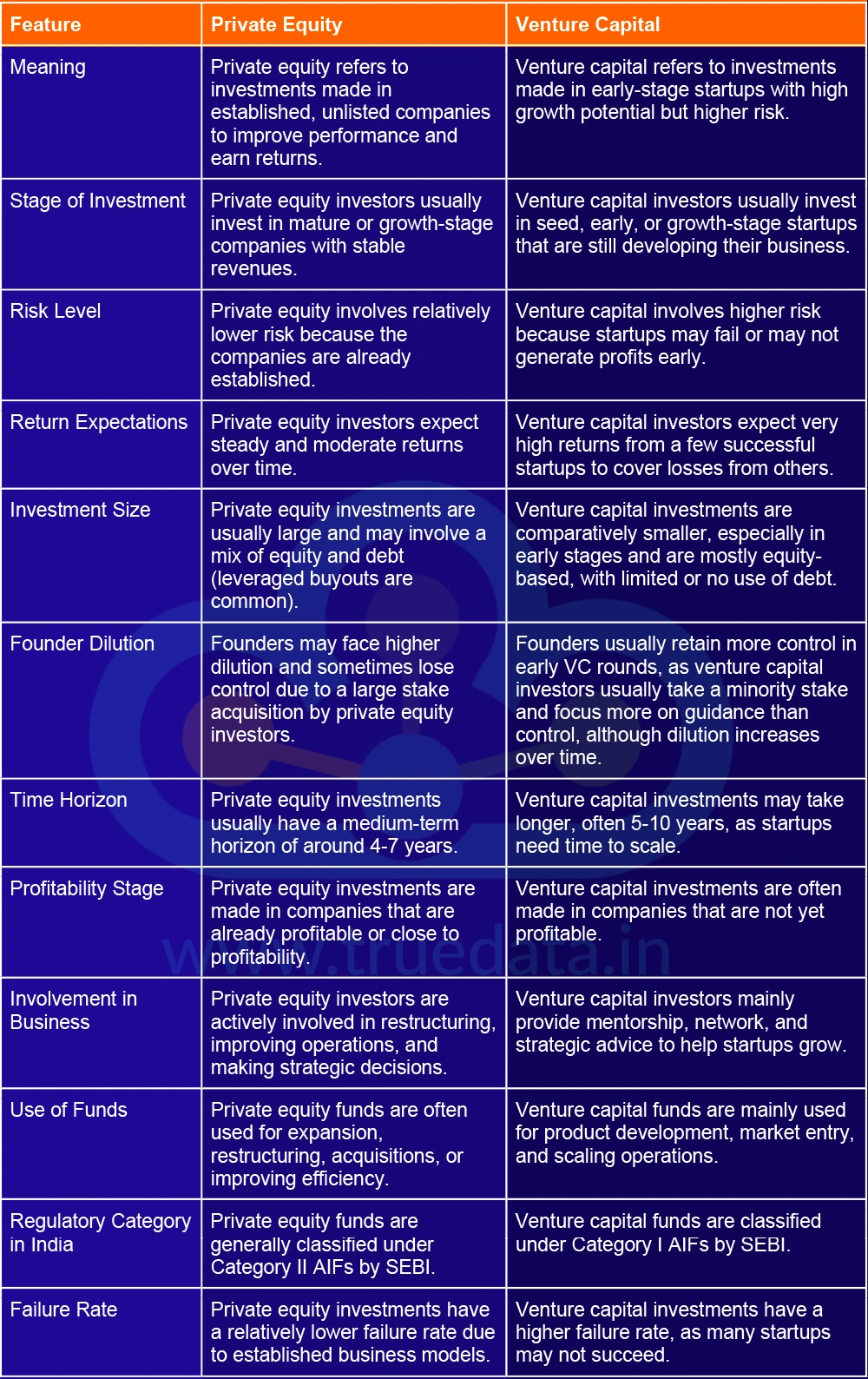
Now that we have seen the meaning and regulations governing the private equity and venture capital funding. Let us now focus on the key differences between them and how they impact a startup.

What are the Differences Between Private Equity and Venture Capital

Feature

Private Equity 

Venture Capital

Meaning 

Private equity refers to investments made in established, unlisted companies to improve performance and earn returns.

Venture capital refers to investments made in early-stage startups with high growth potential but higher risk.

Stage of Investment

Private equity investors usually invest in mature or growth-stage companies with stable revenues.

Venture capital investors usually invest in seed, early, or growth-stage startups that are still developing their business.

Risk Level

Private equity involves relatively lower risk because the companies are already established.

Venture capital involves higher risk because startups may fail or may not generate profits early.

Return Expectations

Private equity investors expect steady and moderate returns over time.

Venture capital investors expect very high returns from a few successful startups to cover losses from others.

Investment Size

Private equity investments are usually large and may involve a mix of equity and debt (leveraged buyouts are common).

Venture capital investments are comparatively smaller, especially in early stages and are mostly equity-based, with limited or no use of debt.

Founder Dilution

Founders may face higher dilution and sometimes lose control due to a large stake acquisition by private equity investors.

Founders usually retain more control in early VC rounds, as venture capital investors usually take a minority stake and focus more on guidance than control, although dilution increases over time.

Time Horizon

Private equity investments usually have a medium-term horizon of around 4-7 years.

Venture capital investments may take longer, often 5-10 years, as startups need time to scale.

Profitability Stage

Private equity investments are made in companies that are already profitable or close to profitability.

Venture capital investments are often made in companies that are not yet profitable.

Involvement in Business

Private equity investors are actively involved in restructuring, improving operations, and making strategic decisions.

Venture capital investors mainly provide mentorship, network, and strategic advice to help startups grow.

Use of Funds

Private equity funds are often used for expansion, restructuring, acquisitions, or improving efficiency.

Venture capital funds are mainly used for product development, market entry, and scaling operations.

Regulatory Category in India

Private equity funds are generally classified under Category II AIFs by SEBI.

Venture capital funds are classified under Category I AIFs by SEBI.

Failure Rate

Private equity investments have a relatively lower failure rate due to established business models.

Venture capital investments have a higher failure rate, as many startups may not succeed.

How to Choose Between Private Equity and Venture Capital?

How to Choose Between Private Equity and Venture Capital

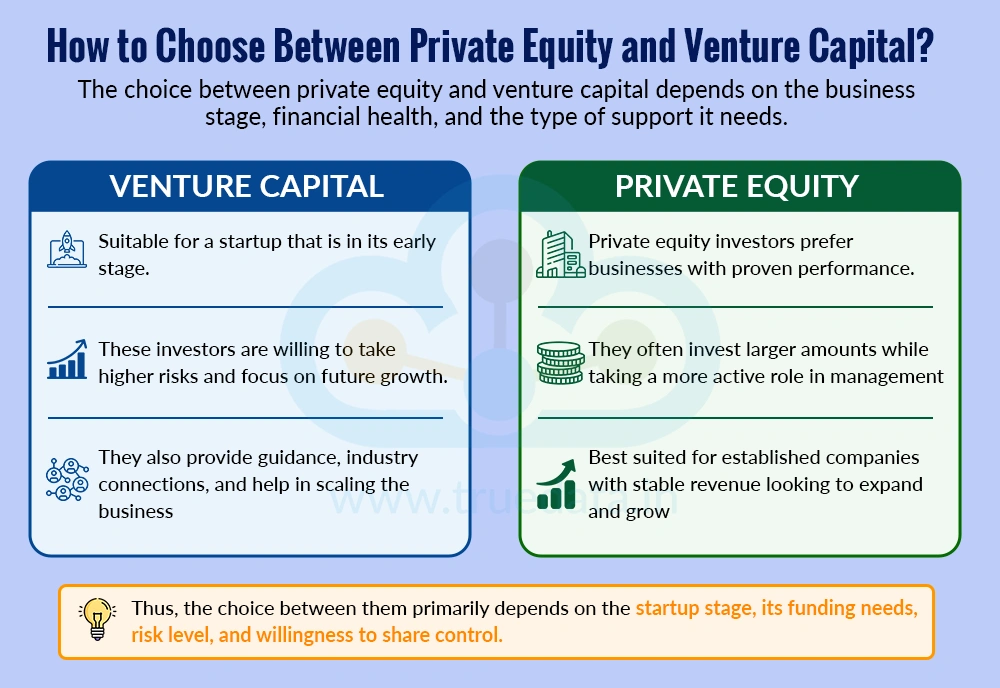
The choice between private equity and venture capital depends mainly on the stage of the business, its financial position, and the kind of support it needs. Venture capital can be a suitable option for a startup that is in its early stage (such as developing a product, testing the market, or just beginning to generate revenue), as these investors are willing to take higher risks and focus on future growth rather than current profits. They also provide guidance, industry connections, and help in scaling the business. 

On the other hand, private equity investors prefer businesses with proven performance and often invest larger amounts while taking a more active role in management. Hence, private equity becomes a better option for a company that is more established, has stable revenues, and is looking to expand operations, improve efficiency, or enter new markets. Thus, the choice between them primarily depends on the startup stage, its funding needs, risk level, and willingness to share control.

Conclusion

Private equity and venture capital are both important sources of funding, but they serve different purposes in a company’s journey. Venture capital supports early-stage startups with high growth potential, even if they are not yet profitable, while private equity focuses on more established businesses looking to expand or improve performance. The choice between the two depends on the stage of the business, its financial stability, and how much control the founders are willing to share.

This article is the next part in our series on startup funding, with a lot more to come in our upcoming posts. Let us know your thoughts on the topic or if you need further information on the same, and we will address it soon. 

Till then, Happy Reading!


Read More: Can You Buy and Sell Unlisted Shares?

Frequently Asked Questions

Private equity investments are usually large, often running into crores, as they are made in established businesses. Venture capital investments are smaller in the early stages and increase gradually as the startup grows through multiple funding rounds.

Yes, private equity usually takes lower risk by investing in established, stable businesses with predictable cash flows. Venture capital takes a higher risk by investing in early-stage startups, expecting that a few big successes will make up for many failures.

Private equity investors usually exit by selling their stake to another company or investor, or through an IPO once the business has grown. Venture capital investors typically exit through IPOs, acquisitions, or by selling their shares in later funding rounds to bigger investors.

A company usually needs a strong idea, a capable team, and high growth potential, even if profits are not yet there to attract venture capital. A company typically needs proven performance, steady revenues, and clear plans for expansion or value improvement to attract private equity.

Private equity often uses a mix of equity and borrowed money (leverage) to fund deals and improve returns. Venture capital mainly invests through equity with little or no debt, as early-stage startups may not have stable cash flows to support borrowing.
Marisha Bhatt

Marisha Bhatt is a financial content writer @TrueData.
She writes with the sole aim of simplifying complex financial concepts and jargon while attempting to clarify technical and fundamental analysis concepts of the stock markets. The ultimate goal is to spread vital knowledge and benefit the maximum audience. Her Chartered Accountant background acts as the knowledge base to help clarify crucial concepts and create a sound investment portfolio.

0 Comments

Related Articles

SEE ALL
Corporate Data
Corporate Data
Investing Smarter: The Power of Corporate Data and Market Sentiment Analysis

Thestock market never stands still, and prices swing constantly with every new h...

Corporate Data
Corporate Data
Solvency and Leverage Ratios - Debt and Equity Ratios

Debt and equity together form the total capital of a company. However, when anal...

Corporate Data
Corporate Data
Understanding Quarterly vs Annual Corporate Data

Corporate data is more than just the numbers of a company. They can show what is...