15-MIN DELAYED
NIFTY 25,607.20 -277.30 (-1.07%) | BANKNIFTY 63,040.90 -494.40 (-0.78%) | SENSEX 83,339.26 -989.34 (-1.17%) | CRUDEOIL-I 7,736.00 -140.00 (-1.78%) | GOLD-I 1,25,350.00 +3,189.00 (+2.61%) | NIFTY 25,607.20 -277.30 (-1.07%) | BANKNIFTY 63,040.90 -494.40 (-0.78%) | SENSEX 83,339.26 -989.34 (-1.17%) | CRUDEOIL-I 7,736.00 -140.00 (-1.78%) | GOLD-I 1,25,350.00 +3,189.00 (+2.61%) |
TrueData
Helpline / Support +91 7304-22-44-66
Get started

WORKSPACE

Workspace overview Workspace overview Our flagship product SignalX SignalX web charting for indian market Sheets Sheets streaming spreadsheet Wealth Wealth corporate data and news


Built for India's markets.

Real-time charts, streaming spreadsheets, live corporate announcements — all in one workspace.

Get started free

What are Lot Sizes in Futures and Options?

Marisha Bhatt · 28 Nov 2026 · 12 mins read · 0 Comments

what-are-lot-sizes-in-futures-and-options

Have you ever wondered why you cannot buy just one share of a stock in the Futures and Options (F&O) market, even if you want to? Unlike the cash market, where you can buy shares individually, derivatives trading requires you to trade in a fixed quantity known as a lot size. But how is this quantity decided, and why does it matter when placing a trade? Understanding lot sizes can help you calculate your trading capital, manage risk, and make more informed decisions in the F&O market. Let us explore what lot sizes are, how they work, and what traders should know before entering a derivatives trade.

What are Lot Sizes in Futures and Options?

What are Lot Sizes in Futures and Options

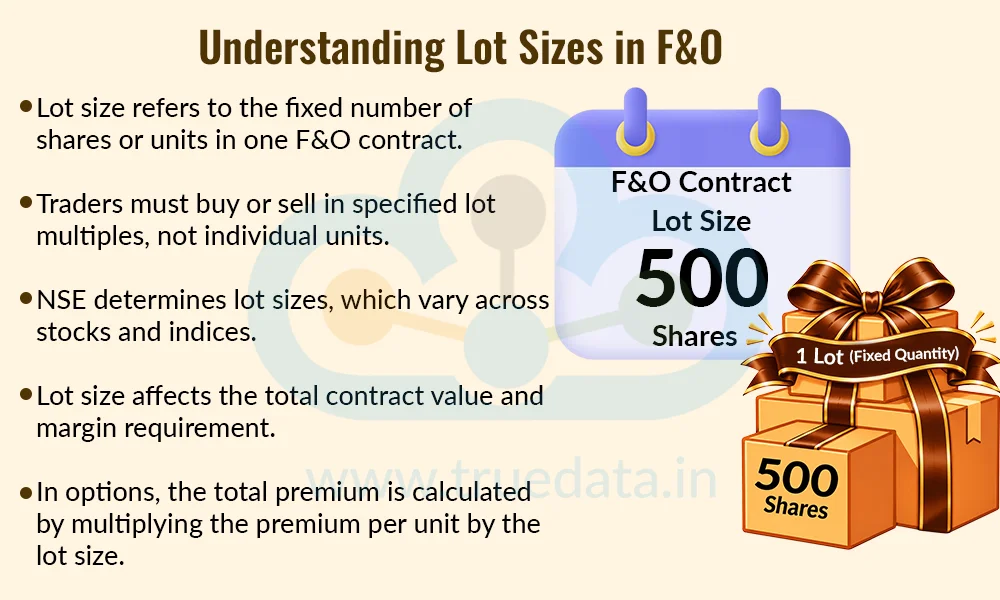
A lot size in Futures and Options (F&O) refers to the fixed number of units of an underlying stock or index covered by a single derivatives contract. Unlike the cash market, where investors can buy even one share of a company, the F&O market requires traders to buy or sell contracts in specified quantities called lots. For example, if a stock futures contract has a lot size of 500 shares, a trader must trade in multiples of 500, such as 500, 1,000, or 1,500 shares, rather than just 100 shares. Stock exchanges, such as the National Stock Exchange (NSE), specify lot sizes under the applicable regulatory framework, and these can vary across stocks and indices. 

Lot size also affects the total contract value and the capital required to take a position. For example, if a futures contract has a lot size of 500 shares and each share is priced at Rs. 200, the total contract value would be Rs. 1,00,000 (500 * Rs. 200). However, a trader may need to deposit only a portion of this amount as margin to take a futures position. In options trading, the lot size determines the number of underlying units covered by one options contract, while the total premium is calculated by multiplying the option premium per unit by the lot size. Understanding lot sizes helps investors and traders estimate their market exposure, plan their trading capital, and manage risk more effectively before entering an F&O trade.

How Are Lot Sizes Decided for Futures and Options?

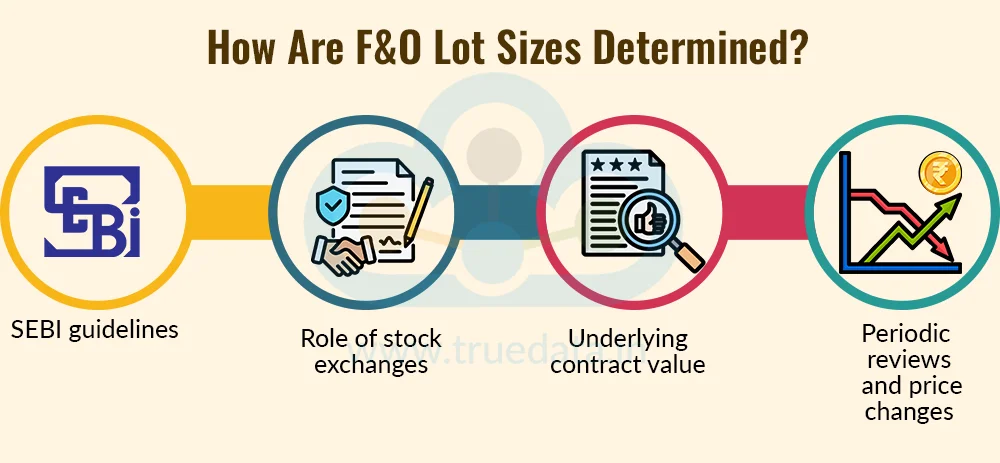
Lot sizes in the Futures and Options (F&O) market are determined by considering SEBI guidelines, stock exchange rules, and the value of the underlying stock or index. The following factors play an important role in deciding lot sizes.

How Are Lot Sizes Decided for Futures and Options

  • SEBI guidelines - The Securities and Exchange Board of India (SEBI) sets the regulatory framework for derivatives trading, including rules on contract sizes and lot-size reviews. These guidelines aim to maintain an orderly market and support investor protection. For example, under the framework introduced in October 2024, new index derivative contracts must have a value of at least Rs. 15,00,000 when introduced, while the lot size is set to keep the contract value between Rs. 15,00,000 and Rs. 20,00,000 on the review date. 

  • Role of stock exchanges - Exchanges determine the specific lot sizes for eligible stocks and indices in line with SEBI's guidelines. They also publish contract specifications and review lot sizes periodically. For a given underlying stock or index, the permitted lot size applies to its futures and options contracts, subject to exchange rules. 

  • Underlying contract value - The price of the stock or index helps determine how many units should be included in one lot. Contract value is generally calculated by multiplying the underlying price by the lot size. For example, if a hypothetical stock is priced at Rs. 1,000 and the required contract value is Rs. 5,00,000, the lot size would be 500 shares (Rs. 5,00,000 / Rs. 1,000). For index derivatives, the applicable contract value range differs under SEBI's framework. 

  • Periodic reviews and price changes - Since stock and index prices change over time, exchanges review lot sizes periodically and may revise them when required. NSE's published framework provides for a review every six months, using the underlying's average closing price over the previous month for index derivatives. Any revision is announced in advance, and its applicability depends on the exchange's rules for existing and new contracts.

Why are Lot Sizes Important in Futures and Options?

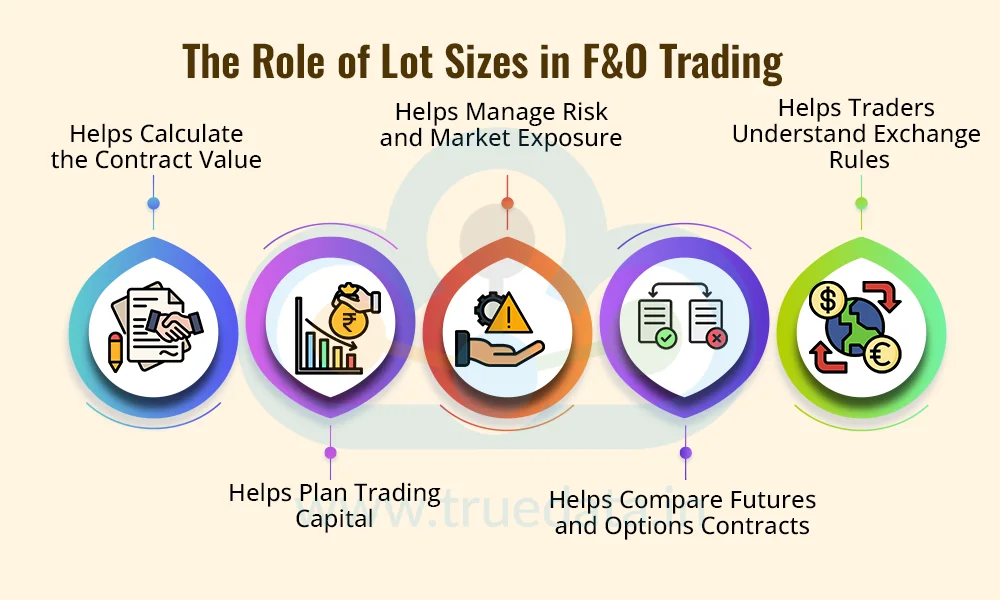
Lot sizes play an important role in Futures and Options (F&O) trading because they determine the number of units a trader must buy or sell in a single contract. Understanding lot sizes helps investors and traders estimate their market exposure, plan their trading capital, and manage risks more effectively. The following factors explain why lot sizes matter in the derivatives market.

Why are Lot Sizes Important in Futures and Options

  • Helps Calculate the Contract Value - Lot size helps traders determine the total value of a futures or options contract. Contract value is generally calculated by multiplying the underlying stock or index value by the lot size. For example, if a hypothetical stock is priced at Rs. 500 and its futures contract has a lot size of 200 shares, the total contract value is Rs. 1,00,000 (Rs. 500 × 200). Knowing this value helps traders understand the size of the position they are taking in the market.

  • Helps Plan Trading Capital - Lot sizes influence the amount of money required to enter an F&O trade. In popular trading, traders generally deposit a margin instead of paying the entire contract value upfront. In options buying, the buyer typically pays the premium multiplied by the lot size. For instance, if an option has a premium of Rs. 20 per unit and a lot size of 200, the total premium payable for one lot is Rs. 4,000 (Rs. 20 * 200), excluding applicable charges. Understanding these calculations helps traders plan their available capital before placing an order.

  • Helps Manage Risk and Market Exposure - A lot size determines how much a trader can gain or lose when the underlying stock or index moves in price. For example, if a futures contract has a lot size of 200 shares, a Rs. 5 change in the underlying price can result in a Rs. 1,000 change in the position's value (Rs. 5 * 200), before charges. A larger lot size can increase the impact of price movements, while a smaller lot size can allow more flexibility in managing position sizes. Traders should consider their risk tolerance and potential losses before entering a trade.

  • Helps Compare Futures and Options Contracts - Lot sizes help traders understand the quantity covered by different derivatives contracts. For example, two stocks may have different lot sizes because their prices and contract specifications differ. Even if one stock has a larger lot size than another, its total contract value may not necessarily be higher. Comparing lot size along with the underlying price, margin requirements, and option premium gives traders a clearer picture of the capital and exposure involved.

  • Helps Traders Understand Exchange Rules - Stock exchanges such as the National Stock Exchange (NSE) specify lot sizes for eligible stock and index derivatives under the applicable regulatory framework. Traders cannot usually choose an arbitrary quantity that is smaller than one lot when trading these contracts. Exchanges may also revise lot sizes from time to time, so traders should check the latest contract specifications before placing an order. This is particularly important for traders who follow a regular strategy or hold positions across different expiry dates.

How to Calculate Lot Size and Contract Value?

How to Calculate Lot Size and Contract Value

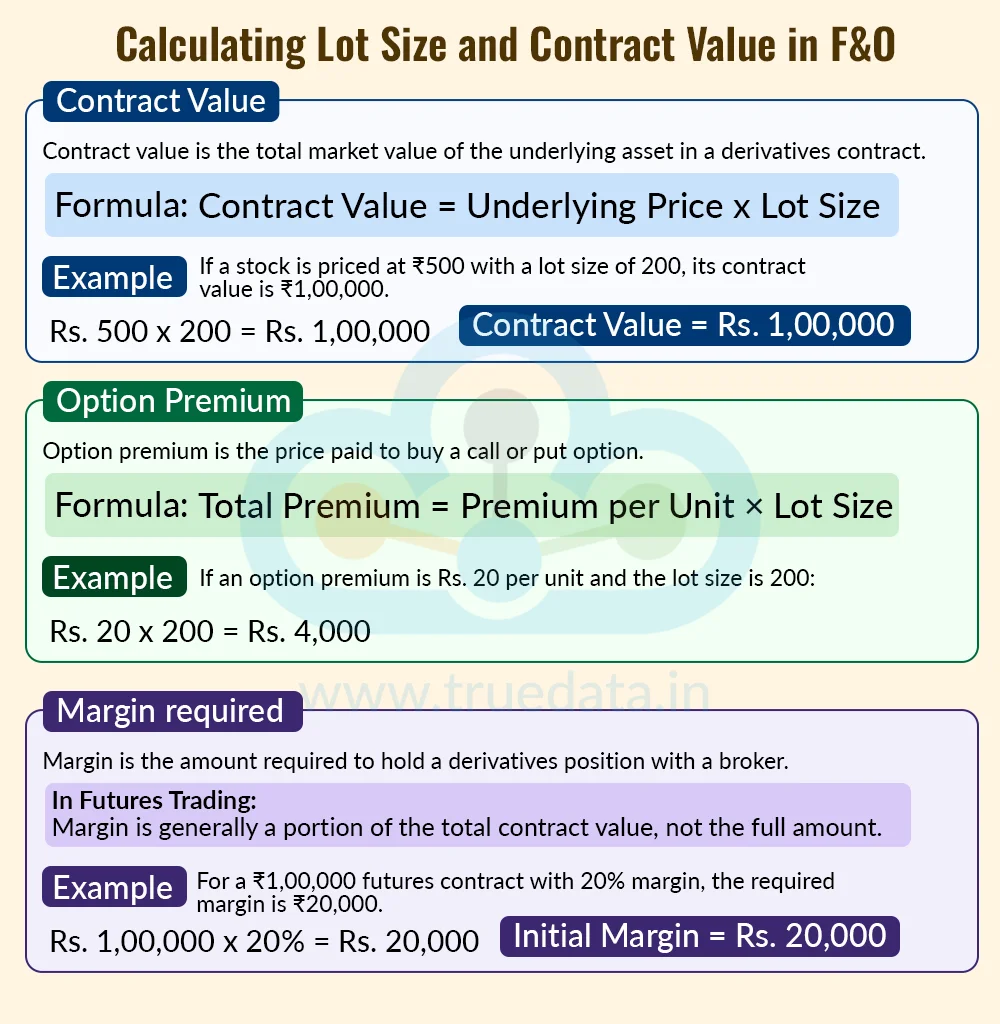
Calculating lot size and contract value helps investors and traders understand the financial commitment involved in Futures and Options (F&O) trading. Before entering a trade, it is important to distinguish between the total contract value, the option premium, and the margin required, as each represents a different amount.

  • Contract value - Contract value refers to the total market value of the underlying stock or index covered by a derivatives contract. It is calculated by multiplying the underlying price by the lot size. For example, if a hypothetical stock is priced at Rs. 500 and its futures contract has a lot size of 200 shares, the contract value is Rs. 1,00,000 (Rs. 500 * 200).

  • Option premium - An option premium is the price paid by an options buyer to purchase a call or put option. It is quoted per unit, so the total premium for one lot is calculated by multiplying the premium per unit by the lot size. For example, if an option premium is Rs. 20 per unit and the lot size is 200, the buyer pays Rs. 4,000 (Rs. 20 * 200), excluding applicable charges. The option buyer's maximum loss is generally limited to the premium paid, plus applicable charges, if the option expires worthless. An option seller, however, faces a different risk profile and generally needs to maintain the required margin.

  • Margin required - Margin is the amount a trader must maintain with the broker to take or hold certain derivatives positions. In futures trading, the margin is generally only a portion of the total contract value, rather than the full amount. For example, if a futures contract is worth Rs. 1,00,000 and the applicable margin requirement is hypothetically 20%, the initial margin would be Rs. 20,000. The actual margin depends on exchange requirements, the underlying, market conditions, and the position held. It can change, and additional funds may be required if the market moves against the trader.

Calculation of Lot Sizes

Calculation of Lot Sizes

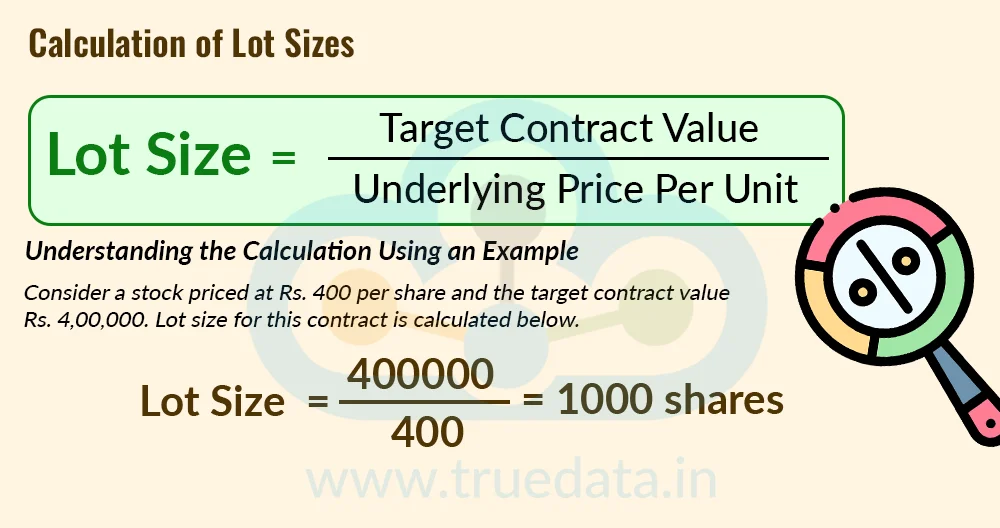
Lot size refers to the number of units of the underlying stock or index covered by one derivatives contract. The lot size for a given contract value can be calculated using the following formula

Lot Size = Target Contract Value / Underlying Price Per Unit

Understanding the Calculation Using an Example

Consider a stock priced at Rs. 400 per share and the target contract value Rs. 4,00,000. Lot size for this contract is calculated below. 

Lot Size = Target Contract Value / Underlying Price Per Unit

Lot Size = 400000 / 400 = 1000 shares

Calculation of Contract Value

Calculation of Contract Value

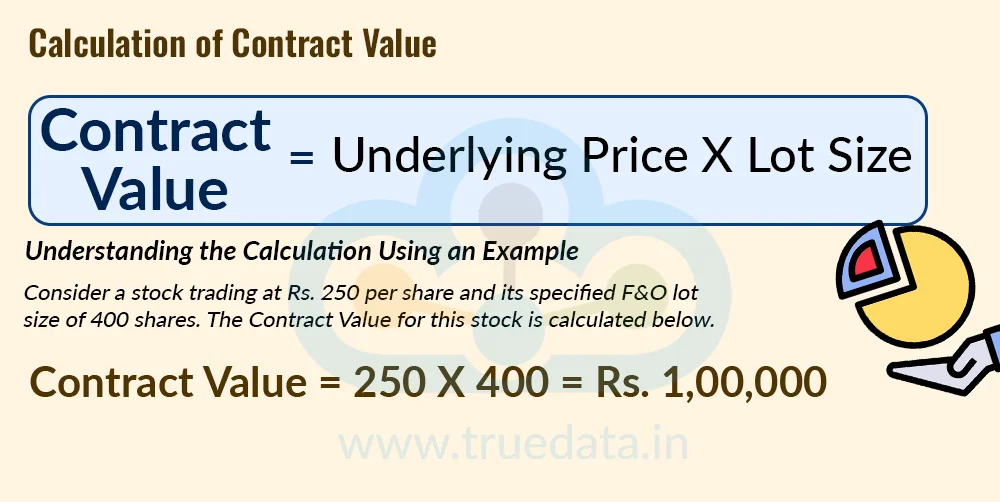
Once the lot size is known, the total contract value can be calculated using this formula. 

Contract Value = Underlying Price * Lot Size

Understanding the Calculation Using an Example

Consider a stock trading at Rs. 250 per share and its specified F&O lot size of 400 shares. The Contract Value for this stock is calculated below. 

Contract Value = Underlying Price * Lot Size

Contract Value = 250 * 400 = Rs. 1,00,000

What Are the Current Lot Sizes of Index and Stock F&O Contracts?

Lot sizes determine the number of units covered by a single Futures and Options (F&O) contract. The lot sizes vary across indices and individual stocks, and stock exchanges may revise these quantities periodically under the applicable SEBI framework.

Lot sizes of Index F&O Contracts

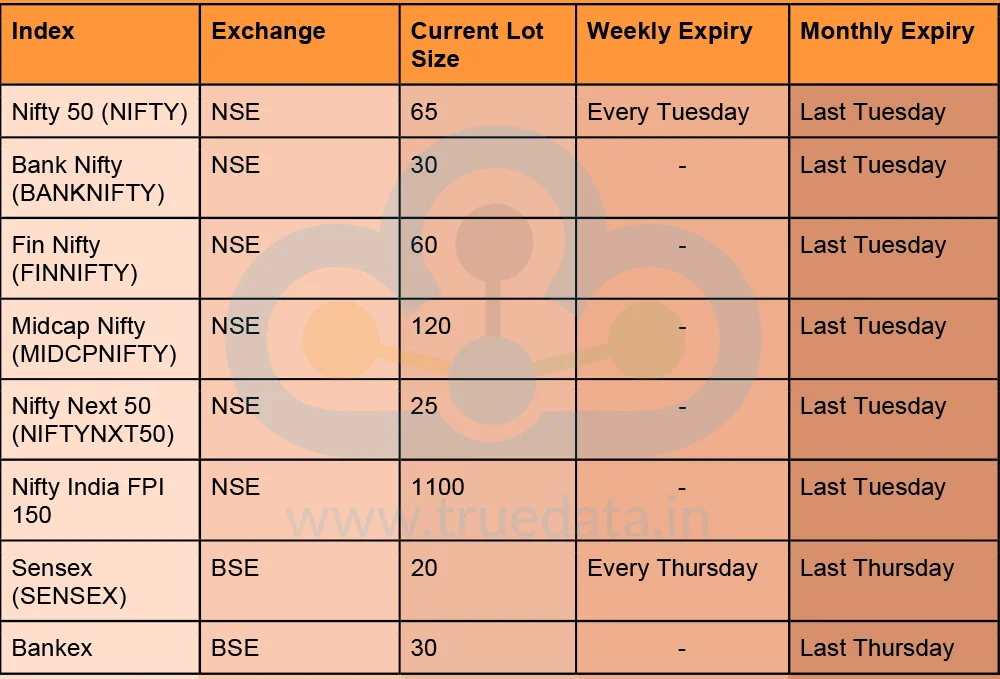
The current lot sizes for indices on NSE and BSE are,

Lot sizes of Index F&O Contracts

Index

Exchange

Current Lot Size

Weekly Expiry

Monthly Expiry

Nifty 50 (NIFTY)

NSE

65

Every Tuesday

Last Tuesday

Bank Nifty (BANKNIFTY)

NSE

30

- 

Last Tuesday

Fin Nifty (FINNIFTY)

NSE

60

-

Last Tuesday

Midcap Nifty (MIDCPNIFTY)

NSE

120

-

Last Tuesday

Nifty Next 50 (NIFTYNXT50)

NSE

25

-

Last Tuesday

Nifty India FPI 150

NSE

1100

-

Last Tuesday

Sensex (SENSEX)

BSE

20

Every Thursday

Last Thursday

Bankex

BSE

30

-

Last Thursday

Lot Sizes of Selected Stocks F&O Contracts

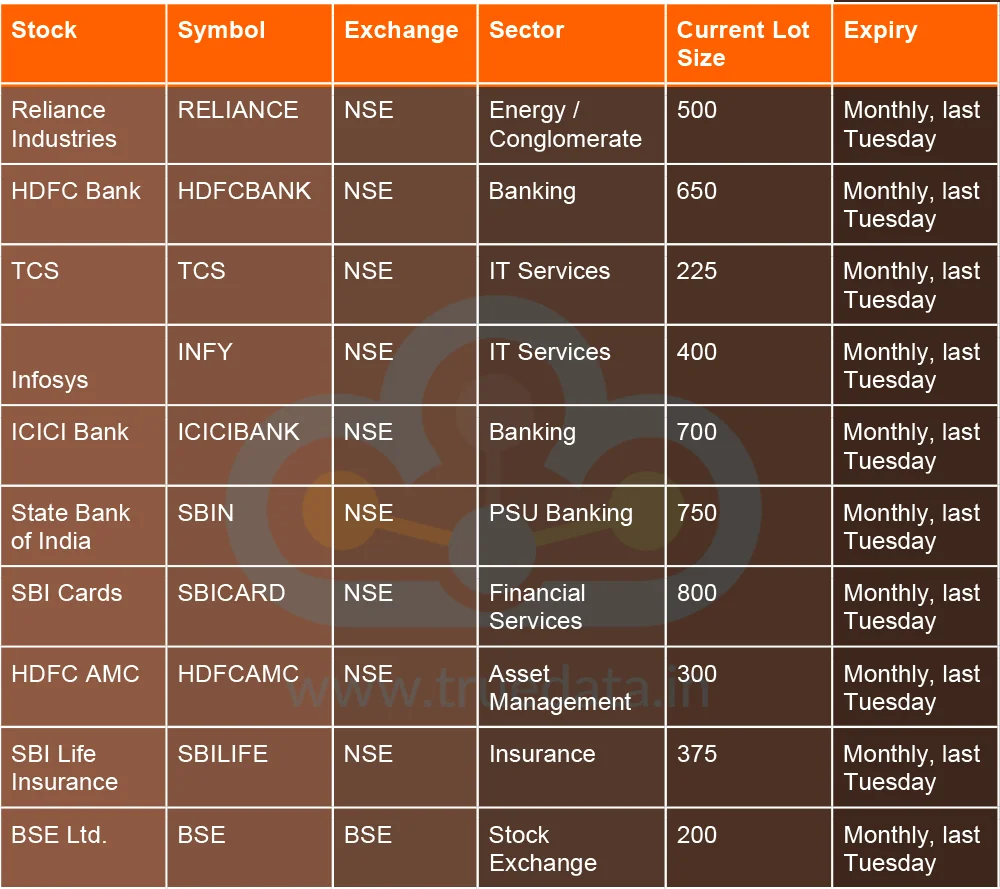
The lot size for individual stocks represents the number of shares covered by one futures or options contract. The following are examples from recent lot-size references.

Lot Sizes of Selected Stocks F&O Contracts

Stock

Symbol

Exchange

Sector

Current Lot Size

Expiry

Reliance Industries

RELIANCE

NSE

Energy / Conglomerate

500

Monthly, last Tuesday

HDFC Bank

HDFCBANK

NSE

Banking

650

Monthly, last Tuesday

TCS

TCS

NSE

IT Services

225

Monthly, last Tuesday


Infosys

INFY

NSE

IT Services

400

Monthly, last Tuesday

ICICI Bank

ICICIBANK

NSE

Banking

700

Monthly, last Tuesday

State Bank of India 

SBIN

NSE

PSU Banking

750

Monthly, last Tuesday

SBI Cards

SBICARD

NSE

Financial Services

800

Monthly, last Tuesday

HDFC AMC

HDFCAMC

NSE

Asset Management

300

Monthly, last Tuesday

SBI Life Insurance

SBILIFE

NSE

Insurance

375

Monthly, last Tuesday

BSE Ltd. 

BSE

BSE

Stock Exchange

200

Monthly, last Tuesday

How to Find F&O Lot Sizes Easily Using Sheets by TrueData?

How to Find F&O Lot Sizes Easily Using Sheets by TrueData

Before placing a futures or options (F&O) trade, it is important to know the lot size of the underlying index or stock. Since lot sizes can differ across F&O contracts and may be revised by the exchanges, checking the applicable lot size can help traders calculate contract quantities and estimate their trade value more accurately.

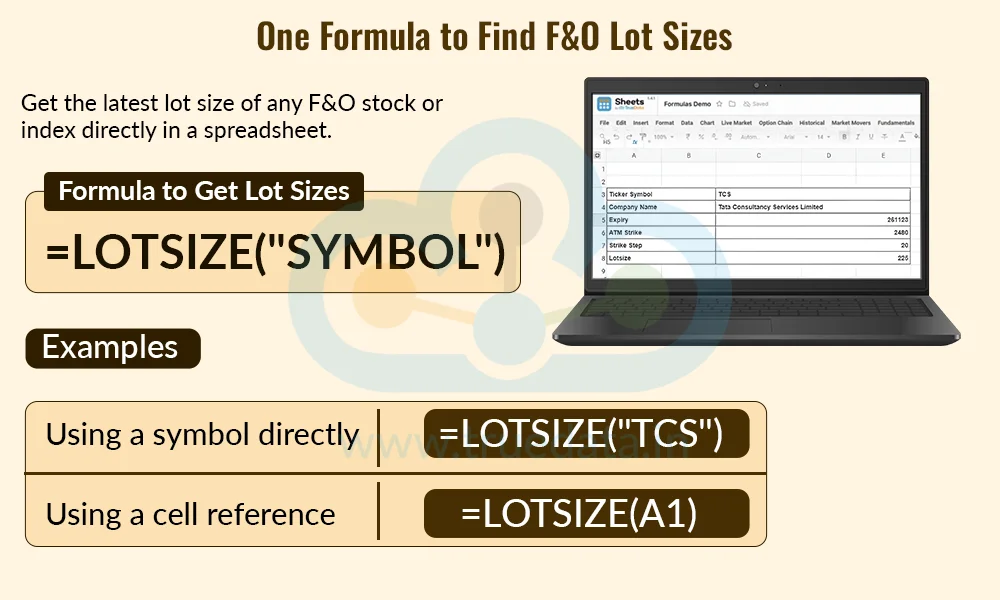
Instead of searching for the lot size of each stock or index manually, traders can use Sheets by TrueData, which offers a dedicated LOTSIZE formula to fetch lot-size information directly into a spreadsheet. This makes it easier to organise lot sizes for multiple F&O symbols in one place

Formula to Get Lot Sizes in Sheets by TrueData

The formula for Lot Sizes is,

=LOTSIZE("SYMBOL")

For example, to fetch the lot size of a symbol, enter its name within the formula. You can also refer to a cell containing the symbol instead of typing the name directly.

  • Using a symbol directly - =LOTSIZE("TCS")

  • Using a cell reference - =LOTSIZE(A1)

In the second example, if cell A1 contains TCS, the formula fetches the lot size associated with that symbol

Can Lot Sizes Be Modified?

Can Lot Sizes Be Modified

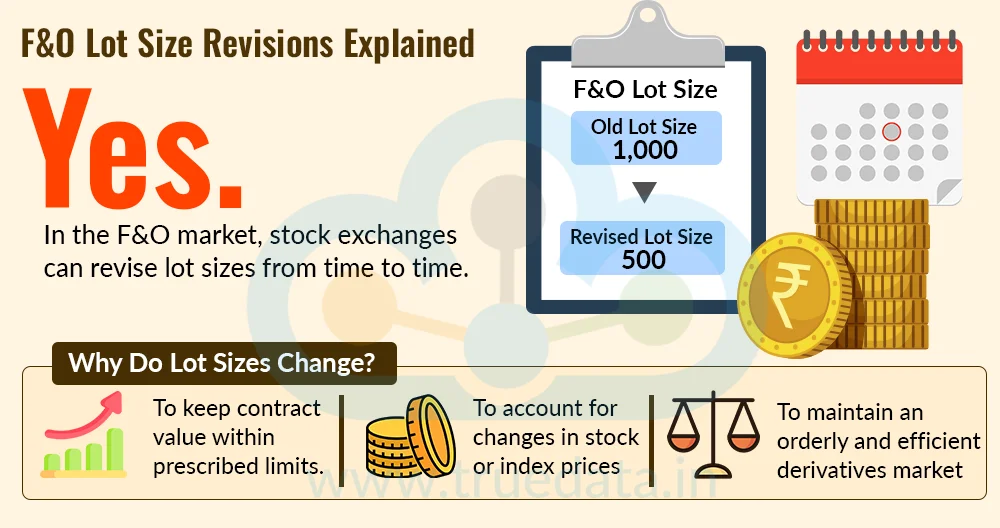
The lot sizes in the Futures and Options (F&O) market can change from time to time. SEBI establishes the regulatory framework for derivatives contracts, while stock exchanges such as the National Stock Exchange (NSE) and the Bombay Stock Exchange (BSE) specify and publish the applicable lot sizes. These quantities may be revised to keep contract values within the prescribed limits, account for changes in stock or index prices, and maintain an orderly derivatives market. For example, if the price of a stock rises significantly, the exchange may reduce its lot size to keep the total contract value within the applicable range. Similarly, a lot size may be increased when the underlying price falls, subject to the exchange's rules. Such revisions do not necessarily apply to every contract immediately; the exchange announces when the revised lot sizes will take effect for specific expiry months. Therefore, investors and traders should regularly check the latest exchange circulars and contract specifications before placing an F&O trade.

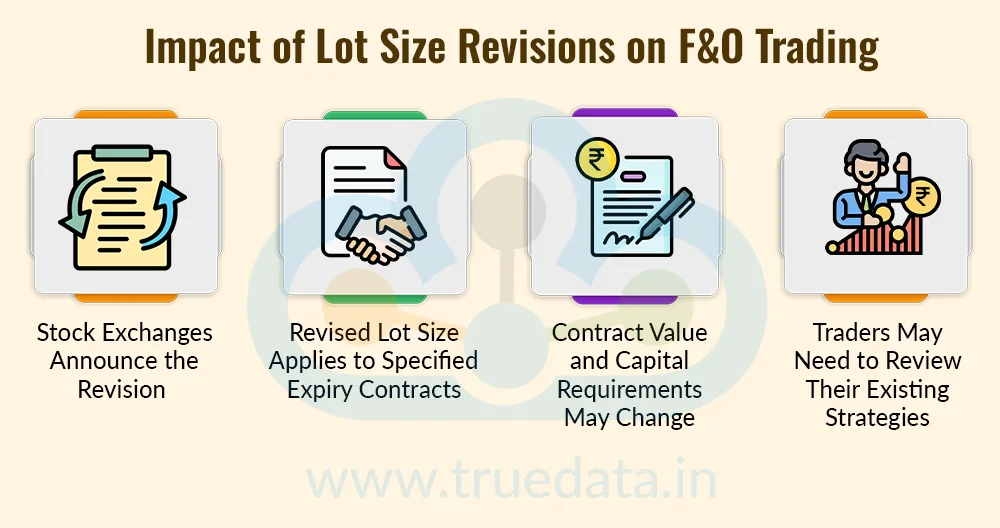
What Happens When Lot Sizes Are Revised?

What Happens When Lot Sizes Are Revised

When the lot sizes are revised, investors have to consider the following to make informed portfolio decisions. 

  • Stock Exchanges Announce the Revision - When a lot size is revised, the stock exchange issues a circular specifying the affected stocks or indices, the revised quantities, and the dates from which the changes will apply. Traders can refer to these announcements to understand which contracts will be affected.

  • Revised Lot Size Applies to Specified Expiry Contracts - A lot-size revision may apply only to contracts expiring in particular months. Depending on the exchange's circular, existing contracts may continue with their original lot sizes, while contracts introduced for later expiries may follow the revised quantities. Traders should check the applicable expiry rather than assume that every contract changes immediately.

  • Contract Value and Capital Requirements May Change - A change in lot size affects the total quantity covered by a contract and, consequently, its contract value. For example, if a stock is priced at Rs. 500, reducing the lot size from 500 shares to 250 shares reduces the contract value from Rs. 2,50,000 to Rs. 1,25,000, assuming the price remains unchanged. The margin required for futures and option-selling positions may also change, depending on the applicable margin rules.

  • Traders May Need to Review Their Existing Strategies - A revised lot size can affect position sizing, trading capital, and risk management. Traders who regularly trade multiple lots should check whether the revised quantities suit their available capital and risk tolerance. They should also verify how their broker and the exchange handle existing positions and orders during the transition.

Conclusion

Understanding lot sizes is an important part of Futures and Options (F&O) trading, as they determine the quantity covered by a contract and influence its total value, capital requirements, and potential risk. By knowing how lot sizes are decided, calculating contract values, and checking the latest exchange specifications, investors and traders can plan their trades more effectively. Since lot sizes may change for specific expiry contracts, checking the latest exchange updates before placing an order can help traders make informed decisions and manage their market exposure better.

This article explains a simple yet crucial part of F&O trading. Let us know your thoughts on the topic or if you need further information, and we will address it soon.

Till then, Happy Reading!


Read More: What is options expiration? Strategies to Avoid Traps on Options Expiration Day 

Frequently Asked Questions

Investors can find the lot size and expiry date of an F&O contract on their broker’s trading platform or the official NSE website under the equity derivatives contract information section. They should check the specific contract and expiry month, as lot sizes and expiry dates may vary across contracts.

No, investors and traders generally cannot buy or sell less than one lot in Futures and Options (F&O) trading in India. They must trade in multiples of the specified lot size, such as one, two, or three lots, depending on their trading requirements.

Lot size is the fixed number of units covered by one options contract, while quantity refers to the total number of units traded. For example, if an options contract has a lot size of 65 units, buying 2 lots means trading a total quantity of 130 units.

A larger lot size generally increases the contract value and may increase the margin required for futures and options selling positions. The actual margin depends on the contract, market conditions, and exchange requirements, while options buyers generally pay the total premium upfront rather than a margin.

Yes, futures and options contracts for the same stock generally have the same lot size on Indian stock exchanges. However, traders should check the latest exchange contract specifications, as lot sizes may change for specific expiry contracts.

If a stock’s lot size changes after an options contract is purchased, the exchange’s rules determine how existing contracts are handled, and the change may apply only to contracts with specified expiry dates. Traders should check the relevant exchange circular and their broker’s updates to understand how the revision affects their existing position.

The minimum trading quantity is one lot. Currently, Nifty 50 options have a lot size of 65 units, while Bank Nifty options have a lot size of 30 units for the applicable NSE contracts.
Marisha Bhatt

Marisha Bhatt is a financial content writer @TrueData.

She writes with the sole aim of simplifying complex financial concepts and jargon while attempting to clarify technical and fundamental analysis concepts of the stock markets. The ultimate goal is to spread vital knowledge and benefit the maximum audience. Her Chartered Accountant background acts as the knowledge base to help clarify crucial concepts and create a sound investment portfolio.

0 Comments

Related Articles

SEE ALL
Investing / Trading
Investing / Trading
High-Frequency Trading vs Algorithmic Trading

Financial markets are becoming faster and more technology-driven, but what reall...

Investing / Trading
Investing / Trading
How do I download BSE and NSE stock prices in Excel in real time?

NSE Stock Prices in Excel in Real Time - Microsoft Excel is a super software cap...

Investing / Trading
Investing / Trading
Max Pain Theory - Does It Really Work?

Options trading has grown exponentially in India. However, it is still quite tri...

Relevant Tags