Stock markets in India often react sharply to global events such as tariff policies, trade negotiations, and geopolitical conflicts like the recent tensions in the Middle East. During such times, markets may correct suddenly, leaving investors uncertain about their next move. If you are investing through SIPs, you might wonder whether to continue, pause, or stop your investments during these market downturns. Are you facing the same dilemma? Dive into this blog where we explore how SIPs work during market corrections and whether staying invested can help you make smarter long-term decisions.
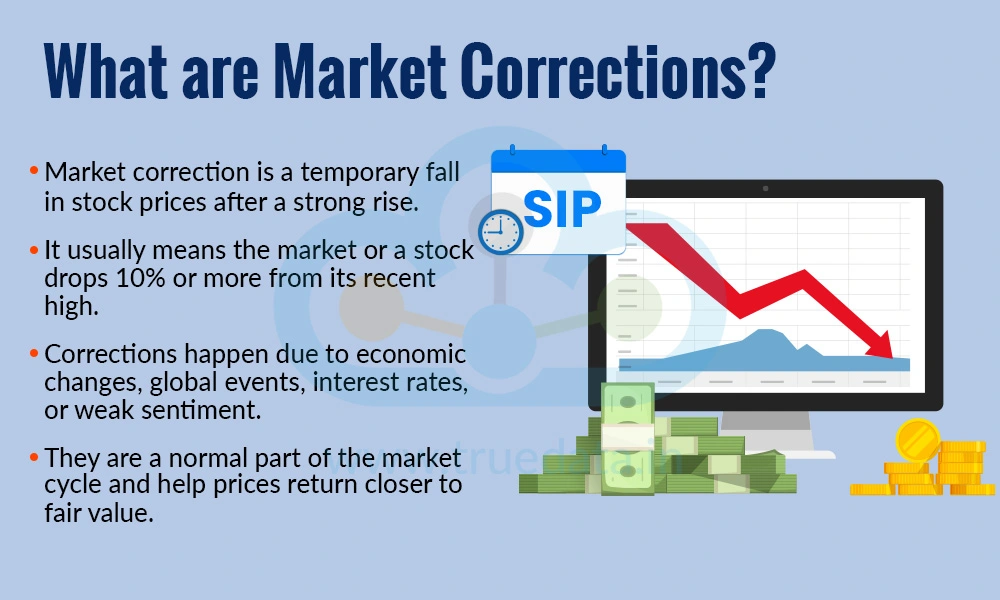
Market corrections refer to a temporary fall in stock prices after a period when markets or certain stocks have risen quickly. In simple terms, a correction usually means the market or a stock has dropped around 10% or more from its recent peak. Unlike the small daily ups and downs caused by normal buying and selling, corrections happen when investors start adjusting their expectations due to factors such as global events, economic changes, rising interest rates, or company performance concerns. During this phase, many stocks may fall together because overall market sentiment becomes cautious. Even shares of fundamentally strong companies can decline for a short period because investors become more risk-averse. Although market corrections can reduce portfolio values temporarily and create panic among investors, they are considered a normal and healthy part of the market cycle, as they help bring stock prices closer to their fair value and prevent markets from becoming excessively overvalued.
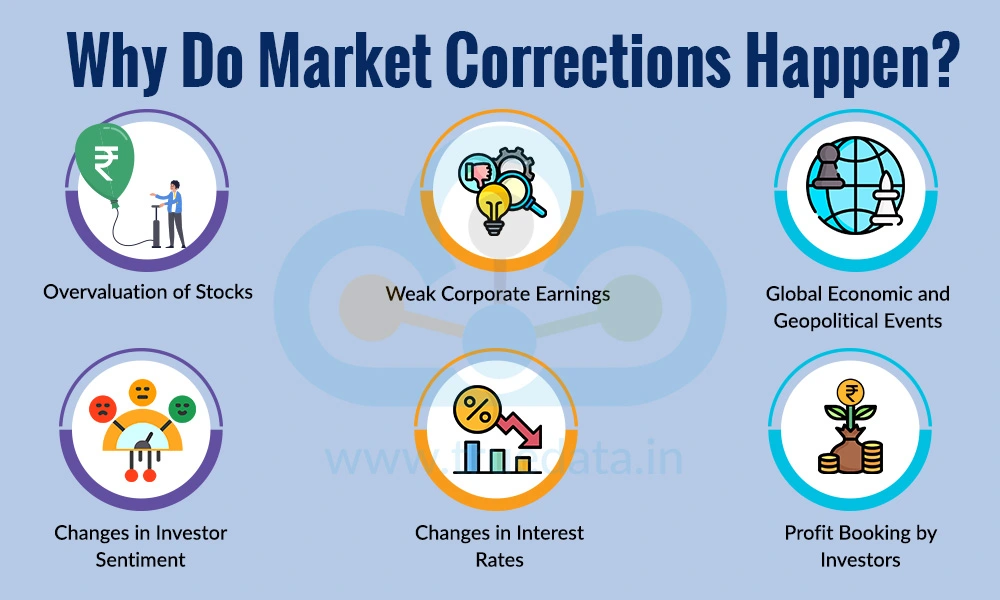
Market corrections usually occur when stock prices fall after a period of rapid growth or when investors react to changes in economic conditions. While short-term ups and downs are normal in the market, corrections often occur when investors reassess the value of stocks based on new information or changing circumstances. This decline can be triggered by several factors, such as
Overvaluation of Stocks - One common reason for market corrections is when stock prices rise too quickly and become higher than what the company’s fundamentals justify. When investors realise that prices have moved ahead of actual earnings, growth prospects, or valuations, they start selling their holdings. This selling pressure causes stock prices to fall, bringing them closer to more reasonable levels.
Weak Corporate Earnings - Stock prices are closely linked to a company’s financial performance. If companies report lower-than-expected earnings or weak growth forecasts, investors may lose confidence in those stocks. When many companies report disappointing results, it can affect the broader market and trigger a correction.
Global Economic and Geopolitical Events - Global events such as wars, trade tensions, economic slowdowns, or political instability can create uncertainty in financial markets. When investors feel uncertain about the future, they often become cautious and reduce their exposure to stocks. Such events can trigger widespread selling, leading to market corrections.
Changes in Investor Sentiment - Stock markets are influenced not only by economic data but also by investor psychology. Fear, uncertainty, or negative news can quickly change how investors feel about the market. When sentiment turns negative, investors may rush to sell their holdings, which can accelerate the decline in stock prices.
Changes in Interest Rates - Interest rates play a significant role in stock market movements. When central banks raise interest rates to control inflation, borrowing becomes more expensive for companies and consumers. Higher interest rates can slow economic growth and reduce corporate profits, which can lead investors to sell stocks and cause market prices to fall.
Profit Booking by Investors - After a long period of rising markets, many investors choose to lock in their gains by selling some of their investments. This is known as profit booking. When a large number of investors start selling to secure their profits, the increase in supply of stocks in the market can push prices downward, resulting in a correction.

Market corrections can have a noticeable impact on an investor’s portfolio as they lead to a temporary decline in stock prices. A fall in markets leads to a decline in the value of the stocks, mutual funds, or ETFs in the portfolio. While this can be worrying for many investors, it is important to understand that such declines are usually short-term adjustments and are a natural part of how markets function. The impact of market correction on portfolios is explained below.
Temporary Drop in Portfolio Value - The most immediate impact of market corrections is the drop in the overall value of investments or portfolio value. This is due to the significant fall in the stock prices of almost all the equities or mutual funds, making the portfolio appear diminished. However, this is just paper loss or notional loss unless investors actually book it. Thus, this loss can be recovered over time once the markets revive and stabilise.
Impact on Investor Confidence - Market corrections have a drastic impact on the overall investor confidence. A decrease in the value of the portfolio can lead investors to question their decisions. This may trigger them to sell off fundamentally strong investments that may be part of the temporary downturn. However, such emotional decisions can sometimes result in missing out on future market recoveries.
Optimum Buying Opportunities - While corrections reduce portfolio values in the short term, they can also create opportunities for investors. When stock prices fall, good quality companies may become available at more reasonable valuations. Long-term investors can use such periods to accumulate more investments at lower prices, which may benefit them when markets recover in the future.
Higher Volatility in Investments - During market corrections, price movements tend to become more volatile. Stocks may move up and down sharply within a short period as investors react to news and market sentiment. This volatility can make the market feel uncertain and unpredictable, which may cause stress for investors who closely track their portfolios.
Long-Term Impact Depends on Investment Strategy - The long-term impact of a market correction largely depends on the investor’s strategy and time horizon. Investors with a long-term perspective often see corrections as temporary setbacks rather than permanent losses. Diversified portfolios and disciplined investing methods, such as Systematic Investment Plans (SIPs), can help investors manage the impact of market fluctuations more effectively.
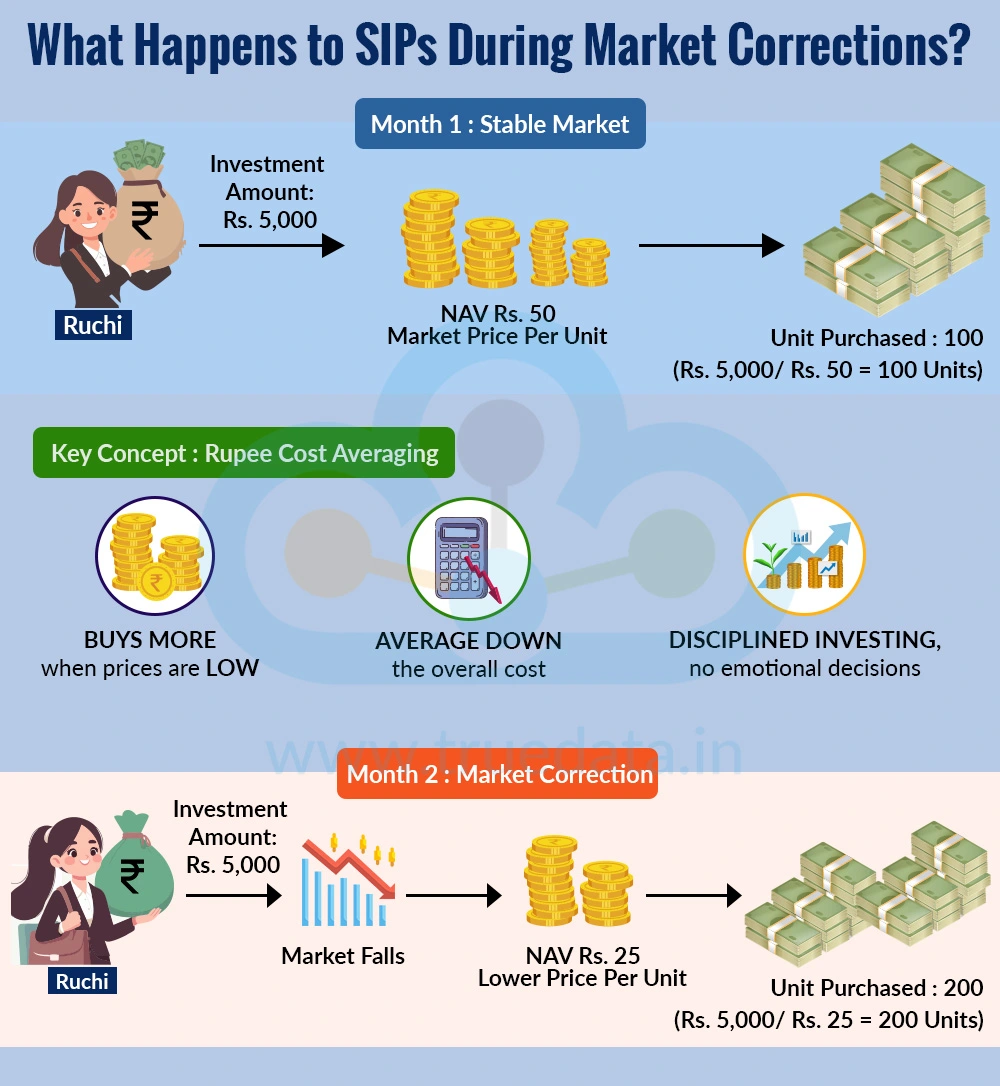
During market corrections, SIP (Systematic Investment Plan) investments continue as usual, but they become more effective for long-term investors. Due to the reduction in stock prices during this period, the same fixed SIP amount buys more units of a mutual fund compared to when markets are high. This is known as rupee cost averaging, where SIP investments automatically enable investors to invest more when prices are low and less when prices are high, helping reduce the average cost of their investment over time. Although the value of existing investments may temporarily decline during a correction, continuing the SIPs allows investors to accumulate more units at lower prices. This can benefit them when the market eventually recovers. This disciplined approach helps investors avoid emotional decisions and keeps investments aligned with long-term financial goals.
Let us understand this with a simple example.
Consider Ruchi, who invests Rs. 5,000 every month in a mutual fund. In the first month, the NAV is Rs. 50, so she gets 100 units through the SIP investment. Next month, due to a market correction, if the NAV falls to Rs. 25, she will get 200 units for the same Rs. 5,000 SIP. Therefore, even though the market has fallen, Ruchi has accumulated more units at a lower price. Thus, when the market recovers and the NAV rises again, the value of her total investments will increase faster as she owns more units due to the market correction.
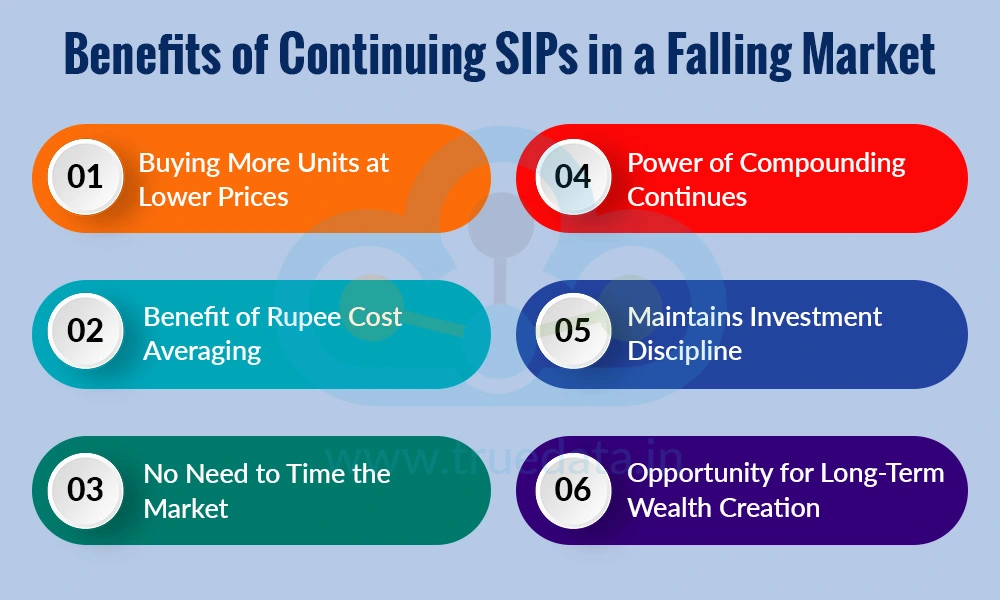
Continuing SIP (Systematic Investment Plan) investments during a falling market may feel uncomfortable for many investors, but it can be a smart approach for those focused on long-term goals. Market corrections are usually temporary, and staying consistent with investments allows investors to take advantage of lower prices and gradually build wealth over time. Instead of reacting to short-term market movements, disciplined investing through SIPs helps maintain a steady and goal-oriented approach.
Buying More Units at Lower Prices - When markets decline, the NAV (price) of mutual funds also falls. This enables investors to purchase more units with the same SIP amount. Over time, this leads to a higher accumulation of units, which can result in better returns when the market recovers and prices rise again.
Benefit of Rupee Cost Averaging - SIPs follow the principle of rupee cost averaging, where a fixed amount is invested regularly regardless of market conditions. This ensures that investors automatically buy more units when prices are low and fewer units when prices are high. As a result, the overall average cost of investment reduces over time, which can improve returns in the long run.
No Need to Time the Market - Predicting market movements accurately is very difficult, even for experienced investors. By continuing SIPs during a falling market, investors avoid the need to time their entry and exit. This reduces the chances of making wrong decisions, such as stopping investments during a downturn and missing out on the eventual recovery.
Power of Compounding Continues - Regular SIP investments ensure that money stays invested for a longer duration. This allows the power of compounding to work effectively, where the returns generated also start earning returns over time. Staying invested during market corrections helps strengthen this compounding effect and supports long-term wealth creation.
Maintains Investment Discipline - Market downturns can create fear and uncertainty, leading some investors to make emotional decisions. Continuing SIPs during such periods helps maintain financial discipline and prevents actions like stopping investments or redeeming funds at a loss. This disciplined approach is important for achieving long-term financial goals.
Opportunity for Long-Term Wealth Creation - Falling markets often provide an opportunity to invest in quality mutual funds at lower valuations. Investors who continue their SIPs during such phases can benefit from market recovery over time, as the units purchased at lower prices contribute to higher gains in the future.
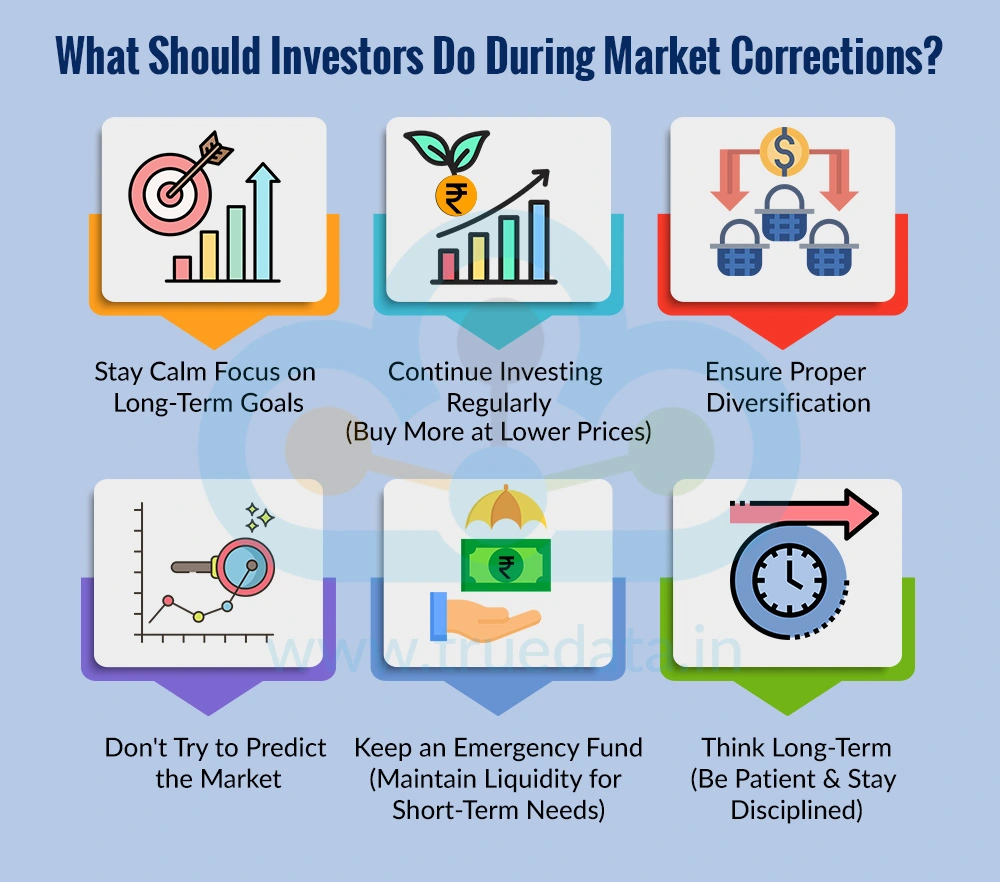
During market corrections, investors should focus on staying calm and sticking to their long-term financial plan instead of reacting to short-term market movements. Rather than stopping SIPs or selling investments in panic, investors should continue investing regularly, as lower market levels provide an opportunity to accumulate more units at reduced prices. It is also important for investors to review their portfolios and ensure they are well-diversified across asset classes, aligned with their risk tolerance and financial goals. If needed, they may rebalance their portfolio to maintain the right allocation. At the same time, investors should avoid trying to time the market, as predicting exact market movements is difficult and can lead to missed opportunities. Keeping an emergency fund and maintaining liquidity for short-term needs can also help investors avoid withdrawing investments during a downturn. Overall, a disciplined, patient, and goal-oriented approach can help investors navigate market corrections more effectively and benefit from long-term market growth.
Market corrections are routine changes of stock markets that can be triggered by multiple factors. While these corrections can have a deep impact on the portfolio, they are an excellent investment opportunity for long-term investors. Thus, to continue investing even during market corrections is a safe bet for investors to meet their long-term goals.
This blog explains the nature of SIPs and the reaction to market corrections, along with investor behaviour. Let us know your thoughts on the topic or if you have any queries on the same, and we will address them soon.
Till then, Happy Reading!
Read More: What is Loss Aversion? Is It Bad For Your Portfolio?

Marisha Bhatt is a financial content writer @TrueData.
She writes with the sole aim of simplifying complex financial concepts and jargon while attempting to clarify technical and fundamental analysis concepts of the stock markets. The ultimate goal is to spread vital knowledge and benefit the maximum audience. Her Chartered Accountant background acts as the knowledge base to help clarify crucial concepts and create a sound investment portfolio.

Mutual fund investments have simplified greatly with just a tap on your smartpho...

Introduction For the longest time, investment in stock markets was thought to b...

Every investor knows that the stepping stones to a good investment in thestock m...
