An analysis of divergent paths among the world's three largest economies and their implications for global markets
Economic Snapshots: Comparative analysis of key indicators across the US, China, and Japan
Global Implications: How these divergent paths create market volatility and growth concerns
Detailed Country Analysis: In-depth examination of each economy's unique challenges and outlook
Strategic Considerations: Key factors to monitor and potential scenarios for investors
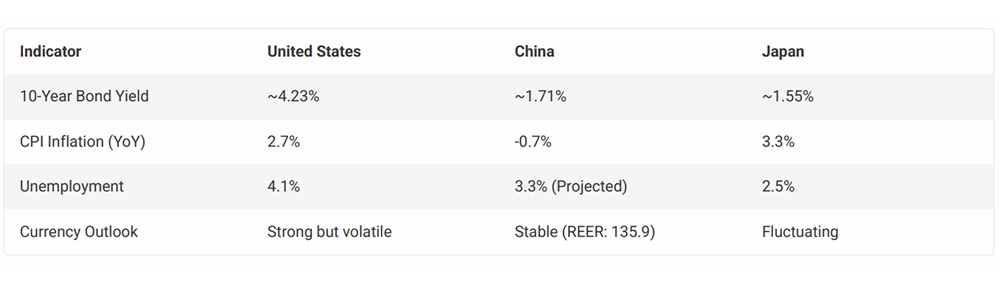
Comparative analysis of current economic indicators as of August 2025

Sources: National economic data as of August 1, 2025

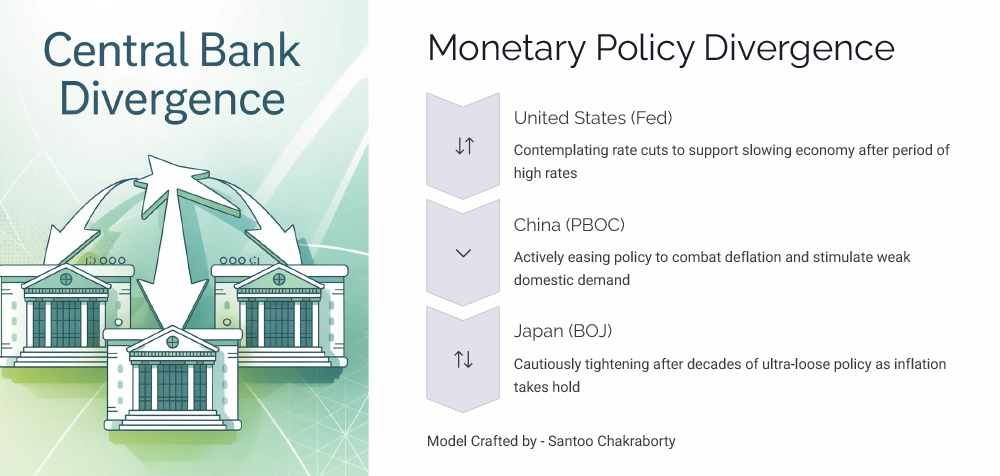
United States (Fed): Contemplating rate cuts to support slowing economy after period of high rates
China (PBOC): Actively easing policy to combat deflation and stimulate weak domestic demand
Japan (BOJ): Cautiously tightening after decades of ultra-loose policy as inflation takes hold

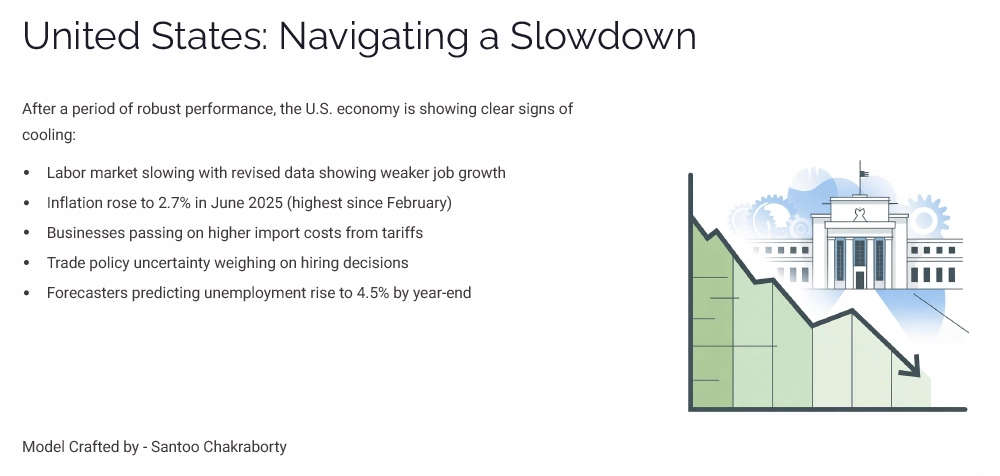
After a period of robust performance, the U.S. economy is showing clear signs of cooling:
Labor market slowing with revised data showing weaker job growth
Inflation rose to 2.7% in June 2025 (highest since February)
Businesses passing on higher import costs from tariffs
Trade policy uncertainty weighing on hiring decisions
4.23% 10-Year Treasury Yield Down from previous months, reflecting market anticipation of Fed rate cuts
2.7% Inflation Rate Second consecutive monthly increase, complicating Fed policy decisions
4.1% Unemployment Slight decrease in June 2025, but job growth expected to decelerate

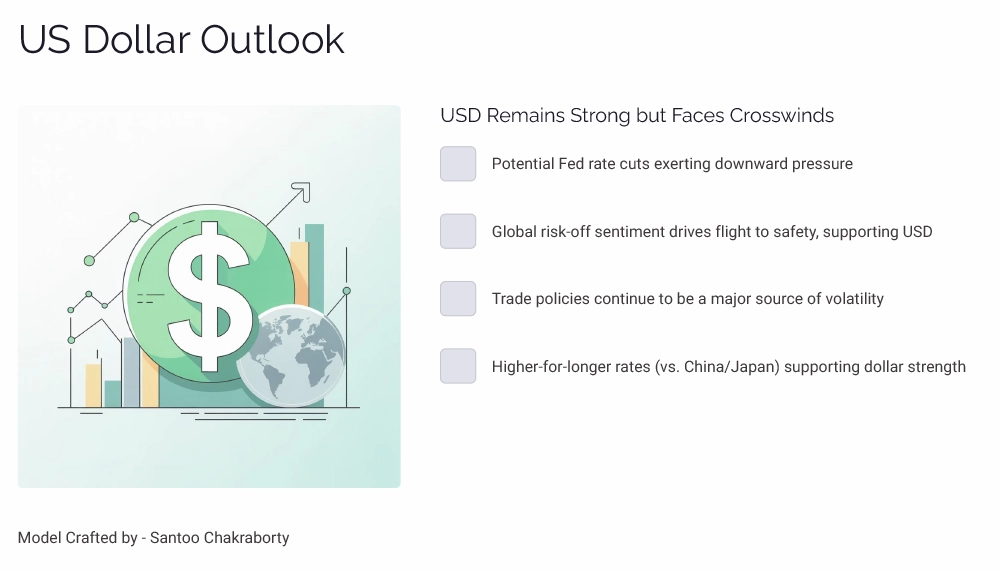
USD Remains Strong but Faces Crosswinds
Potential Fed rate cuts exerting downward pressure
Global risk-off sentiment drives flight to safety, supporting USD
Trade policies continue to be a major source of volatility

Weak domestic demand creating persistent deflationary pressures
CPI at -0.7% year-over-year (February 2025)
CPI decreased to 102.90 points in June from 103.00 in May
10-year government bond yield fallen to ~1.71%
Official unemployment projected at 3.3% for 2025 (down from 3.5%)
Statistics may mask underemployment amid slowing GDP growth
Workforce policy changes include gradual retirement age increases
10-year government bond yield fallen to ~1.71%
Managed for stability by monetary authorities
Real Effective Exchange Rate (REER) at 135.9 (January 2025)
Relatively strong in trade-weighted terms
Exchange rate against Indian Rupee around 12.19 in early 2025

This deflationary environment presents significant challenges for Chinese policymakers, with potential to export deflation globally through lower-priced exports and reduced commodity demand.

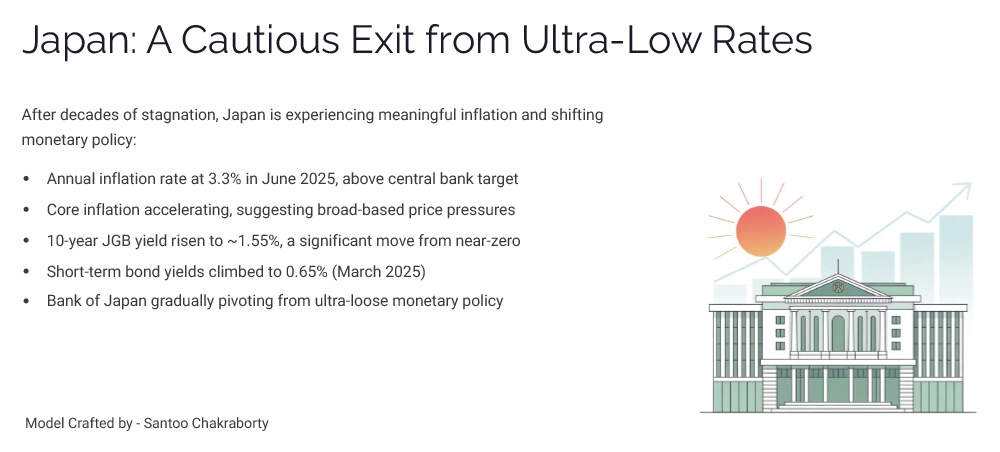
After decades of stagnation, Japan is experiencing meaningful inflation and shifting monetary policy:
Annual inflation rate at 3.3% in June 2025, above central bank target
Core inflation accelerating, suggesting broad-based price pressures
10-year JGB yield risen to ~1.55%, a significant move from near-zero
Short-term bond yields climbed to 0.65% (March 2025)
Unemployment rate steady at 2.5% (May 2025)
Female employment rate at record high
Overall employment rate improved
Historically low rates made JPY a carry trade target
Recent BOJ policy shifts introducing new dynamics
Future path dependent on normalization pace vs. other central banks
Potential for capital repatriation as domestic yields rise

This policy normalization could trigger significant capital flows as Japanese investors, who have deployed vast sums overseas in search of yield, may begin repatriating assets back to domestic markets where returns are finally improving.

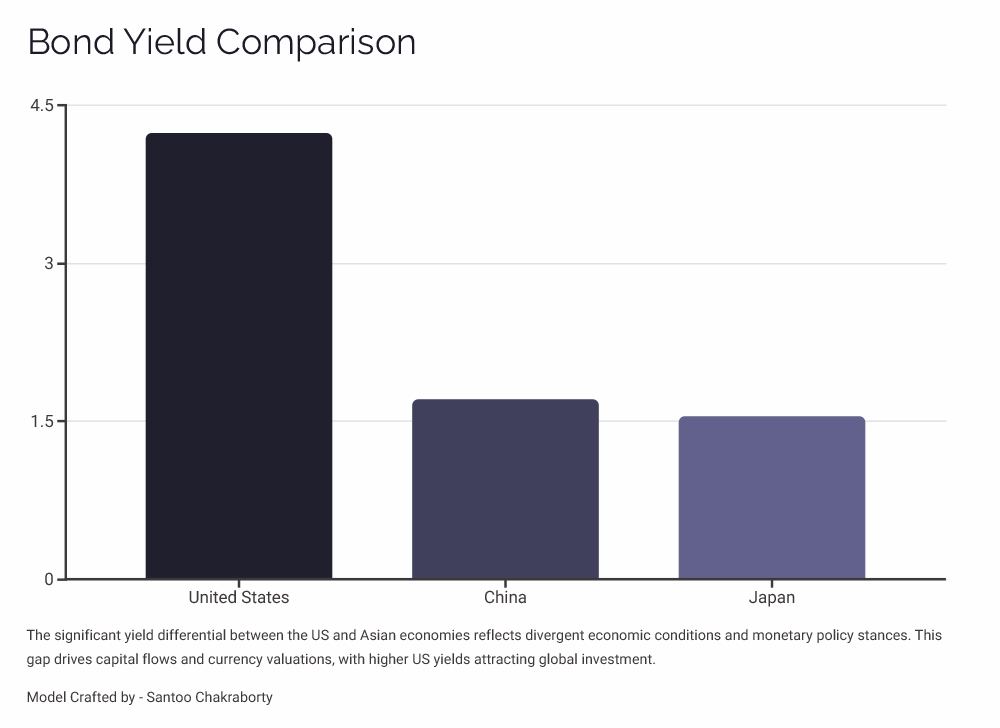
The significant yield differential between the US and Asian economies reflects divergent economic conditions and monetary policy stances. This gap drives capital flows and currency valuations, with higher US yields attracting global investment.

The stark contrast in inflation trajectories illustrates the divergent economic challenges: China battling deflation, Japan experiencing sustained inflation above target, and the US seeing a recent uptick after moderation.

The differing economic trajectories create a complex outlook with several key dynamics:
Policy Divergence: Asynchronous central bank policies creating capital flow volatility and currency fluctuations
Growth Concerns: Simultaneous US slowdown and Chinese weakness weighing heavily on global growth prospects
Contagion Risk: Deep interconnections magnifying policy impacts across borders through trade and financial channels
Higher-for-longer rates supporting strong dollar, pressuring emerging markets
Sharp US slowdown would reduce global demand, impacting export economies
Prolonged economic malaise disrupting global supply chains
Reduced demand for commodities affecting resource-rich economies
Potential to export deflation through lower-priced exports
Declining imports impacting corporate earnings globally
Monetary policy normalization potentially triggering capital repatriation
Disruption to global markets that have relied on Japanese liquidity
Changing carry trade dynamics affecting currency markets
Deflation Contagion: China's deflationary environment could spread globally through lower export prices and reduced commodity demand, creating a race to the bottom in global prices.
Policy Missteps: Central banks navigating unprecedented divergence face heightened risk of policy errors-cutting rates too soon or too late could amplify market volatility.
Capital Flow Disruption: Rapid shifts in interest rate differentials could trigger disorderly capital flows, especially if Japanese investors repatriate significant overseas investments.
Inflation Trajectories: Monitor persistence of US inflation, deepening of Chinese deflation, and sustainability of Japanese inflation
Bond Market Signals: Assess yield curve shapes, credit spreads, and foreign participation in sovereign debt markets
Trade Patterns: Evaluate impact of US tariffs, Chinese export competitiveness, and Japanese trade balances
Central Bank Actions: Watch for Fed rate cut timing, PBOC stimulus effectiveness, and BOJ normalization pace
Labor Market Dynamics: Track US job growth deceleration, Chinese youth unemployment, and Japanese wage growth
Currency Movements: Observe USD strength persistence, CNY stability, and JPY reaction to policy normalization

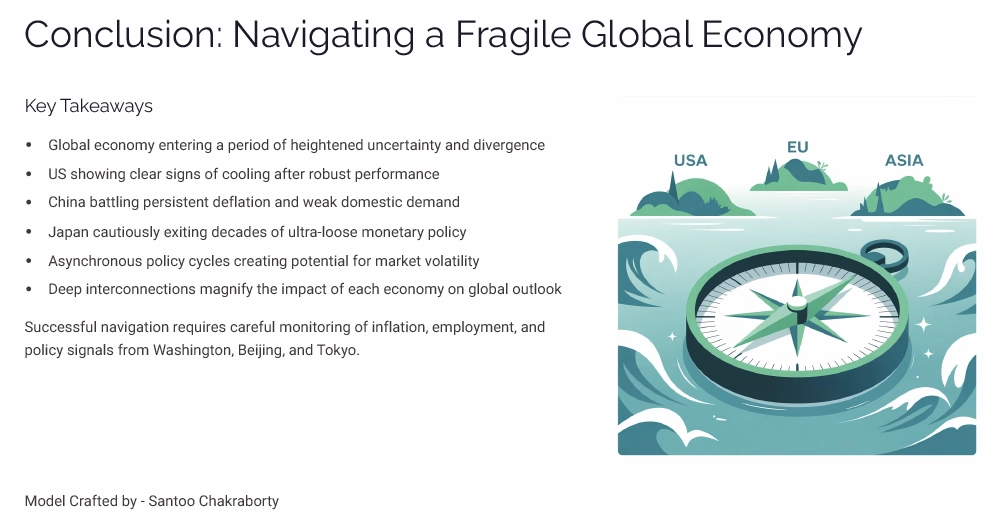
Global economy entering a period of heightened uncertainty and divergence
US showing clear signs of cooling after robust performance
China battling persistent deflation and weak domestic demand
Japan cautiously exiting decades of ultra-loose monetary policy
Asynchronous policy cycles creating potential for market volatility
Successful navigation requires careful monitoring of inflation, employment, and policy signals from Washington, Beijing, and Tokyo.
The U.S. dollar is not just another currency. It is the backbone of global trade...
The Next India - Investing in a High-Growth Powerhouse An economist's guide to ...