15-MIN DELAYED
NIFTY 25,349.65 -450.95 (-1.75%) | BANKNIFTY 62,585.35 -2,049.85 (-3.17%) | SENSEX 82,435.99 -1,483.72 (-1.77%) | CRUDEOIL-I 7,485.00 -78.00 (-1.03%) | GOLD-I 1,24,521.00 -1,500.00 (-1.19%) | NIFTY 25,349.65 -450.95 (-1.75%) | BANKNIFTY 62,585.35 -2,049.85 (-3.17%) | SENSEX 82,435.99 -1,483.72 (-1.77%) | CRUDEOIL-I 7,485.00 -78.00 (-1.03%) | GOLD-I 1,24,521.00 -1,500.00 (-1.19%) |
TrueData
Helpline / Support +91 7304-22-44-66
Get started

WORKSPACE

Workspace overview Workspace overview Our flagship product SignalX SignalX web charting for indian market Sheets Sheets streaming spreadsheet Wealth Wealth corporate data and news


Built for India's markets.

Real-time charts, streaming spreadsheets, live corporate announcements — all in one workspace.

Get started free

Butterfly Spread Strategy

Marisha Bhatt · 24 Nov 2026 · 14 mins read · 0 Comments

butterfly-spread-strategy

Options trading offers traders several strategies to navigate different market conditions, but how do you choose a strategy when you expect a stock to remain within a specific price range? This is where understanding different options strategies becomes important. From iron butterflies to iron condors, we have explored several approaches in our earlier blogs. Let us now take a closer look at the butterfly spread strategy, how it works, when traders may consider using it, and the potential risks and rewards involved.

What is a Butterfly Spread Strategy?

what-is-a-butterfly-spread-strategy

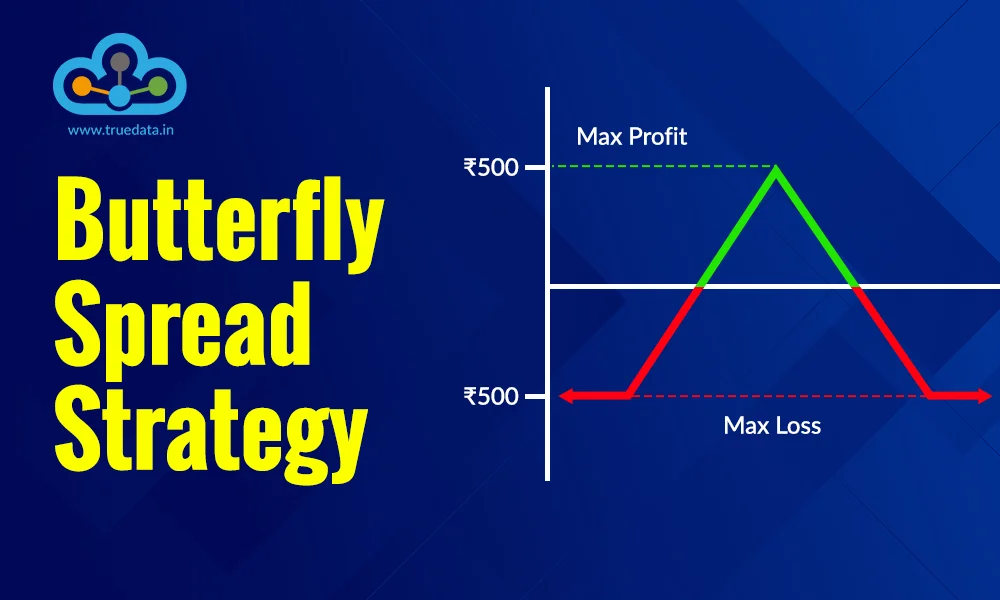
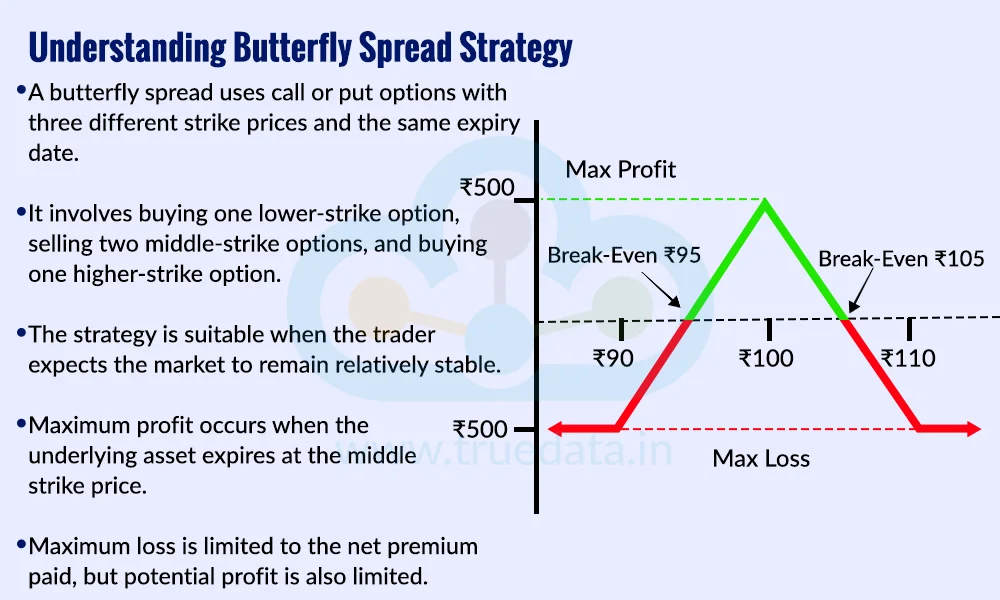
A butterfly spread strategy is an options trading strategy that combines multiple call options or multiple put options with different strike prices but the same expiry date. It involves three strike prices, i.e., a lower strike price, a middle strike price, and a higher strike price. In a standard long butterfly spread, a trader buys one option at the lower strike price, sells two options at the middle strike price, and buys one option at the higher strike price. All four options have the same underlying asset and expiry date. The strategy is generally used when a trader expects the underlying asset, such as a stock or an index like Nifty 50, to remain relatively stable and close to the middle strike price at expiry. The maximum profit occurs when the underlying asset expires at the middle strike price, while the maximum loss is limited to the net premium paid to establish the strategy. Since the potential profit and loss are both limited, a butterfly spread can help traders plan their risk in advance. However, the potential profit is also limited, and the strategy may result in a loss if the underlying asset moves too far away from the middle strike price.

What are the Types of Butterfly Spread Strategy?

The butterfly spread strategy has several types, and each is designed for a different market outlook. Traders can use these strategies in the options market based on their expectations of price movements, volatility, and risk. The types of butterfly spread strategies are explained below.

Long Call Butterfly Spread

Long Call Butterfly Spread

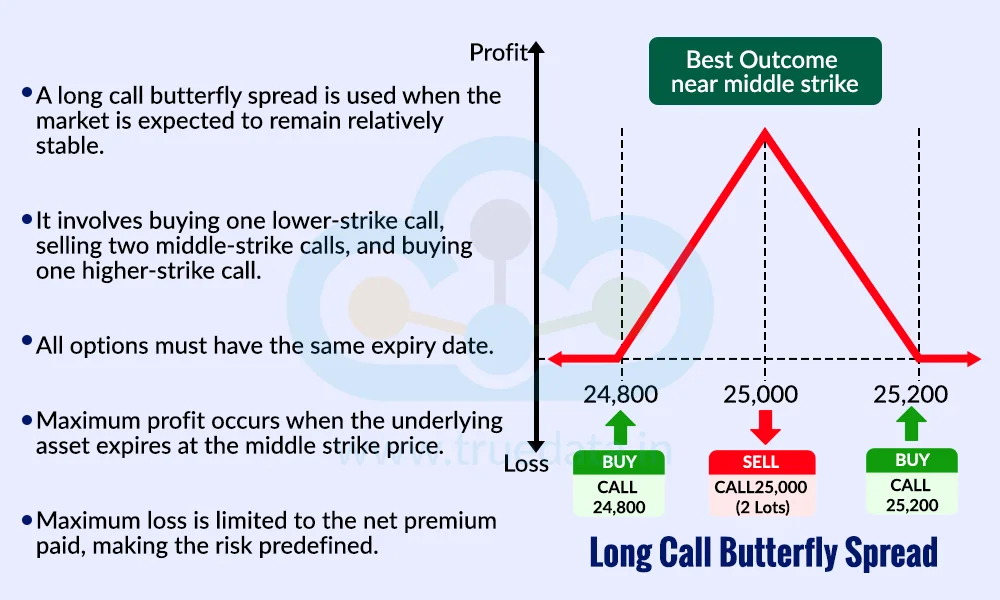
A long call butterfly spread is an options trading strategy used when a trader expects the underlying asset, such as Nifty 50, Bank Nifty, or an individual stock, to remain close to a specific price at expiry. This strategy involves buying one call option at a lower strike price, selling two call options at a middle strike price, and buying one call option at a higher strike price. All the options have the same expiry date. The strategy generally benefits when the underlying asset expires at or near the middle strike price. The maximum profit occurs at the middle strike price at expiry, while the maximum loss is limited to the net premium paid to establish the position. Therefore, this strategy may suit traders who expect limited price movement rather than a strong upward or downward trend.

Trading a Long Call Butterfly Spread

  • Traders first select an underlying asset, such as Nifty 50, based on the expectation that its price will remain within a narrow range.

  • Traders should select three call option strike prices with equal intervals, such as 24,800, 25,000, and 25,200.

    • Buy one call option with a strike price of 24,800.

    • Sell two call options with a strike price of 25,000.

    • Buy one call option with a strike price of 25,200.

  • Traders then choose the same expiry date for all four option contracts and calculate the net premium paid.

  • Traders then monitor the position and evaluate the potential profit or loss based on the underlying asset's price at expiry.

Short Call Butterfly Spread

Short Call Butterfly Spread

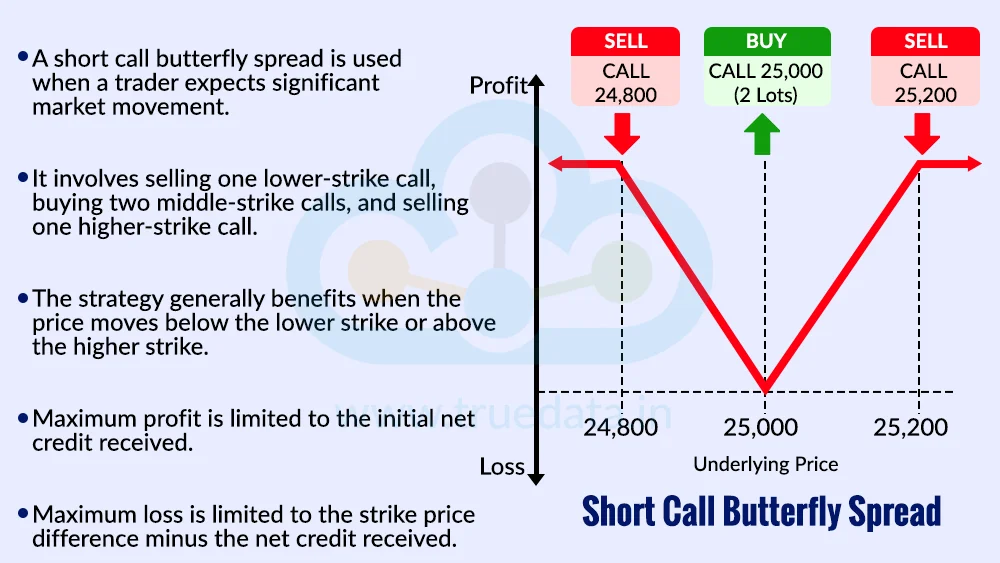
A short call butterfly spread is designed for a trader who expects the underlying asset to move significantly away from a specific middle strike price. Unlike a long call butterfly spread, which generally benefits from limited price movement, a short call butterfly spread generally benefits when the underlying asset expires below the lower strike price or above the higher strike price. This strategy involves selling one call option at a lower strike price, buying two call options at a middle strike price, and selling one call option at a higher strike price. The position typically generates a net credit when established, although the actual premium depends on market conditions. The maximum profit is generally limited to the initial net credit, while the maximum loss is limited to the distance between adjacent strike prices minus that credit, assuming equally spaced strikes and standard contract terms. It may be considered when a trader expects a substantial price move but does not want to take an unlimited-risk naked options position.

Trading a Short Call Butterfly Spread

  • Traders should identify an underlying asset that may experience a significant price movement before expiry.

  • Traders should select three equally spaced call option strike prices, such as 24,800, 25,000, and 25,200.

    • Sell one call option at 24,800.

    • Buy two call options at 25,000.

    • Sell one call option at 25,200.

  • Calculate the net premium received and the maximum possible loss.

  • Traders should then monitor the underlying asset and consider exiting the position if market conditions change.

Long Put Butterfly Spread

Long Put Butterfly Spread

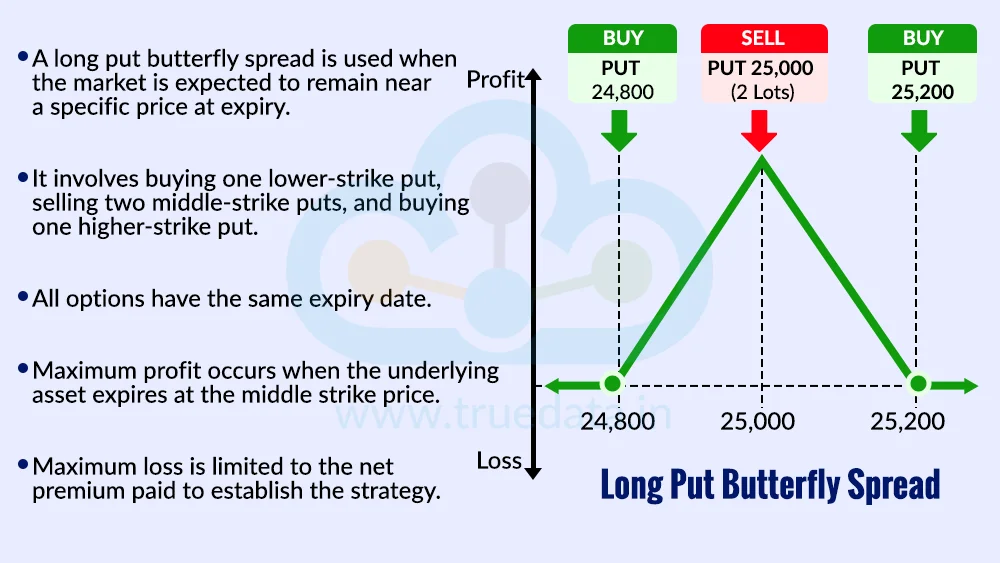
A long put butterfly spread is another limited-risk options strategy that is generally used when a trader expects the underlying asset to remain close to a particular price at expiry. It uses put options instead of call options but follows the same basic structure as a long call butterfly spread. The trader buys one put option at a lower strike price, sells two put options at a middle strike price, and buys one put option at a higher strike price. All options have the same expiry date. The strategy generally achieves its maximum profit when the underlying asset expires at the middle strike price. Its maximum loss is limited to the net premium paid to establish the position. Since the strategy requires the underlying asset to finish near a specific price for the best outcome, the trader needs to select the strike prices carefully. Although its payoff at expiry is equivalent to a comparable long call butterfly under standard assumptions, differences in premiums, liquidity, and execution costs can affect the actual trade.

Trading a Long Put Butterfly Spread

  • Traders first select an underlying asset that is expected to remain relatively stable until expiry.

  • Traders should then choose three equally spaced put option strike prices, such as 24,800, 25,000, and 25,200.

    • Buy one put option at 24,800.

    • Sell two put options at 25,000.

    • Buy one put option at 25,200.

  • Traders should then calculate the total premium paid after accounting for the premiums received from the two short put options.

  • Traders should finally track the position and assess the potential profit or loss as expiry approaches.

Short Put Butterfly Spread

Short Put Butterfly Spread

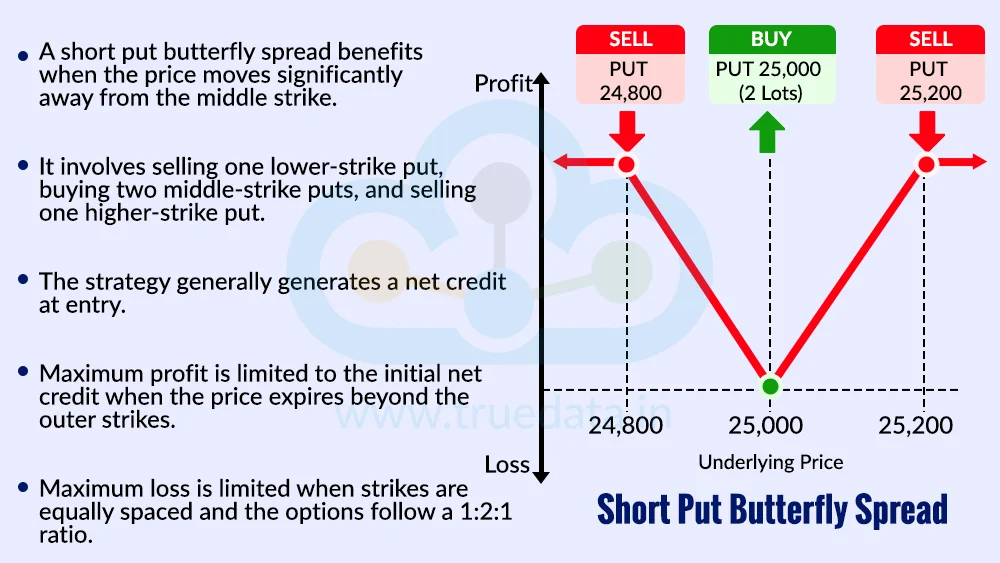
A short put butterfly spread is an options strategy that generally benefits when the underlying asset moves significantly away from the middle strike price before expiry. It is constructed by selling one put option at a lower strike price, buying two put options at a middle strike price, and selling one put option at a higher strike price. The position generally receives a net credit at the time of entry. Its maximum profit is limited to this initial credit and is achieved when the underlying asset expires below the lower strike price or above the higher strike price. The maximum loss is limited when the options have equally spaced strikes and the position is constructed in the standard 1:2:1 ratio. This strategy may be considered when a trader expects a substantial price movement in either direction. However, the trader should remember that a large move is not sufficient by itself; the price must move far enough to cover the effect of the premiums and the position's payoff structure.

Trading a Short Put Butterfly Spread

  • Traders should first identify an underlying asset that may experience a significant price movement before expiry.

  • Traders then select three equally spaced put option strike prices, such as 24,800, 25,000, and 25,200.

    • Sell one put option at 24,800.

    • Buy two put options at 25,000.

    • Sell one put option at 25,200.

  • Calculate the net premium received and the maximum possible loss.

  • Traders finally monitor the position and evaluate whether the expected price movement is developing.

Iron Butterfly Spread

Iron Butterfly Spread

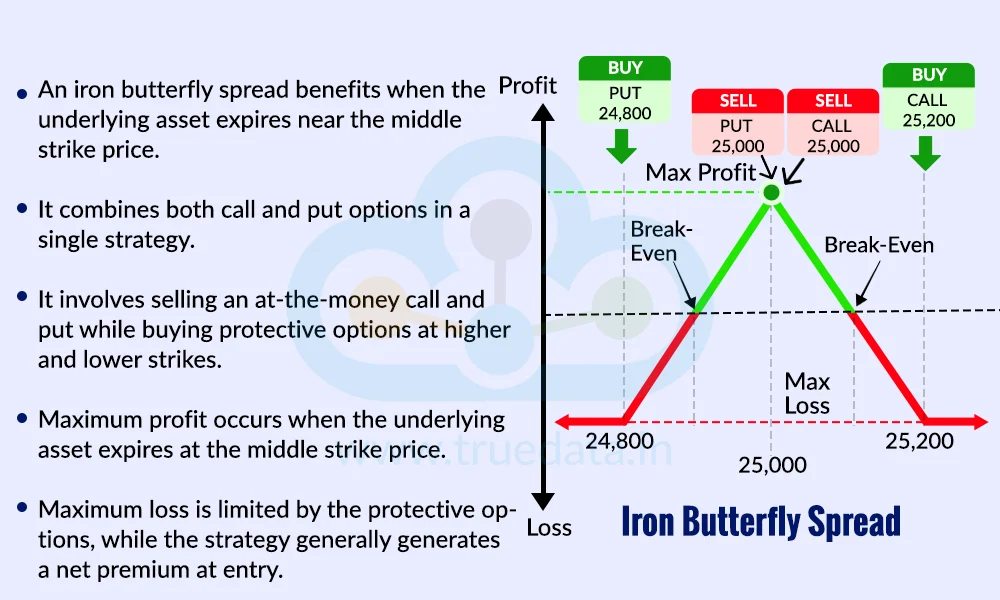
An iron butterfly spread combines call and put options to create a limited-risk strategy that generally benefits when the underlying asset expires close to a selected middle strike price. Unlike a standard butterfly spread, which uses only call options or only put options, an iron butterfly uses both types. A typical short iron butterfly involves selling one at-the-money call option and one at-the-money put option at the same middle strike price, while buying one out-of-the-money put option below that strike and one out-of-the-money call option above it. All four options have the same expiry date. The strategy generally receives a net premium at entry, and its maximum profit occurs when the underlying asset expires at the middle strike price. The maximum loss is limited by the protective options, assuming the position is established correctly, and the options have standard contract specifications. It may be considered when a trader expects limited price movement and wants to define the risk in advance.

Trade an Iron Butterfly Spread

  • Traders should first identify an underlying asset, such as Nifty 50, that is expected to remain close to its current price until expiry.

  • Select a middle strike price, such as 25,000.

    • Sell one call option and one put option at 25,000.

    • Buy one put option at a lower strike price, such as 24,800.

    • Buy one call option at a higher strike price, such as 25,200.

  • Use the same expiry date for all four options and calculate the net premium received.

  • Calculate the maximum profit and maximum loss before entering the position.

  • Traders should finally monitor the position and consider the impact of changes in price, volatility, and time to expiry.

Broken-Wing Butterfly Spread

Broken-Wing Butterfly Spread

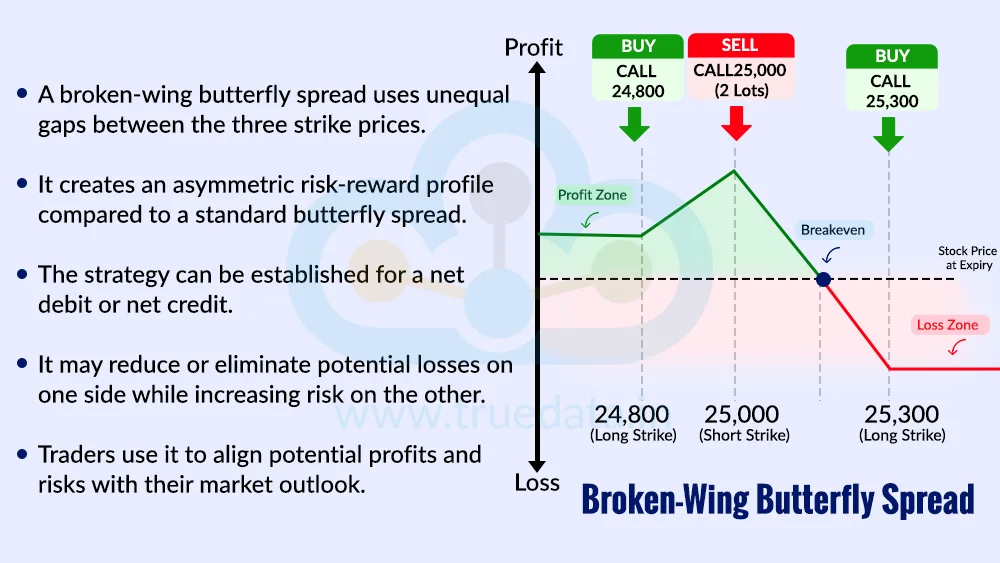
A broken-wing butterfly spread is a variation of a standard butterfly spread in which the distance between the strike prices is unequal. In a standard butterfly spread, the lower, middle, and higher strike prices are generally equally spaced. In a broken-wing butterfly, one side has a wider strike-price gap than the other. This changes the strategy's payoff profile and can create an asymmetric risk-reward structure. Depending on the options used, the direction of the position, and the premiums received or paid, the strategy may be established for a net debit or a net credit. Some broken-wing structures can reduce or eliminate the maximum loss on one side of the payoff diagram, but they may expose the trader to a larger loss on the other side. Traders may consider this strategy when they have a directional view or want to adjust the balance between potential profit and risk.

Trading a Broken-Wing Butterfly Spread

  • The trader should first identify an underlying asset and form a view about its likely price movement before expiry.

  • The trader should then select three strike prices with unequal gaps, such as 24,800, 25,000, and 25,300.

    • For a broken-wing call butterfly, the trader should buy one call at the lower strike, sell two calls at the middle strike, and buy one call at the higher strike.

  • Check the premiums to determine whether the position requires a net debit or generates a net credit.

  • Calculate the maximum profit and examine the risk on both sides of the middle strike price.

  • Check whether the wider strike gap creates a larger potential loss on one side.

  • Enter the position only after understanding the payoff at different expiry prices and the margin requirements.

Reverse Iron Butterfly Spread

Reverse Iron Butterfly Spread

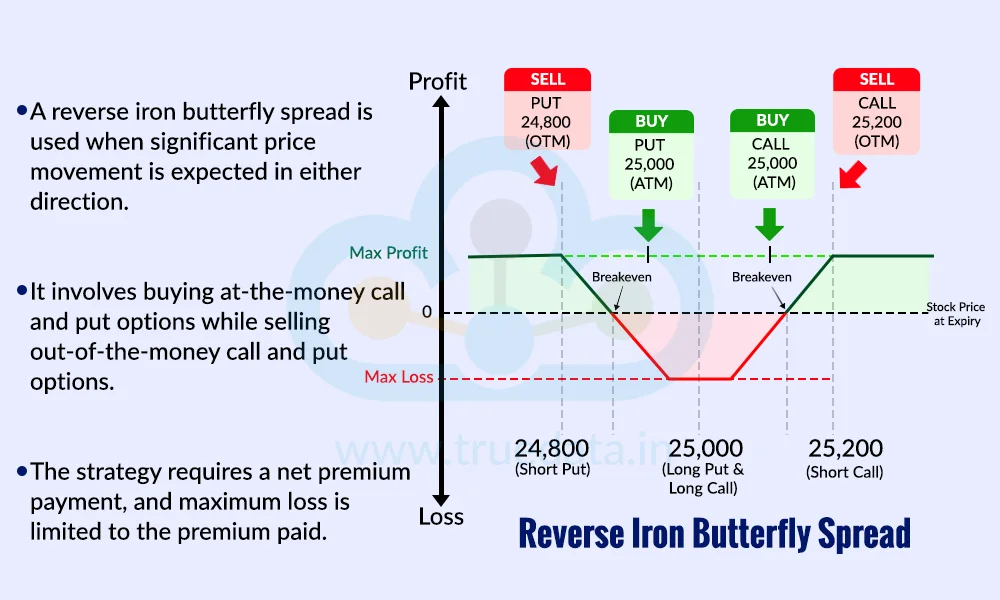
A reverse iron butterfly spread is an options trading strategy used when a trader expects the underlying asset, such as Nifty 50, Bank Nifty, or an individual stock, to experience a significant price movement in either direction before expiry. It is the opposite of a standard short iron butterfly spread. The strategy involves buying one at-the-money call option and one at-the-money put option at the same middle strike price, while selling one out-of-the-money put option at a lower strike price and one out-of-the-money call option at a higher strike price. All four options have the same expiry date. The strategy generally requires a net premium payment and may benefit when the underlying asset moves sufficiently far above or below the middle strike price. The maximum loss is limited to the net premium paid and generally occurs when the underlying asset expires at the middle strike price. The potential profit is limited on the downside by the lower strike price, while the upside profit is also limited by the short call option at the higher strike price. Therefore, traders may consider this strategy when they expect a substantial price movement but want to define their maximum potential loss in advance.

Trading a Reverse Iron Butterfly Spread

  • The trader should first identify an underlying asset, such as Nifty 50, that may experience a significant price movement before expiry.

  • The trader should then select a middle strike price, such as 25,000.

    • Buy one call option and one put option at the middle strike price of 25,000.

    • Sell one put option at a lower strike price, such as 24,800.

    • Sell one call option at a higher strike price, such as 25,200.

  • Ensure that all four options have the same expiry date and calculate the net premium paid after accounting for the premiums received from the two short options.

  • Calculate the maximum possible loss and the potential profit at different expiry prices before entering the position.

  • Monitor the underlying asset's price and consider whether the movement is large enough to offset the initial premium paid and other trading costs.

What is the Difference Between Butterfly Spread Strategy and Straddle Strategy?

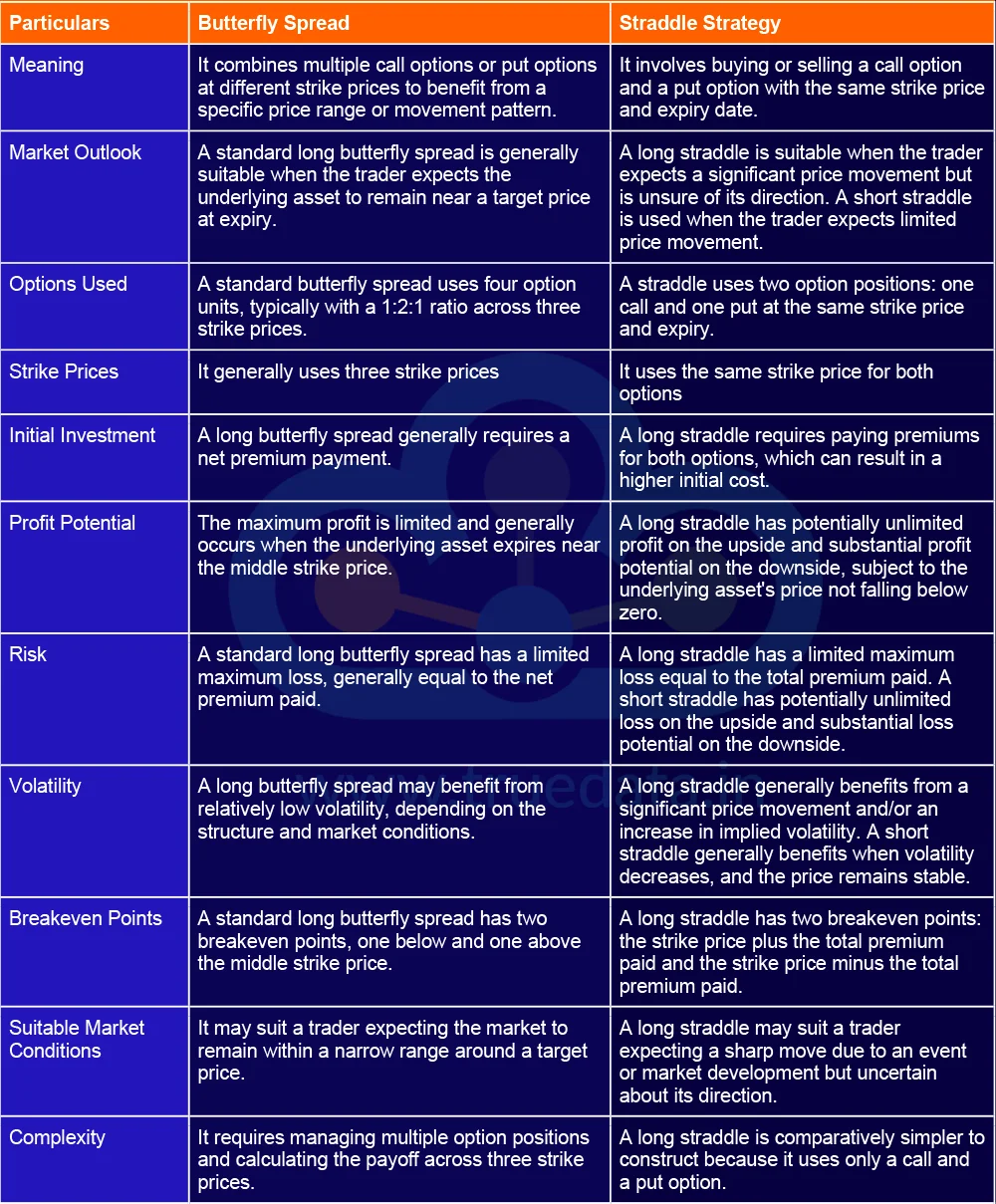
The butterfly spread strategy and the straddle strategy are options trading strategies that traders can use based on their expectations of market movements. However, they differ in how they are constructed, the market conditions they suit, and their potential risks and rewards.

What is the Difference Between Butterfly Spread Strategy and Straddle Strategy

Particulars

Butterfly Spread

Straddle Strategy

Meaning

It combines multiple call options or put options at different strike prices to benefit from a specific price range or movement pattern.

It involves buying or selling a call option and a put option with the same strike price and expiry date.

Market Outlook

A standard long butterfly spread is generally suitable when the trader expects the underlying asset to remain near a target price at expiry.

A long straddle is suitable when the trader expects a significant price movement but is unsure of its direction. A short straddle is used when the trader expects limited price movement.

Options Used

A standard butterfly spread uses four option units, typically with a 1:2:1 ratio across three strike prices.

A straddle uses two option positions: one call and one put at the same strike price and expiry.

Strike Prices

It generally uses three strike prices

It uses the same strike price for both options

Initial Investment

A long butterfly spread generally requires a net premium payment.

A long straddle requires paying premiums for both options, which can result in a higher initial cost.

Profit Potential

The maximum profit is limited and generally occurs when the underlying asset expires near the middle strike price.

A long straddle has potentially unlimited profit on the upside and substantial profit potential on the downside, subject to the underlying asset's price not falling below zero.

Risk

A standard long butterfly spread has a limited maximum loss, generally equal to the net premium paid.

A long straddle has a limited maximum loss equal to the total premium paid. A short straddle has potentially unlimited loss on the upside and substantial loss potential on the downside.

Volatility

A long butterfly spread may benefit from relatively low volatility, depending on the structure and market conditions.

A long straddle generally benefits from a significant price movement and/or an increase in implied volatility. A short straddle generally benefits when volatility decreases, and the price remains stable.

Breakeven Points

A standard long butterfly spread has two breakeven points, one below and one above the middle strike price.

A long straddle has two breakeven points: the strike price plus the total premium paid and the strike price minus the total premium paid.

Suitable Market Conditions

It may suit a trader expecting the market to remain within a narrow range around a target price.

A long straddle may suit a trader expecting a sharp move due to an event or market development but uncertain about its direction.

Complexity

It requires managing multiple option positions and calculating the payoff across three strike prices.

A long straddle is comparatively simpler to construct because it uses only a call and a put option.

What are the Pros and Cons of Using the Butterfly Spread?

Understanding the pros and cons of the butterfly spread strategy can help traders use these strategies efficiently and create an informed trading plan. 

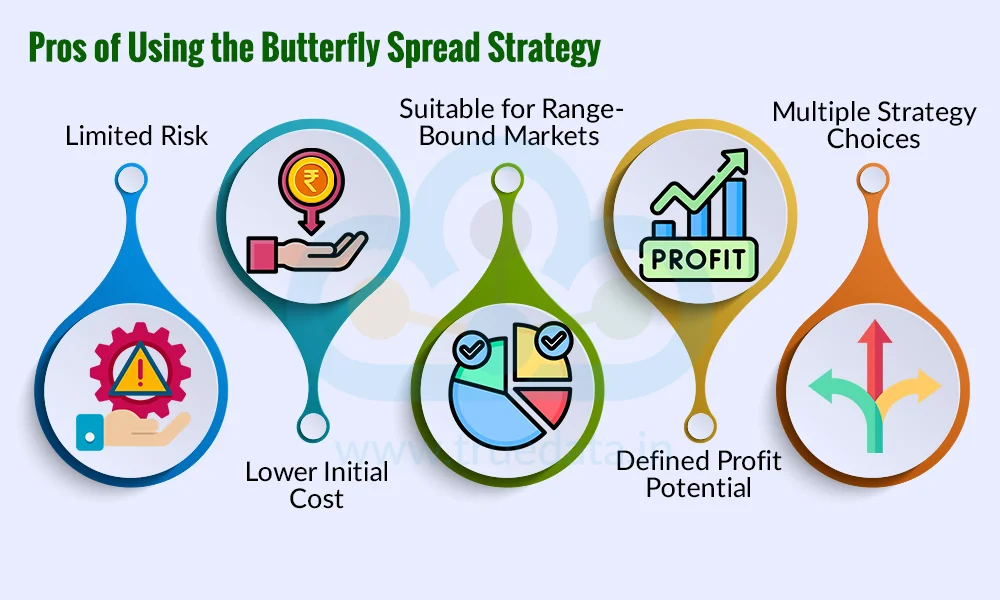
  • Pros of Using the Butterfly Spread Strategy

Pros of Using the Butterfly Spread Strategy

  • Limited Risk - A standard long butterfly spread has a predefined maximum loss, generally limited to the net premium paid.

  • Lower Initial Cost - It may require a lower initial premium than some other options strategies, depending on the strike prices and market conditions.

  • Suitable for Range-Bound Markets - It can be useful when a trader expects an index like Nifty 50 or Bank Nifty to remain near a specific price at expiry.

  • Defined Profit Potential - The maximum possible profit can be calculated before entering the trade.

  • Multiple Strategy Choices - Traders can choose call, put, iron butterfly, or broken-wing variations based on their market outlook and risk preferences.

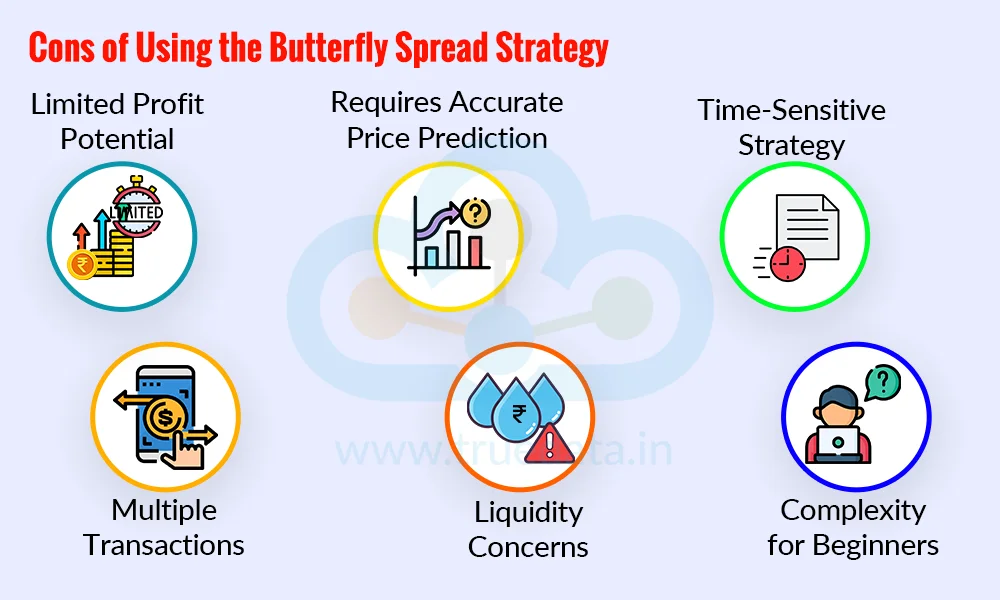
  • Cons of Using the Butterfly Spread Strategy

Cons of Using the Butterfly Spread Strategy

  • Limited Profit Potential - The maximum profit is capped, even if the market moves favourably.

  • Requires Accurate Price Prediction - The best outcome generally occurs when the underlying asset expires near the target strike price.

  • Time-Sensitive Strategy - The outcome depends on the underlying asset's price at expiry, and the position may lose value if market conditions do not match expectations.

  • Multiple Transactions - Opening and closing several option positions can increase brokerage, taxes, and other trading costs.

  • Liquidity Concerns - Some strike prices may have wider bid-ask spreads, making it harder to execute all legs at favourable prices.

  • Complexity for Beginners - Traders need to understand strike prices, option premiums, expiry dates, and payoff calculations before using the strategy.

Conclusion

The butterfly spread strategy can be a useful option for traders who want to benefit from specific price movements while keeping their potential risk limited. Depending on their market outlook, traders can choose from different types of butterfly spreads to suit their trading goals. However, it is important to understand how the strategy works, calculate the potential profit and loss, and consider factors such as option premiums, volatility, and expiry dates before entering a trade. With proper research and risk management, traders can make more informed decisions when using the butterfly spread strategy in the Indian stock market.

This article is an attempt to explain an important concept in options trading in a simplified manner. Let us know your thoughts on the topic or if you need further information, and we will address it soon.

Till then, Happy Reading!


Read More: Calendar Spread vs Diagonal Spread

Frequently Asked Questions

In a standard long butterfly spread, maximum profit is calculated by subtracting the net premium paid from the difference between adjacent strike prices, while maximum loss is limited to the net premium paid to enter the trade. Traders should multiply these amounts by the applicable lot size and number of lots to estimate the total profit or loss.

A butterfly spread strategy generally works best when traders expect the underlying asset, such as Nifty 50 or Bank Nifty, to remain near a specific price until expiry, with relatively low price movement. It may suit range-bound markets where traders want to limit their potential loss and target a defined profit.

In a standard long butterfly spread, the two breakeven points are calculated by subtracting the net premium paid from the middle strike price and adding it to the middle strike price. At these points, the trader neither makes a profit nor incurs a loss, excluding brokerage, taxes, and other trading costs.

Implied volatility affects option premiums and, therefore, the value of a butterfly spread; a rise or fall in volatility can change the position’s profit or loss before expiry. For a standard long butterfly spread, lower implied volatility may be favourable in some conditions, but the impact depends on the strike prices, premiums, and time remaining until expiry.

Traders should choose the middle strike price based on where they expect the underlying asset, such as Nifty 50 or Bank Nifty, to be at expiry, and select lower and higher strike prices around it. They should also consider option premiums, market volatility, liquidity, and the potential profit and loss before entering the trade.

Time decay reduces the value of options as expiry approaches, and a butterfly spread may benefit when the underlying asset stays near the middle strike price. However, the effect depends on the option premiums and market conditions, so traders should monitor their positions closely as expiry approaches

Traders may exit a butterfly spread when their profit target is reached, the underlying asset moves away from the expected price range, or the potential loss becomes unacceptable. They should also consider exiting before expiry to manage risk and avoid unexpected changes in option prices or settlement-related complications.
Marisha Bhatt

Marisha Bhatt is a financial content writer @TrueData.

She writes with the sole aim of simplifying complex financial concepts and jargon while attempting to clarify technical and fundamental analysis concepts of the stock markets. The ultimate goal is to spread vital knowledge and benefit the maximum audience. Her Chartered Accountant background acts as the knowledge base to help clarify crucial concepts and create a sound investment portfolio.

0 Comments

Related Articles

SEE ALL
Trading Strategies / Indicators
Point-And-Figure (P&F) Chart in Trading

Technical analysis has evolved with a wide range of modern indicators and charti...

Trading Strategies / Indicators
What are Trend Lines? How to Use Them?

Have you ever wondered how experienced traders can quickly tell whether a stock ...

Relevant Tags