15-MIN DELAYED
NIFTY 25,334.95 +79.90 (+0.32%) | BANKNIFTY 61,150.65 +358.25 (+0.59%) | SENSEX 81,911.01 +31.61 (+0.04%) | CRUDEOIL-I 8,049.00 -134.00 (-1.64%) | GOLD-I 1,38,460.00 -1,270.00 (-0.91%) | NIFTY 25,334.95 +79.90 (+0.32%) | BANKNIFTY 61,150.65 +358.25 (+0.59%) | SENSEX 81,911.01 +31.61 (+0.04%) | CRUDEOIL-I 8,049.00 -134.00 (-1.64%) | GOLD-I 1,38,460.00 -1,270.00 (-0.91%) |
TrueData
Helpline / Support +91 7304-22-44-66
Get started

WORKSPACE

Workspace overview Workspace overview Our flagship product SignalX SignalX web charting for indian market Sheets Sheets streaming spreadsheet Wealth Wealth corporate data and news


Built for India's markets.

Real-time charts, streaming spreadsheets, live corporate announcements — all in one workspace.

Get started free

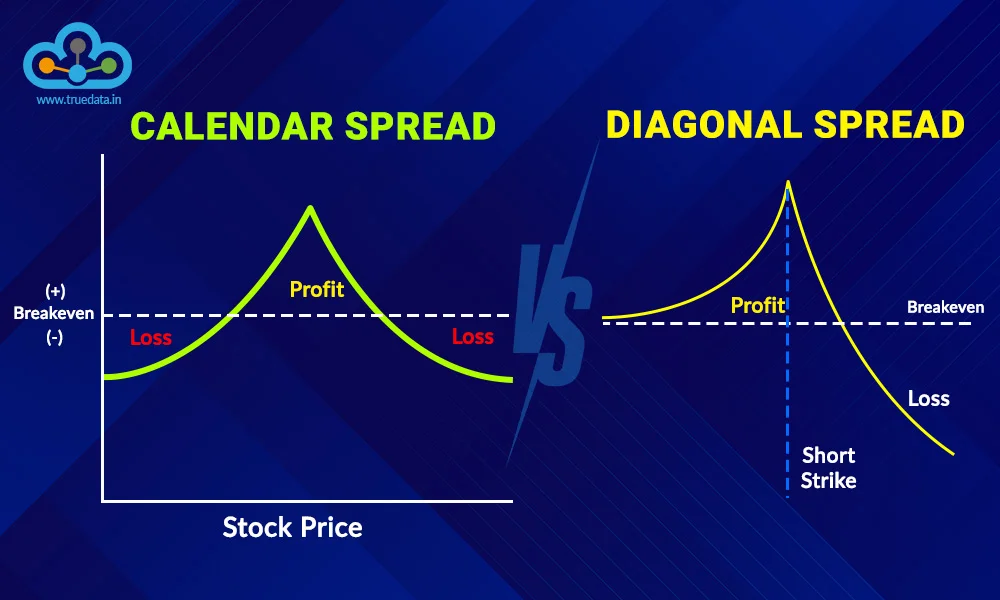
Calendar Spread vs Diagonal Spread

Marisha Bhatt · 15 Oct 2026 · 12 mins read · 46 Comments

calendar-spread-vs-diagonal-spread

Options trading has gained significant traction among Indian market participants, offering traders a range of strategies to manage risk, express market views and potentially benefit from different market conditions. However, options can be complex, and understanding how each strategy works is essential before putting it into practice. Two strategies that often catch the attention of options traders are calendar spreads and diagonal spreads. While both involve options with different expiry dates, they differ in their strike prices, market outlook and potential risk-reward characteristics. So, how do calendar spreads and diagonal spreads work, and how do they differ? Get answers to these questions and more in this blog where we decode these trading strategies. 

What is a Calendar Spread?

What is a Calendar Spread

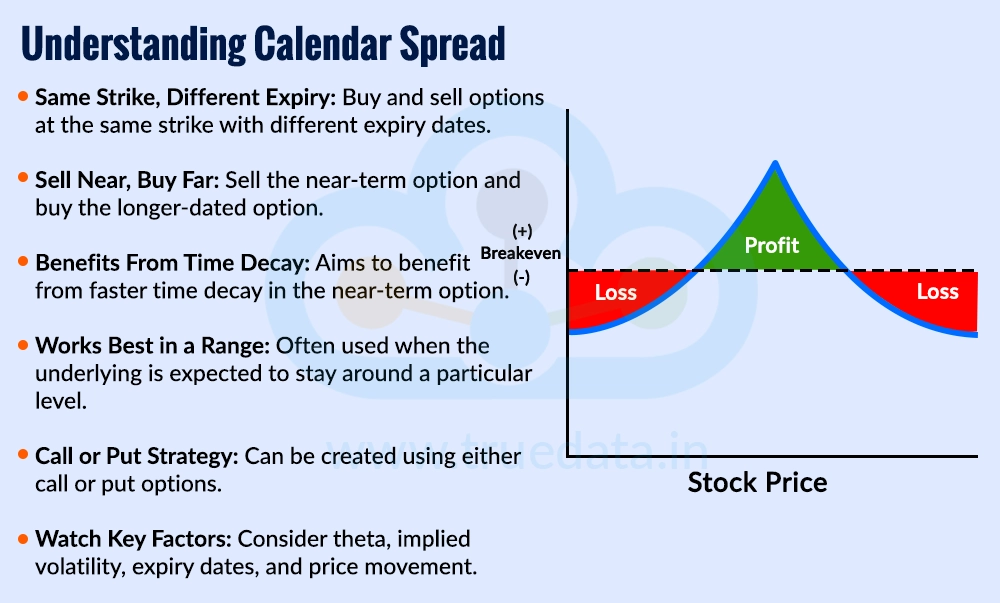
A calendar spread, also known as a time spread, is an options trading strategy that involves buying and selling two options on the same underlying asset and usually at the same strike price, but with different expiry dates. Typically, a trader sells the option with the nearer expiry and buys the option with a later expiry. For example, if a trader expects Nifty 50 to remain around a particular level in the near term, they could sell a Nifty option expiring in one week and buy another Nifty option with the same strike price expiring in the following month. The strategy aims to benefit from the difference in time decay between the two options. Since the near-term option generally loses time value faster as expiry approaches, the trader may benefit if the underlying stays within the expected range and the sold option loses value faster than the longer-dated option. A calendar spread can be created using either call options or put options, depending on the trader's market view. While the strategy can help traders express a view on time and volatility, it is important to understand factors such as time decay (theta), implied volatility, expiry dates and the movement of the underlying asset before using it.

How to Use a Calendar Spread?

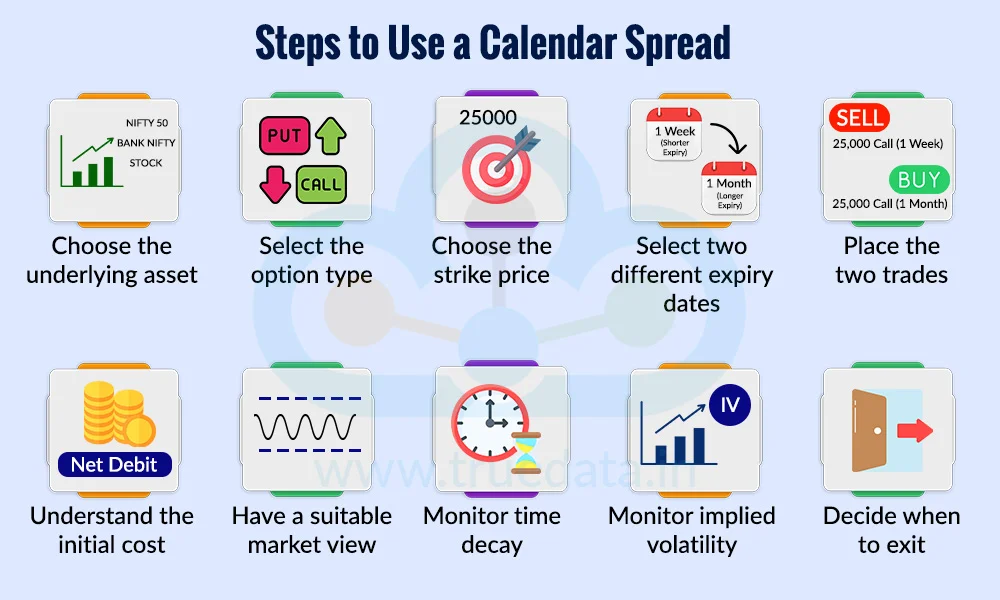
A calendar spread means selling a shorter-expiry option and buying a longer-expiry option at the same strike price. The strategy primarily seeks to benefit from the difference in time decay and changes in option value across the two expiry periods, rather than simply betting on whether the underlying will rise or fall. Traders can use a calendar spread when they have a view that the underlying asset may remain relatively stable or move within a certain range over the near term. The calendar spread strategy can be used as follows.

How to Use a Calendar Spread

  • Choose the underlying asset - Select the stock or index to create the calendar spread, such as NIFTY 50, BANK NIFTY or an individual stock.

  • Select the option type - Decide whether to use call options or put options based on your market view. A calendar spread can be created with either type of option.

  • Choose the strike price - Select a strike price around which you expect the underlying to trade near the shorter expiry. For example, if NIFTY is trading at 25,000 and traders expect it to remain around this level, they could consider the 25,000 strike.

  • Select two different expiry dates - A calendar spread always involves options with different expiry dates. Typically, the trader sells an option with a nearer expiry and buys an option with a later expiry, using the same strike price.

  • Place the two trades - For example, a trader could sell a 25,000 NIFTY Call expiring in one week and buy a 25,000 NIFTY Call expiring in the following month. This creates a long calendar spread.

  • Understand the initial cost - Since the longer-dated option generally has more time value, it usually costs more than the shorter-dated option. Therefore, a standard calendar spread is generally entered for a net debit, meaning the trader pays the difference between the premium paid for the long option and the premium received from the short option.

  • Have a suitable market view - Calendar spreads are generally considered when the trader expects the underlying to remain near the selected strike price in the short term, rather than making a sharp move away from it. The exact profit or loss, however, depends on the underlying's movement, time decay and changes in implied volatility.

  • Monitor time decay - The short-term option tends to lose time value faster as its expiry approaches. If the underlying remains near the chosen strike, the trader may benefit from this faster decay in the short option while continuing to hold the longer-dated option.

  • Monitor implied volatility - Changes in implied volatility (IV) can affect the value of both options. A calendar spread may be particularly sensitive to changes in IV because the two options have different expiry dates.

  • Decide when to exit - A trader can close the spread before the short option expires, or manage the position by closing the short option and deciding what to do with the longer-dated option. The exit should depend on the trader's strategy, market view, risk limit and the spread's profit or loss.

What is a Diagonal Spread?

What is a Diagonal Spread

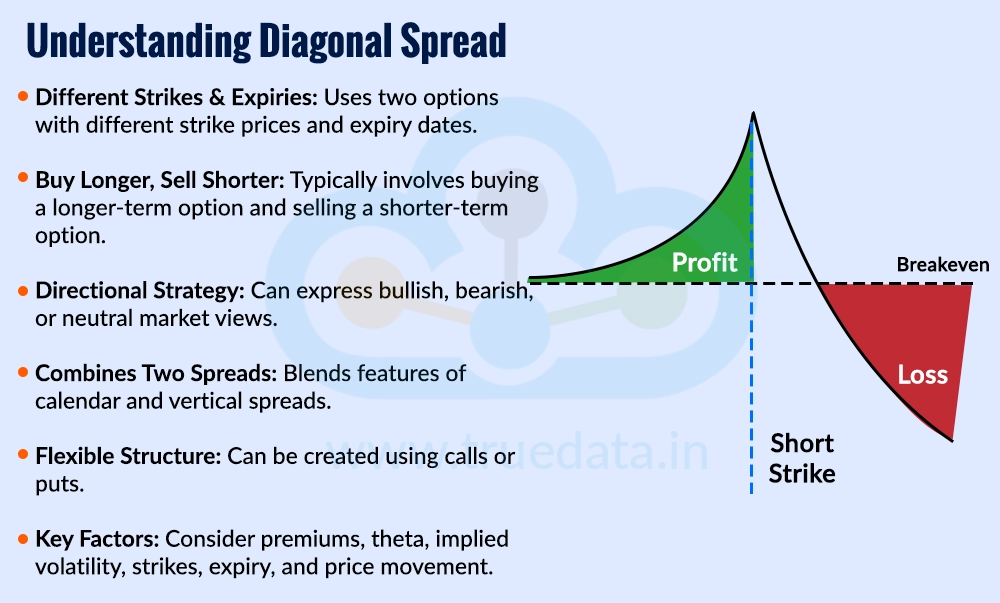
A diagonal spread is an options trading strategy that involves buying and selling two options on the same underlying asset but with different expiry dates and different strike prices. Typically, a trader buys a longer-term option and sells a shorter-term option, while choosing different strike prices for the two contracts. For example, a trader expecting a moderately bullish view on NIFTY 50 could buy a longer-expiry 25,000 Call and sell a shorter-expiry 25,200 Call. Since the options have both different expiry dates and different strike prices, the strategy is called a diagonal spread. A diagonal spread combines elements of a calendar spread and a vertical spread, allowing traders to take a more specific view on the underlying's direction while also considering the impact of time decay. Depending on whether calls or puts are used and how the strike prices are selected, a diagonal spread can be structured for bullish, bearish or neutral market views. Traders should consider factors such as option premiums, time decay (theta), implied volatility, strike prices, expiry dates and the movement of the underlying asset before entering the strategy.

How to Use a Diagonal Spread? 

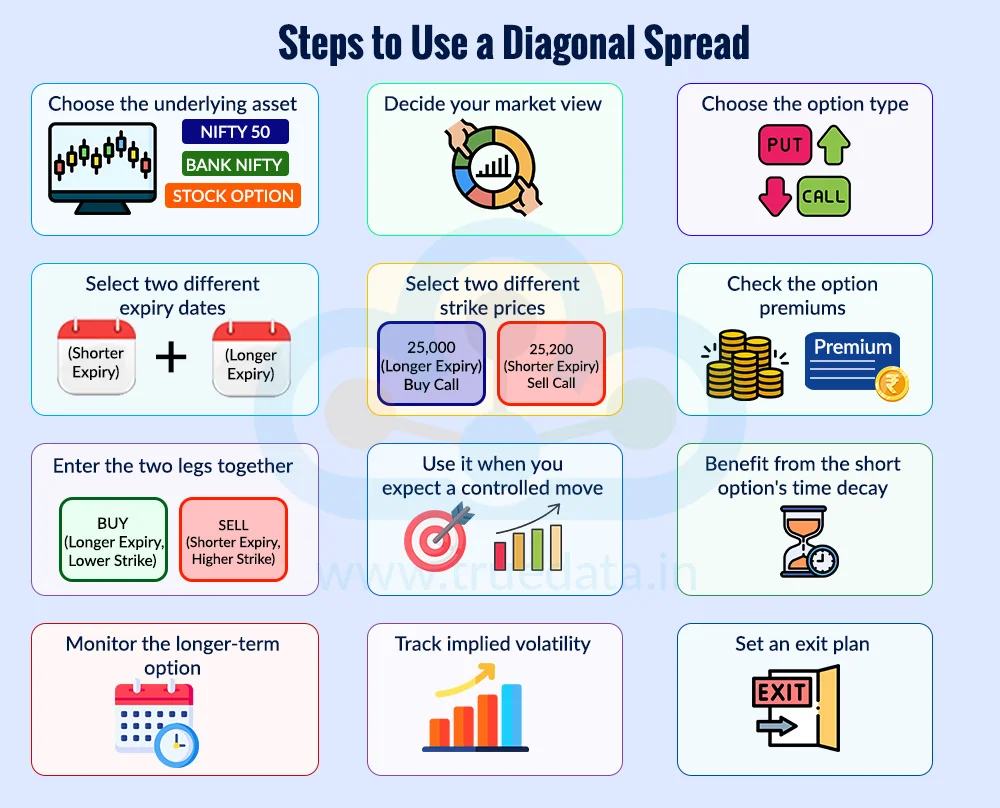
A diagonal spread combines different strike prices and different expiry dates. The trader generally buys a longer-expiry option and sells a shorter-expiry option, using the difference in strikes to express a directional view and the difference in expiries to benefit from changes in time value. A diagonal spread can be useful when a trader has a directional view on the underlying asset but also wants to take advantage of differences in option expiry and time decay. The diagonal spread strategy can be used as follows.

How to Use a Diagonal Spread

  • Choose the underlying asset - Select the stock or index to create the spread, such as NIFTY 50, BANK NIFTY or an eligible stock option.

  • Decide your market view - First determine whether traders have a bullish or bearish view. The strike prices and option type can then be selected accordingly. For example, call-based diagonal spreads are commonly structured for a bullish-to-moderately bullish view, while put-based structures can be used for a bearish-to-moderately bearish view.

  • Choose the option type - Decide whether to use call options or put options. The choice depends on the direction traders expect the underlying to take.

  • Select two different expiry dates - A diagonal spread uses options with different expiry dates. Typically, the trader buys the longer-expiry option and sells the shorter-expiry option.

  • Select two different strike prices - Unlike a calendar spread, a diagonal spread uses different strike prices for the two options. For example, a trader could buy a longer-expiry 25,000 Call and sell a shorter-expiry 25,200 Call.

  • Check the option premiums - Before entering the trade, compare the premiums of both options. Depending on the strikes, expiry dates and market conditions, the strategy may be established for a net debit or, in some structures, a net credit.

  • Enter the two legs together - Buy one option and sell the other option according to the planned structure. Since the two legs have different strikes and expiry dates, the position's overall behaviour depends on both the underlying's movement and changes in time value.

  • Use it when you expect a controlled move - A diagonal spread can be considered when traders expect the underlying to move in a particular direction but not necessarily make a very large move. For example, a trader with a moderately bullish view may buy a longer-dated call at a lower strike and sell a nearer-dated call at a higher strike.

  • Benefit from the short option's time decay - The shorter-expiry option generally loses time value faster as expiry approaches. If the underlying moves as expected and the short option declines in value, this can benefit the overall position.

  • Monitor the longer-term option - The longer-expiry option retains more time value and remains in the position after the short option approaches expiry. The trader can then decide whether to close the entire spread, roll the short option to another expiry or continue managing the position, depending on the strategy.

  • Track implied volatility - Changes in implied volatility (IV) can affect both legs of the spread. As the options have different expiry dates, a change in IV can affect their premiums differently.

  • Set an exit plan - Before entering the trade, decide the maximum loss acceptable and the conditions under which you will exit. A diagonal spread should be monitored because a sharp move in the underlying, an unexpected change in IV or changes in the value of either option can affect its profitability.

What are the Differences Between a Calendar Spread and a Diagonal Spread?

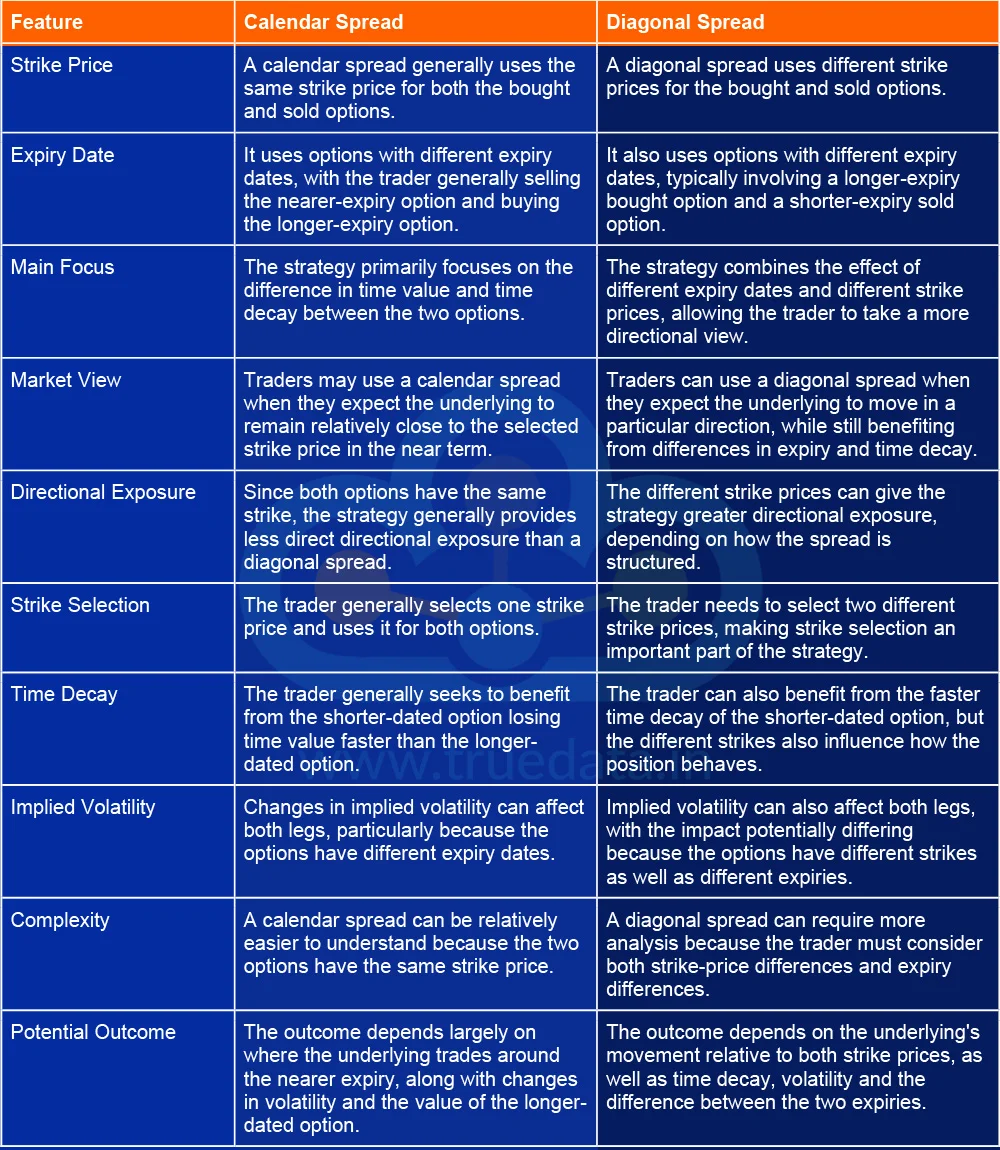
Both calendar spreads and diagonal spreads involve options with different expiry dates, but they differ mainly in their strike prices and the type of market view they can express. The key differences are explained below.

What are the Differences Between a Calendar Spread and a Diagonal Spread

Feature

Calendar Spread

Diagonal Spread

Strike Price

A calendar spread generally uses the same strike price for both the bought and sold options.

A diagonal spread uses different strike prices for the bought and sold options.

Expiry Date

It uses options with different expiry dates, with the trader generally selling the nearer-expiry option and buying the longer-expiry option.

It also uses options with different expiry dates, typically involving a longer-expiry bought option and a shorter-expiry sold option.

Main Focus

The strategy primarily focuses on the difference in time value and time decay between the two options.

The strategy combines the effect of different expiry dates and different strike prices, allowing the trader to take a more directional view.

Market View

Traders may use a calendar spread when they expect the underlying to remain relatively close to the selected strike price in the near term.

Traders can use a diagonal spread when they expect the underlying to move in a particular direction, while still benefiting from differences in expiry and time decay.

Directional Exposure

Since both options have the same strike, the strategy generally provides less direct directional exposure than a diagonal spread.

The different strike prices can give the strategy greater directional exposure, depending on how the spread is structured.

Strike Selection

The trader generally selects one strike price and uses it for both options.

The trader needs to select two different strike prices, making strike selection an important part of the strategy.

Time Decay

The trader generally seeks to benefit from the shorter-dated option losing time value faster than the longer-dated option.

The trader can also benefit from the faster time decay of the shorter-dated option, but the different strikes also influence how the position behaves.

Implied Volatility

Changes in implied volatility can affect both legs, particularly because the options have different expiry dates.

Implied volatility can also affect both legs, with the impact potentially differing because the options have different strikes as well as different expiries.

Complexity

A calendar spread can be relatively easier to understand because the two options have the same strike price.

A diagonal spread can require more analysis because the trader must consider both strike-price differences and expiry differences.

Potential Outcome

The outcome depends largely on where the underlying trades around the nearer expiry, along with changes in volatility and the value of the longer-dated option.

The outcome depends on the underlying's movement relative to both strike prices, as well as time decay, volatility and the difference between the two expiries.

What are the Limitations of Using a Calendar Spread and a Diagonal Spread?

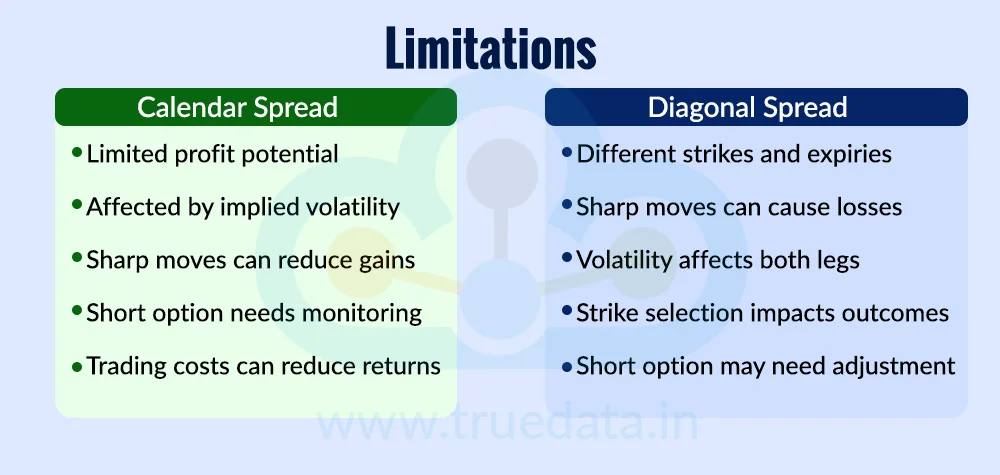
The limitations of calendar spread and diagonal spread are part of understanding and using them effectively. These limitations include,

What are the Limitations of Using a Calendar Spread and a Diagonal Spread

  • Calendar Spread

    • Limited profit potential as returns depend on the underlying staying near the chosen strike.

    • Changes in implied volatility can affect the spread's value.

    • A sharp move away from the strike can reduce potential gains.

    • The short option needs to be monitored as expiry approaches.

    • Brokerage and other trading costs can reduce returns.

  • Diagonal Spread

    • Different strikes and expiry dates can make the strategy harder to manage.

    • A sharp move against the trader's view can cause losses.

    • Changes in implied volatility can affect both option legs differently.

    • Choosing unsuitable strike prices can affect the strategy's outcome.

    • The short option may need to be closed, rolled or adjusted before expiry.

Conclusion

Calendar spreads and diagonal spreads can both help traders use differences in option expiry and time decay, but they suit different market views. A calendar spread uses the same strike price with different expiries, while a diagonal spread uses different strike prices and expiries, giving traders more directional flexibility. Before using either strategy, traders should understand the impact of price movement, time decay, implied volatility, premiums and expiry, and manage the position according to their risk tolerance and trading plan.

This article is an attempt to explain the two important option trading startegies simplifying them for traders. Let us know your thoughts on the topic or if you need further information and we will address them soon.

Till then, Happy Reading!


Read More: What is Options Expiration? Strategies to Avoid Traps on Options Expiration Day 

Frequently Asked Questions

Neither is universally better. A calendar spread may suit traders expecting limited near-term movement around a strike, while a diagonal spread may suit those with a more directional view and willingness to manage different strike prices and expiries.

Calendar spreads and diagonal spreads are not strictly bullish or bearish; their direction depends on how the options are structured. Generally, calendar spreads are often used for a neutral or range-bound view, while diagonal spreads can be structured for bullish, bearish or neutral views.

A calendar spread has limited profit potential, which depends on the underlying’s price, time decay and changes in implied volatility. The maximum loss is generally limited to the net premium paid to set up the spread, plus applicable trading costs.

Yes, both calendar spreads and diagonal spreads can be used to generate income by selling shorter-expiry options and benefiting from their time decay. However, they involve risks from price movements, implied volatility and option expiry, so they should be used with proper risk management.

Implied volatility (IV) affects the value of both calendar and diagonal spreads, as changes in IV can increase or decrease the premiums of the options differently. Since the two options have different expiry dates (and, for diagonal spreads, different strikes), traders should consider IV changes along with time decay and the underlying’s price movement.
Marisha Bhatt

Marisha Bhatt is a financial content writer @TrueData.

She writes with the sole aim of simplifying complex financial concepts and jargon while attempting to clarify technical and fundamental analysis concepts of the stock markets. The ultimate goal is to spread vital knowledge and benefit the maximum audience. Her Chartered Accountant background acts as the knowledge base to help clarify crucial concepts and create a sound investment portfolio.

46 Comments
K
Kavish
· October 15, 2026

This article explains the difference between calendar spreads and diagonal spreads in a simple and easy-to-understand way.

·
Marisha Bhatt Author
Kavish · October 19, 2026

Thank you for your feedback! We’re glad the article made the differences between calendar spreads and diagonal spreads easier to understand. We hope it helps readers build a better understanding of options strategies and make more informed trading decisions.

·
D
Dinesh
· October 16, 2026

which strategy works better for beginners

·
Marisha Bhatt Author
Dinesh · October 19, 2026

Thank you for your question! Calendar spreads are generally easier for beginners to understand because they involve the same strike price with different expiry dates, while diagonal spreads add another layer of complexity. We recommend learning the basics of both strategies and understanding their risks before using them in live trading.

·
A
Aravindh Das
· October 16, 2026

How do strike prices affect the risk and profit potential of a diagonal spread?A

·
Marisha Bhatt Author
Aravindh Das · October 19, 2026

Thank you for your insightful question! The difference between the strike prices affects a diagonal spread’s cost, potential profit, and risk, while the premiums and price movement of the underlying asset also play an important role. Understanding these factors can help traders evaluate the strategy better before placing a trade.

·
R
Ratish Khanna
· October 16, 2026

Informative. How can i choose the right expiry dates for a calendar spread?

·
Marisha Bhatt Author
Ratish Khanna · October 19, 2026

Thank you for your feedback! When choosing expiry dates for a calendar spread, consider your market outlook, the time you expect the trade to work, and the difference in time value between the two options. It’s also important to understand the risks and test your strategy before trading with real money.

·
P
Prabhu
· October 16, 2026

Excellent Blog

·
Marisha Bhatt Author
Prabhu · October 19, 2026

Thank you for appreciating our post! We are glad you like it!

·
S
Swamy JB
· October 16, 2026

nice

·
Marisha Bhatt Author
Swamy JB · October 19, 2026

Thank you for your valuable feedback! We truly appreciate your continued support!

·
K
Kishore
· October 17, 2026

Great blog post

·
Marisha Bhatt Author
Kishore · October 19, 2026

Thank you for your kind words! We’re happy to know you enjoyed reading the blog. We look forward to sharing more useful and easy-to-understand content to support your learning journey!

·
H
Harshith
· October 17, 2026

A very clear explanation of calendar spreads and diagonal spreads. This blog make it easier to understand the key differences between these options strategies.

·
Marisha Bhatt Author
Harshith · October 19, 2026

Thank you for your encouraging feedback! We’re glad the blog helped you understand the key differences between calendar spreads and diagonal spreads more clearly. We hope our content continues to make learning about options trading simpler and more enjoyable!

·
R
Rejish
· October 17, 2026

hello mam, u nicely explained the differences between calendar and diagonal spreads in a simple way. Very helpful for options traders

·
Marisha Bhatt Author
Rejish · October 19, 2026

Thank you so much for your kind words! We are happy to know the article made the differences between calendar and diagonal spreads easier to understand. We will continue sharing simple, practical insights to help options traders strengthen their knowledge and make informed decisions!

·
D
Deepa Kumar
· October 17, 2026

Good explanation of strike prices, expiry dates, and time decay. The comparison table makes the concepts easy to understand

·
Marisha Bhatt Author
Deepa Kumar · October 19, 2026

Thank you for your valuable feedback! We’re glad the comparison table helped make concepts like strike prices, expiry dates, and time decay easier to understand. We hope our content continues to make learning about options trading simpler and more accessible for everyone!

·
K
kuldeep
· October 17, 2026

A useful guide for beginners who want to understand different options trading strategies and their risks.

·
Marisha Bhatt Author
kuldeep · October 19, 2026

Thank you for your thoughtful feedback! We are glad the guide is helpful for beginners looking to understand options trading strategies and the risks involved. Building a strong foundation is an important step towards making informed trading decisions, and we are happy to be part of your learning journey!

·
D
Devvrat
· October 18, 2026

A helpful guide for options traders. The examples make it easier to understand how strike prices and expiration dates differ in these strategies.

·
Marisha Bhatt Author
Devvrat · October 19, 2026

Thank you for sharing your feedback! We are glad the examples helped clarify how strike prices and expiry dates work in calendar and diagonal spreads. We will keep bringing you practical explanations to make options trading concepts easier to understand!

·
S
Shiv Raj
· October 18, 2026

I found the comparison between calendar spreads and diagonal spreads useful for understanding when each strategy may be suitable.

·
Marisha Bhatt Author
Shiv Raj · October 19, 2026

Thank you for your feedback! We’re glad the comparison helped you understand when calendar spreads and diagonal spreads may be suitable for different market views. We hope this knowledge helps you evaluate these strategies more confidently while keeping their risks in mind.

·
D
Deepti Agarwal
· October 18, 2026

Great explanation of two options strategies that may look similar but have different risk and profit characteristics.

·
Marisha Bhatt Author
Deepti Agarwal · October 19, 2026

Thank you for your thoughtful feedback! We are glad the article helped clarify how calendar spreads and diagonal spreads differ in terms of risk and profit potential. Understanding these differences can help traders choose strategies that better match their market outlook and risk tolerance.

·
M
Mukthar
· October 18, 2026

Understanding the differences in strike prices and expiry dates is important when choosing between these spread strategies. This article explains it clearly.

·
Marisha Bhatt Author
Mukthar · October 19, 2026

Thank you for your kind feedback! We are glad the article helped explain how strike prices and expiry dates influence calendar and diagonal spreads. We hope it helps readers understand these strategies better and make more informed trading decisions!

·
V
Vino XSV
· October 23, 2026

Informative Post

·
Marisha Bhatt Author
Vino XSV · October 26, 2026

Thank you for your valuable feedback! We truly appreciate it!

·
A
Aman
· October 26, 2026

Nice explanation of calendar spreads and diagonal spreads. The comparison makes it easier to understand their differences.

·
Marisha Bhatt Author
Aman · October 26, 2026

Thank you for your kind feedback! We are glad the comparison helped clarify how calendar spreads and diagonal spreads differ in terms of strike prices and expiry dates. We hope these insights help readers build a stronger understanding of options trading strategies!

·
F
Francis
· October 26, 2026

How should traders choose between a calendar spread and a diagonal spread based on market volatility?

·
Marisha Bhatt Author
Francis · October 26, 2026

Thank you for this thoughtful question! Calendar spreads may suit traders who expect changes in implied volatility and want to benefit from differences in time decay, while diagonal spreads offer more flexibility when traders also have a view on the direction of the underlying asset. Before choosing either strategy, traders should assess volatility, expiry dates, potential losses, and their risk tolerance.

·
J
Joaquim
· October 26, 2026

Good. explains calendar spread vs diagonal spread and helps options traders understand their key differences.

·
Marisha Bhatt Author
Joaquim · October 26, 2026

Thank you for your feedback! We are happy to know the comparison helped clarify the key differences between calendar spreads and diagonal spreads. We hope these insights help options traders understand these strategies better and make more informed trading decisions!

·
N
Nabam
· October 26, 2026

Good. one suggestion, can you add practical example with strike prices and expiry dates would make the comparison even clearer.

·
Marisha Bhatt Author
Nabam · October 26, 2026

Thank you for this valuable suggestion! Practical examples using different strike prices and expiry dates can make it much easier to understand how calendar spreads and diagonal spreads work in real trading situations. We will keep your feedback in mind as we continue creating more practical and beginner-friendly content!

·
R
Rejin Jose
· October 26, 2026

Nice blog. understanding how calendar and diagonal spreads differ in options trading

·
Marisha Bhatt Author
Rejin Jose · October 26, 2026

Thank you for your feedback! We are glad the article helped you understand how calendar spreads and diagonal spreads differ in terms of strike prices and expiry dates. We hope these insights make it easier for you to explore options trading strategies with greater confidence!

·
G
Govindh
· November 10, 2026

nice explain

·
Marisha Bhatt Author
Govindh · November 10, 2026

Thank you, we are glad you like our post! Stay tuned for more interesting content on TrueData!

·
N
Nakul
· November 10, 2026

Does implied volatility have a different impact on calendar spreads and diagonal spreads?

·
Marisha Bhatt Author
Nakul · November 10, 2026

Thank you for this interesting question! Yes, implied volatility affects both strategies, but the impact depends on the strike prices and expiry dates of the options involved. In calendar spreads, changes in volatility across expiry dates matter, while diagonal spreads are also affected by differences in volatility across strike prices. Understanding these factors can help traders manage risk more effectively!

·

Related Articles

SEE ALL
Trading Strategies / Indicators
What are popular options trading strategies?

When we talk about trading, which security is the most common one that comes to ...

Trading Strategies / Indicators
Writing Call Options - All You Need to Know

Options trading has become one of the hottest topics in the Indian stock markets...

Trading Strategies / Indicators
Options Greeks - Vega

Options trading is one of the most significant trading segments and is gaining i...