Mutual funds are a popular way to build wealth over the long term. But when life takes an unexpected turn and we lose a loved one, financial matters still need to be taken care of, even during a difficult time. So, what happens to the mutual fund investments held by the deceased? Who gets the mutual fund units, and what is the process for transferring or claiming them? Get answers to all these questions and more on what happens to mutual funds upon the death of an investor and important steps that family members and legal heirs should know.

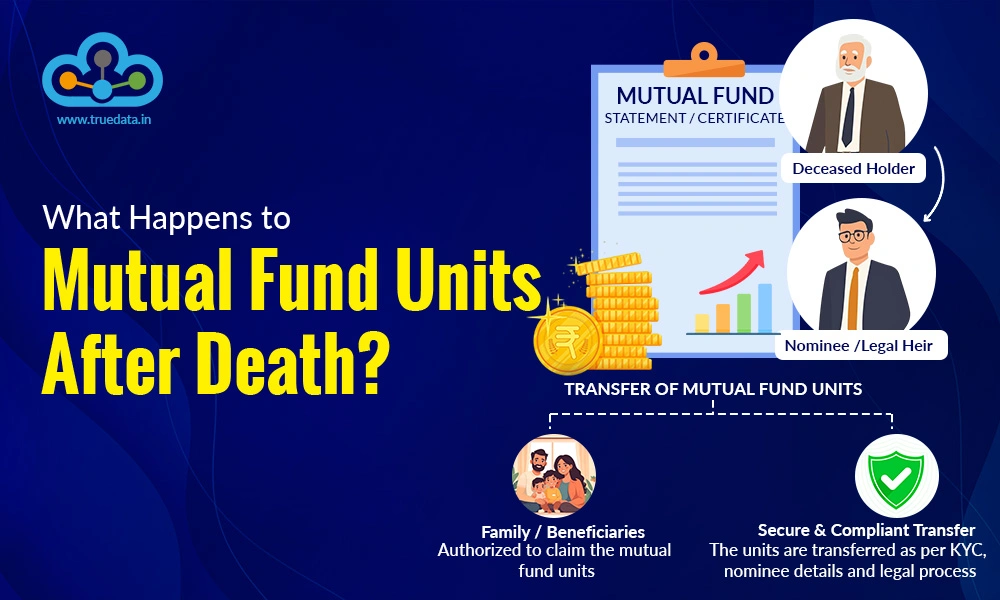
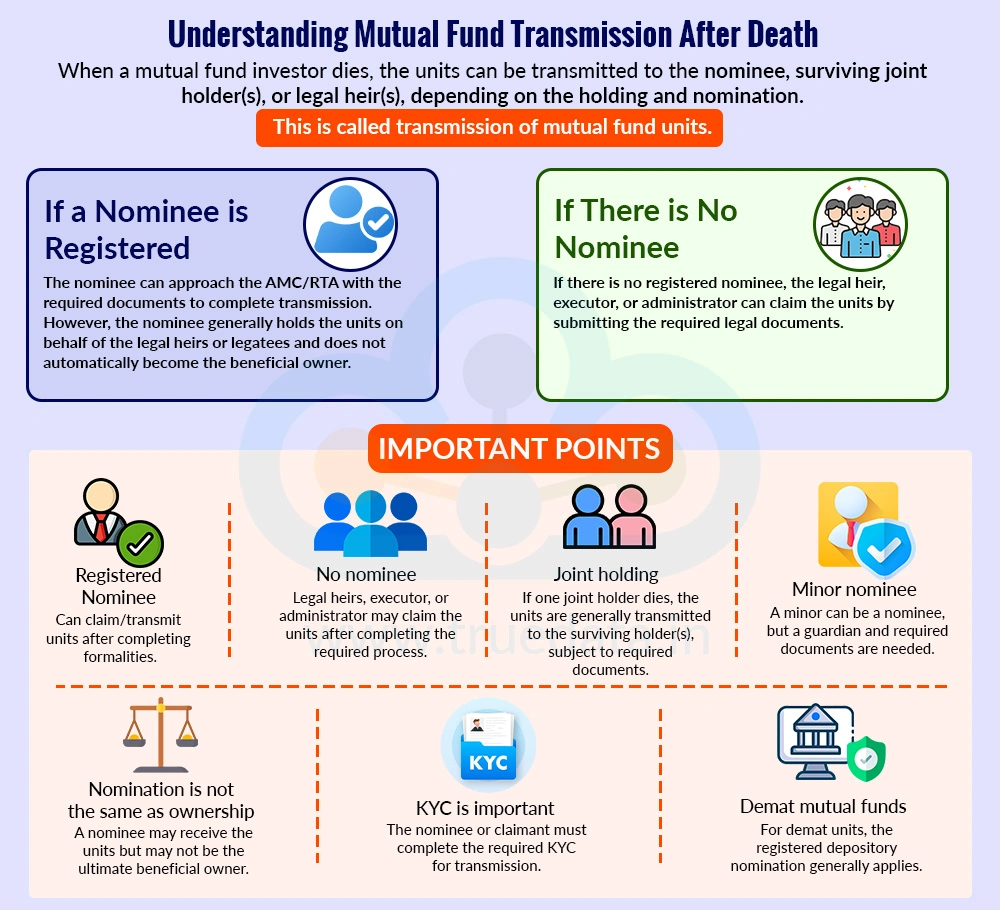
When a mutual fund investor dies, the units do not simply disappear. They can be transmitted to the registered nominee, surviving joint holder(s), or legal heir(s), depending on how the mutual fund investment was held and whether a nomination was registered. This process is known as transmission of mutual fund units. If a nominee is registered, the nominee can approach the AMC or its Registrar and Transfer Agent (RTA) with the required documents, such as the death certificate, KYC details and bank details, to complete the transmission process. However, it is important to understand that under the mutual fund nomination framework, the nominee generally receives the units as an agent/trustee for the legal heirs or legatees, and nomination by itself does not necessarily create beneficial ownership of the deceased investor's assets.
If there is no registered nominee, the units may be claimed by the deceased investor's legal heir(s), executor or administrator of the estate, depending on whether the investor left a Will and the applicable succession law. In such cases, additional documents such as a Will, succession certificate, probate, letter of administration, legal-heirship documents, indemnity bond or NOCs from other legal heirs may be required, depending on the circumstances and value of the investment.
Important points to remember -
Registered nominee - The registered nominee can claim/transmit the mutual fund units after completing the required formalities provided there is no difference between the nominee and legal heir.
No nominee - The legal heirs, executor or administrator of the estate may claim the units, subject to the required legal and documentary process.
Joint holding - If one joint holder dies, the units are generally transmitted to the surviving joint holder(s), subject to the prescribed documentation.
Minor nominee - A minor can be a nominee, but a guardian and additional documentation are required to complete the claim.
Nomination is not the same as ownership - A nominee may receive the units from the AMC but may not necessarily become the ultimate beneficial owner under succession law.
KYC is important - The nominee or claimant generally needs to complete the applicable KYC requirements before transmission can be completed.
Demat mutual funds - If the units are held in demat form, the nomination registered with the depository generally applies, and the transmission process follows the applicable depository rules.

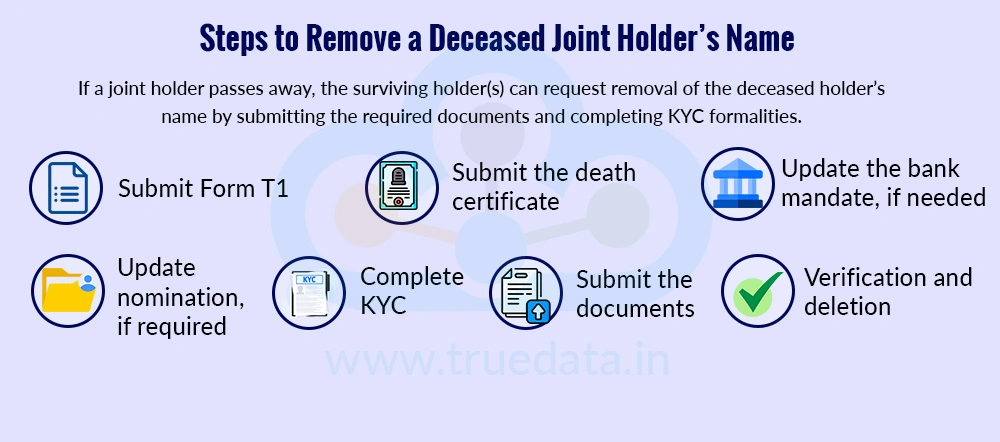
If a mutual fund is held jointly and the 2nd or 3rd holder passes away, the surviving holder(s) can request the mutual fund house or its RTA to remove the deceased holder’s name from the folio. The surviving holder(s) need to submit the required documents and complete the applicable KYC requirements.
The steps involved include,
Submit Form T1 - The surviving holder(s) need to submit Form T1 to request deletion of the deceased holder’s name.
Submit the death certificate - Provide the deceased holder’s death certificate in the format required by the AMC/RTA.
Update the bank mandate, if needed - If the surviving holder(s) want to change the registered bank account, they need to submit a new bank mandate and cancelled cheque.
Update nomination, if required - A fresh nomination form or nomination opt-out form can be submitted, if needed.
Complete KYC - All surviving holder(s) must be KYC compliant. If required, they must complete the KYC process before the request can be processed.
Submit the documents - Submit Form T1 and all supporting documents to the mutual fund AMC or its RTA.
Verification and deletion - The AMC/RTA will verify the documents, and once approved, the deceased holder’s name will be removed, and the surviving holder(s) will continue to hold the units.

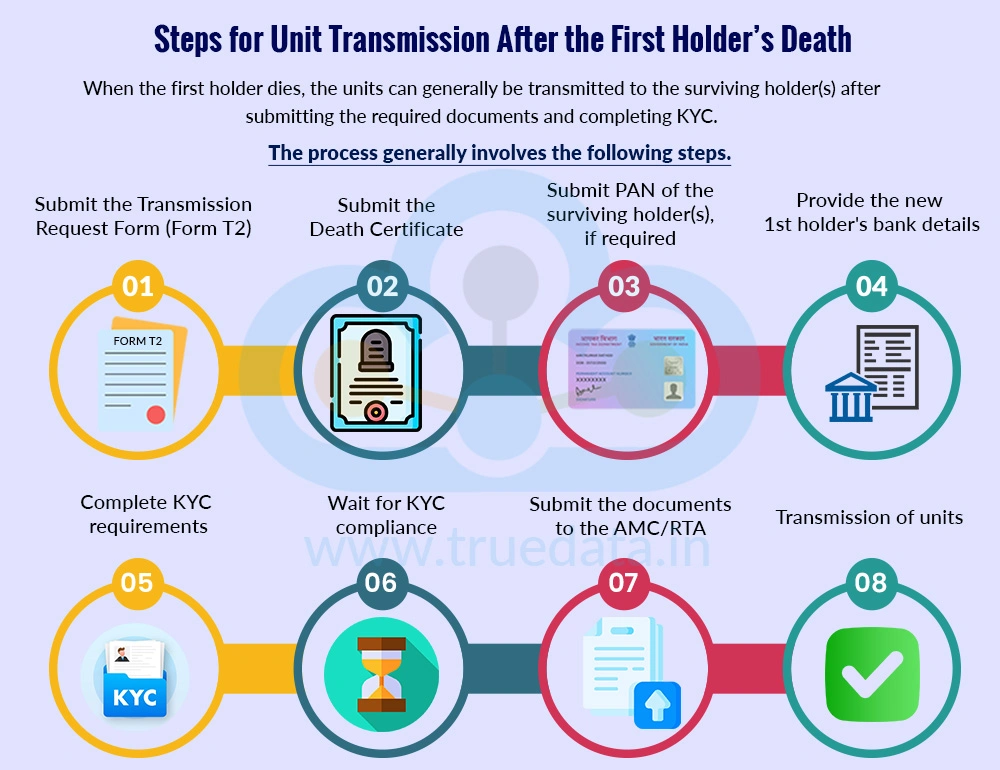
When the 1st holder of a jointly held mutual fund investment passes away, the mutual fund units can generally be transmitted to the surviving joint holder(s), subject to the applicable terms and documentation. The surviving holder(s) need to submit a transmission request along with the death certificate and other required documents to the mutual fund house or its Registrar and Transfer Agent (RTA). Once the documents are verified and the surviving holder(s) meet the applicable KYC requirements, the units can be transmitted, and the surviving holder(s) can continue to hold the investment.
The process generally involves the following steps.
Submit the Transmission Request Form (Form T2) - The surviving joint holder(s) need to submit Form T2, requesting the transmission of the mutual fund units into their name(s).
Submit the Death Certificate - The death certificate of the deceased 1st holder needs to be submitted. Depending on the applicable requirements, this may be the original death certificate or a copy that is self-attested and attested by a Notary Public or Gazetted Officer.
Submit PAN of the surviving holder(s), if required - A self-attested copy of the PAN card of the surviving joint holder(s) needs to be provided if their PAN details are not already registered with the mutual fund folio.
Provide the new 1st holder's bank details - Since the original 1st holder has passed away, the surviving joint holder needs to become the new 1st holder. A cancelled cheque with the new 1st holder's name pre-printed should be submitted. Alternatively, a recent bank statement or passbook, generally not more than 3 months old, showing the new 1st holder's name can be provided.
Complete KYC requirements - The surviving holder(s) must be KYC compliant. If any surviving holder is not KYC compliant, the required KYC Form or KYC acknowledgement needs to be submitted.
Wait for KYC compliance - The transmission process will be completed only after the KYC status of the surviving holder(s) is updated to ‘KYC Complied’.
Submit the documents to the AMC/RTA - The completed Form T2 and supporting documents should be submitted to the concerned mutual fund house or its Registrar and Transfer Agent (RTA) through the applicable submission channel.
Transmission of units - After verifying the documents and completing the necessary checks, the AMC/RTA will transmit the units to the surviving holder(s) and update the folio accordingly.
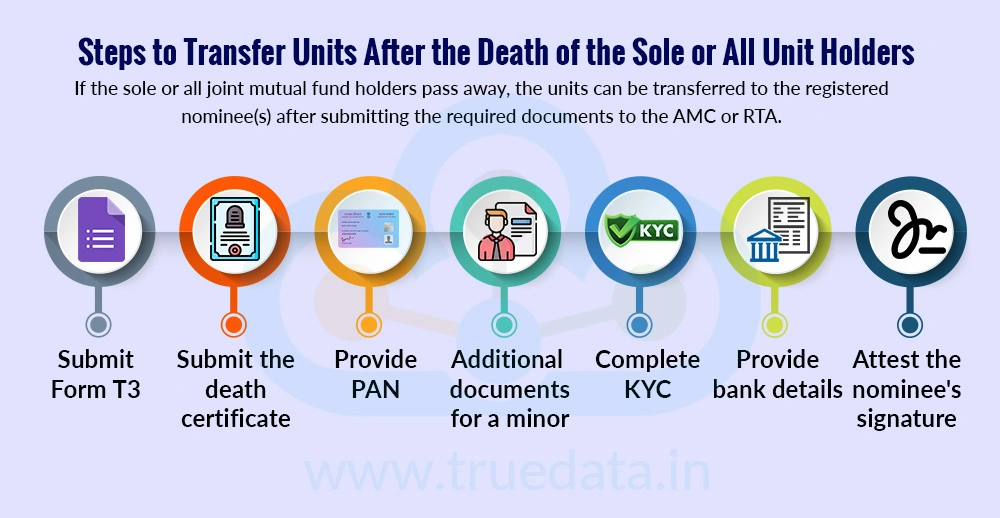
If the sole mutual fund investor, or all joint holders, pass away, the units can generally be transferred to the registered nominee(s). The nominee needs to submit the required documents to the mutual fund AMC or RTA. The exact requirements may vary based on factors such as the nominee's age and the value of units.
The process can be understood through the following steps.

Submit Form T3 - The nominee(s) need to submit Form T3 to request transmission of the mutual fund units.
Submit the death certificate - Provide the death certificate of the deceased investor(s) in the required format.
Provide PAN - Submit a self-attested copy of the nominee's PAN. For a minor nominee, the PAN of the minor and/or guardian may be required.
Additional documents for a minor - If the nominee is a minor, a copy of the birth certificate and the required guardian details must be provided.
Complete KYC - The nominee or guardian must be KYC compliant. If not, the required KYC documents must be submitted before the transmission can be completed.
Provide bank details - Submit a cancelled cheque with the nominee's name or a recent bank statement/passbook showing the nominee's bank account details.
Attest the nominee's signature - The signature attestation requirement depends on the value of the units:
Up to Rs. 5,00,00 - The nominee's signature generally needs to be attested by the bank manager in the prescribed format.
Above Rs. 5,00,000 - The signature generally needs to be attested by a Notary Public or Judicial Magistrate First Class (JMFC).
Once the documents are verified and all requirements are met, the mutual fund units can be transmitted to the nominee's name.
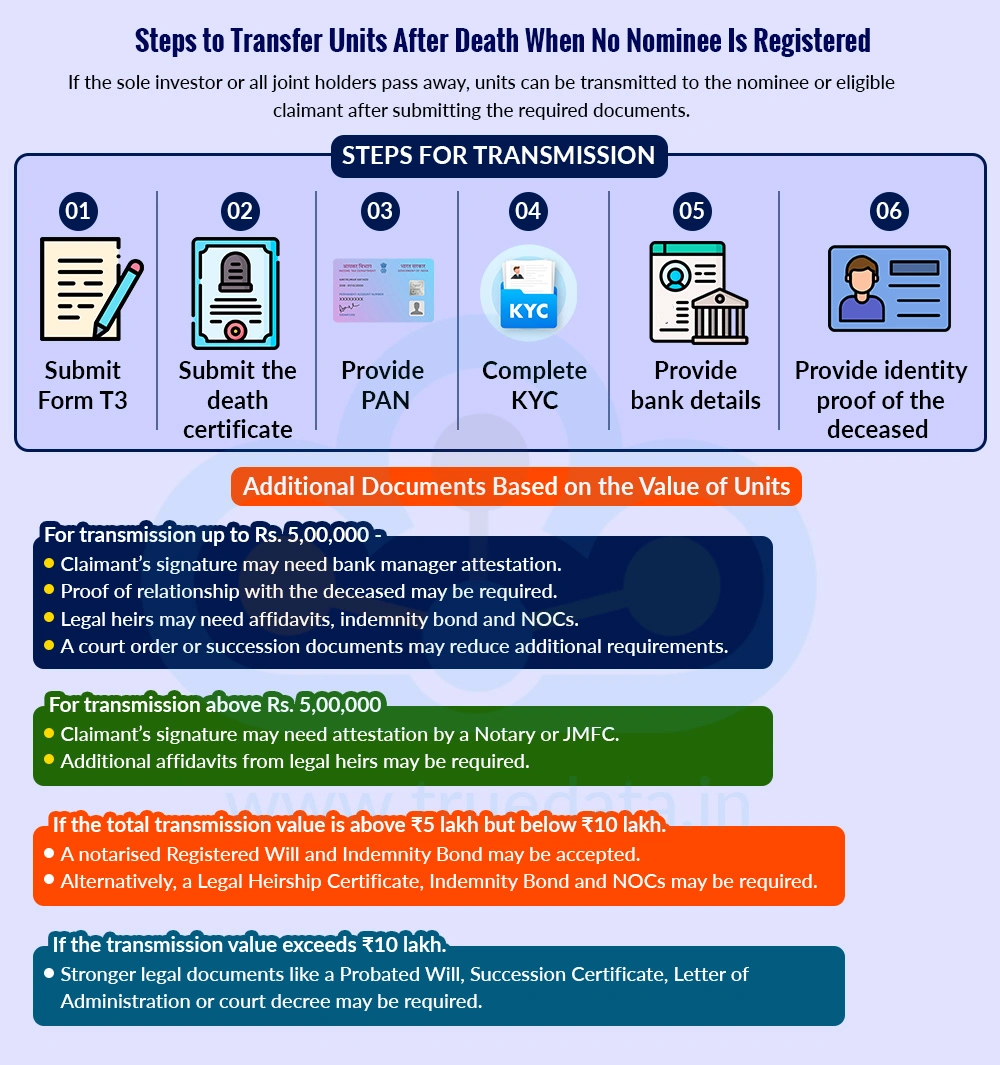
If the sole mutual fund investor, or all joint holders, pass away, the units can generally be transmitted to the registered nominee(s) or other eligible claimant(s). The claimant needs to submit the required transmission form, death certificate, PAN, KYC and bank details. If there is no nominee, additional documents may be required from the legal heirs. The documents required can also depend on the value of the units being transmitted.
The steps include,

Submit Form T3 - The claimant needs to submit Form T3 to request transmission of the mutual fund units.
Submit the death certificate - Provide the death certificate of the deceased investor(s). If the claimant is a minor, the minor's birth certificate may also be required.
Provide PAN - Submit the claimant's self-attested PAN. For a minor, the PAN of the minor and guardian may be required.
Complete KYC - The claimant or guardian must be KYC compliant. If not, the required KYC documents must be submitted.
Provide bank details - Submit a cancelled cheque with the claimant's name or a recent bank statement/passbook.
Provide identity proof of the deceased - PAN, redacted Aadhaar, passport, voter ID or another valid identity document may be required. The document may need to be notarised or verified at the AMC branch.
The documentation becomes more detailed for higher-value transmissions.
For transmission up to Rs. 5,00,000 -
The claimant's signature generally needs to be attested by the bank manager.
Proof of relationship with the deceased may be required.
Legal heirs may need to submit affidavits, a Bond of Indemnity and NOCs from other legal heirs, depending on the circumstances.
If a Succession Certificate, Probate, Letter of Administration or court order is available, some of these documents may not be required.
For transmission above Rs. 5,00,000 -
The claimant's signature generally needs to be attested by a Notary Public or Judicial Magistrate First Class (JMFC).
Additional affidavits from legal heirs may be required.
If the total transmission value linked to the deceased's PAN is above Rs. 5,00,000 but below Rs. 10,00,000 -
A notarised Registered Will and Indemnity Bond may be accepted, where applicable.
Alternatively, a Legal Heirship Certificate, Indemnity Bond and NOCs from other legal heirs may be required.
If the transmission value linked to the deceased's PAN is above Rs. 10,00,000 -
Stronger legal documents may be required, such as a Probated Will, Succession Certificate, Letter of Administration or court decree, depending on the circumstances.
The AMC or RTA may also ask for identity proof of other legal heirs who provide an NOC or affidavit. The exact documents and requirements can vary based on the AMC/RTA, the claimant's circumstances and the value of the units.
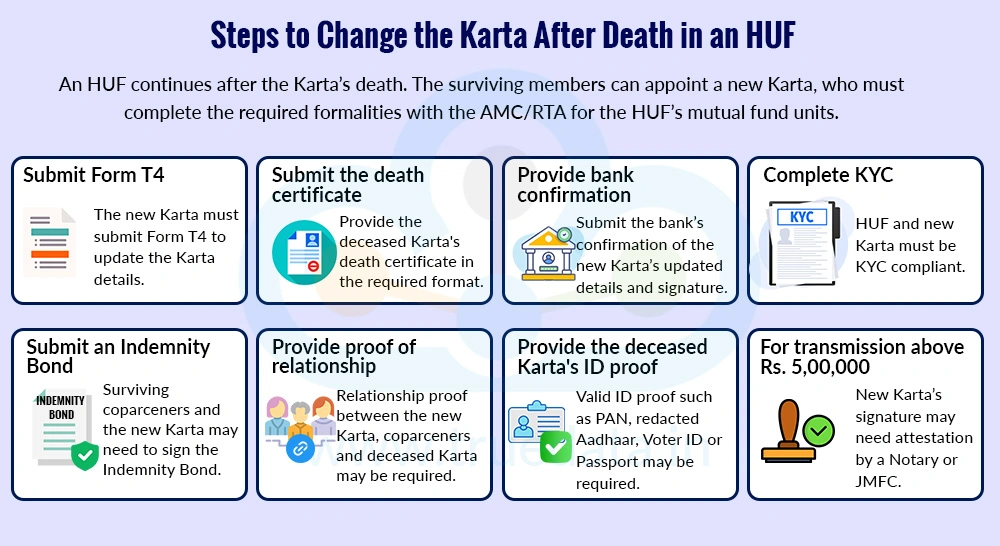
An HUF does not end when its Karta passes away. The surviving members can appoint a new Karta to manage the HUF's assets and investments. If the HUF holds mutual fund units, the new Karta needs to complete the required formalities with the mutual fund AMC or RTA. The key steps are,

Submit Form T4 - The new Karta needs to submit Form T4 to update the Karta's details after the previous Karta's death.
Submit the death certificate - Provide the deceased Karta's death certificate in the required format.
Provide bank confirmation - Submit a letter from the HUF's bank confirming that the new Karta's details and signature have been updated. The bank may also need to attest the new Karta's signature in the prescribed format.
Complete KYC - Both the HUF and the new Karta must be KYC compliant. If required, the relevant KYC documents need to be submitted.
Submit an Indemnity Bond - All surviving coparceners, including the new Karta, may need to sign the prescribed Indemnity Bond.
Provide proof of relationship - Documents establishing the relationship between the new Karta, other coparceners and the deceased Karta may be required.
Provide the deceased Karta's ID proof - PAN, redacted Aadhaar, Voter ID, Passport or another valid identity document may be required. The document may need to be notarised or verified at the AMC branch.
For transmission above Rs. 5,00,000 - The new Karta's signature generally needs to be attested by a Notary Public or Judicial Magistrate First Class (JMFC).
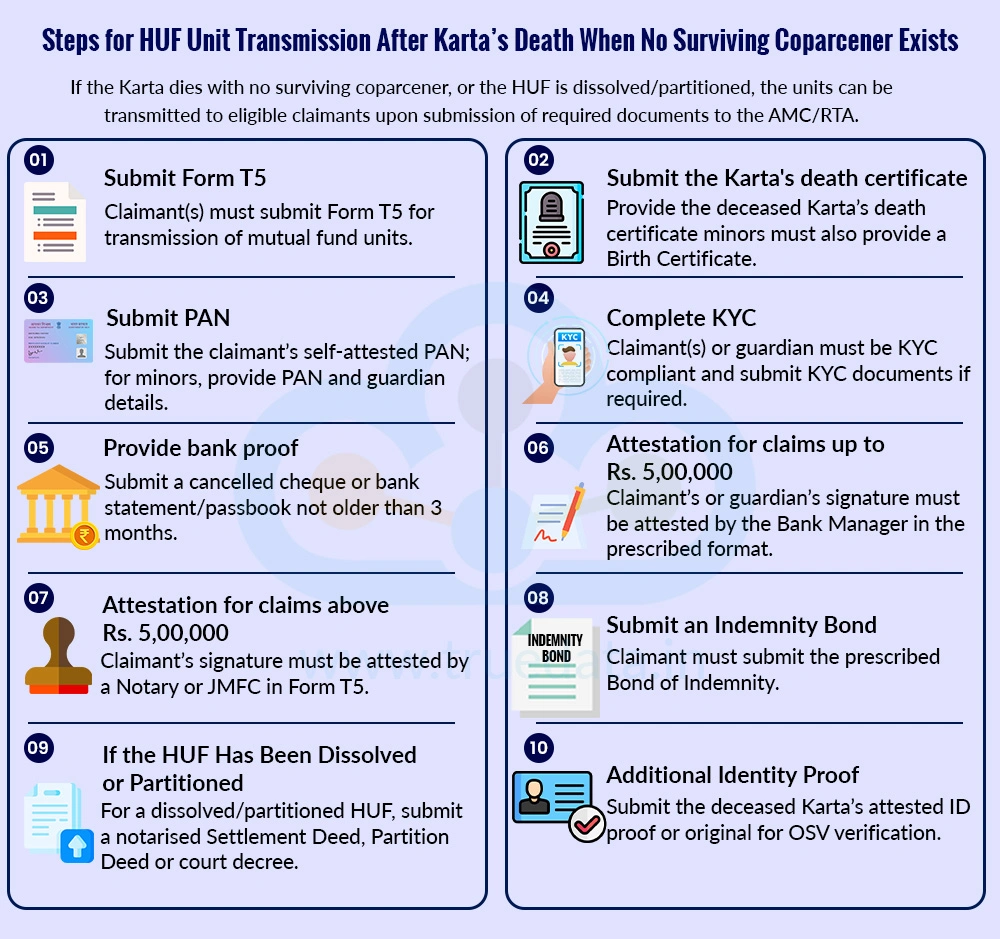
If the Karta of an HUF passes away and there is no surviving co-parcener, or the HUF is subsequently dissolved or partitioned, the mutual fund units can be transmitted to the eligible claimant(s). The claimant needs to submit the prescribed documents to the AMC/RTA.

Submit Form T5 - The claimant(s) need to submit the Transmission Request Form (Form T5) to request transmission of the mutual fund units.
Submit the Karta's death certificate - Provide the deceased Karta's original death certificate or an appropriately attested copy, as required. If the claimant is a minor, the applicable Birth Certificate should also be provided.
Submit PAN - Provide a self-attested copy of the PAN card of the claimant(s). For a minor claimant, the applicable PAN and guardian details should be provided.
Complete KYC - The claimant(s), or guardian in case of a minor, must be KYC compliant. If not, the required KYC form/acknowledgement must be submitted. Transmission will be completed only after the status becomes ‘KYC Complied’.
Provide bank proof - Submit either a cancelled cheque with the claimant's name pre-printed or a recent bank statement/passbook, generally not more than 3 months old.
Attestation for claims up to Rs. 5,00,000 - The claimant's signature should be attested by the Bank Manager in the prescribed Annexure-I(a) format. For a minor, the guardian's signature should be attested based on the minor's bank account or joint account with the guardian.
Attestation for claims above Rs. 5,00,000 - The claimant's signature should be attested by a Notary Public or Judicial Magistrate First Class (JMFC) in the designated section of Form T5.
Submit an Indemnity Bond - The claimant needs to provide a Bond of Indemnity in the prescribed Annexure-VI format.
If the HUF Has Been Dissolved or Partitioned - If the surviving members have dissolved or partitioned the HUF after the Karta's death, the transmission can be processed based on an appropriate legal document, such as,
Notarised copy of a Settlement Deed
Notarised copy of a Deed of Partition
Notarised copy of a decree issued by the relevant competent court
Additional Identity Proof - The claimant may also need to provide an identity document of the deceased Karta, such as PAN, redacted Aadhaar, Voter ID or Passport, or another valid OVD permitted under applicable PMLA guidelines. The document should be appropriately attested/notarised, or the original may be shown at the AMC branch for Original Seen & Verified (OSV) verification.
The death of a mutual fund investor can be emotionally difficult, but understanding what happens to the investments can make the financial process easier for the family. Mutual fund units can generally be transmitted to the registered nominee, surviving joint holder, legal heir or other eligible claimant, depending on how the investment was held. Keeping nominations, KYC and bank details updated can help reduce delays and paperwork. Knowing the transmission process in advance can help families manage the investor’s mutual fund investments with greater clarity and confidence during a difficult time.
This article addresses an important aspect of mutual fund portfolios and safeguarding assets. Let us know your thoughts on the topic or if you need further information, and we will address it soon.
Till then, Happy Reading!
Read More: Can You Transfer Mutual Funds to Others?
Your mutual fund has delivered impressive returns, but are those the actual retu...
Mutual fund investments have simplified greatly with just a tap on your smartpho...