Mutual Funds

Specialised Investment Funds (SIFs): Meaning, Rules, Benefits & Risks

Marisha Bhatt · 25 Nov 2025 · 12 mins read · 8 Comments

specialised-investment-funds-sifs-meaning-rules-benefits-risks

In recent years, mutual fund investments have grown tremendously in India, helping millions of investors build wealth over time. Yet, for many investors seeking higher growth opportunities without meeting the steep entry barriers of Portfolio management Services (PMS), options have been limited, i.e., until now. Recognising this gap, SEBI introduced a new investment avenue in 2025, i..e, the Special Investment Funds (SIFs). These funds aim to bridge the space between mutual funds and PMS, offering investors the chance to pursue higher returns with more flexibility and accessibility. Curious to know how SIFs work and how they can complement your mutual fund portfolio? Let us dive in and explore how this new category could help you craft a more strategic and goal-driven investment plan.

What are Specialised Investment Funds (SIFs)?

What are Specialised Investment Funds (SIFs)

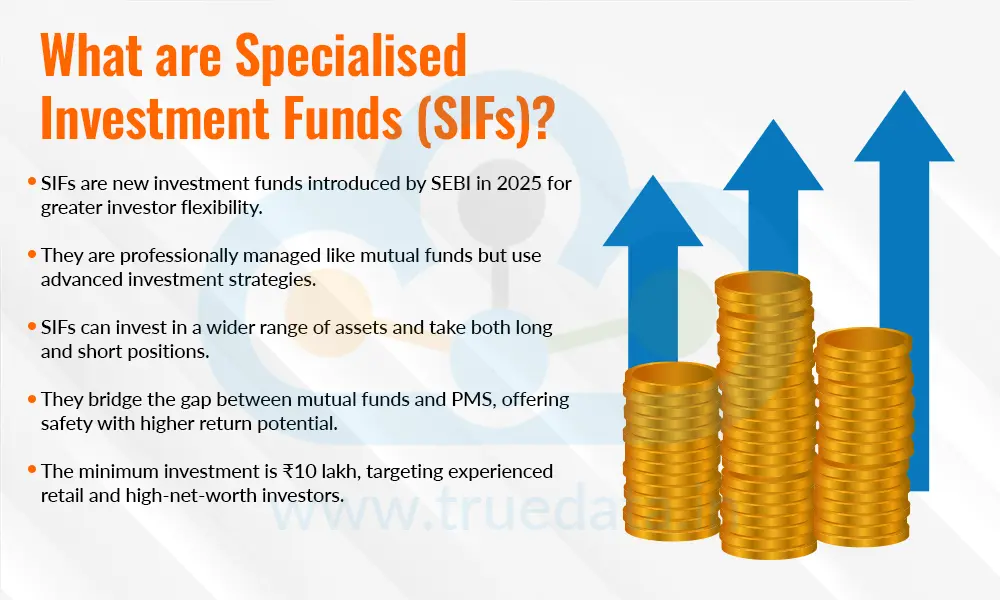
Specialised Investment Funds (SIFs) are a new type of investment option introduced by the Securities and Exchange Board of India (SEBI) in 2025 to give investors more flexibility and opportunities to grow their wealth. In simple terms, SIFs are professionally managed funds, just like mutual funds, however, they are allowed to use more advanced investment strategies that were previously available only to very wealthy investors through Portfolio Management Services (PMS) or Alternate Investment Funds (AIFs) This means SIFs can invest in a wider range of assets and can also take both ‘long’ and ‘short’ positions in the market, allowing fund managers to make money in both rising and falling markets. SIFs, thus, act as a bridge between mutual funds and PMS as they combine the professional management and regulatory safety of mutual funds with the flexibility and higher return potential of PMS. The minimum investment amount for SIFs is Rs. 10,00,000, which makes them accessible to experienced retail investors as well as high-net-worth individuals. SIFs are, therefore, a niche investment product designed for investors who want to aim for higher growth and are comfortable taking a bit more risk, while still staying within SEBI’s regulatory framework.

What are the SEBI Rules for Specialised Investment Funds?

What are the SEBI Rules for Specialised Investment Funds

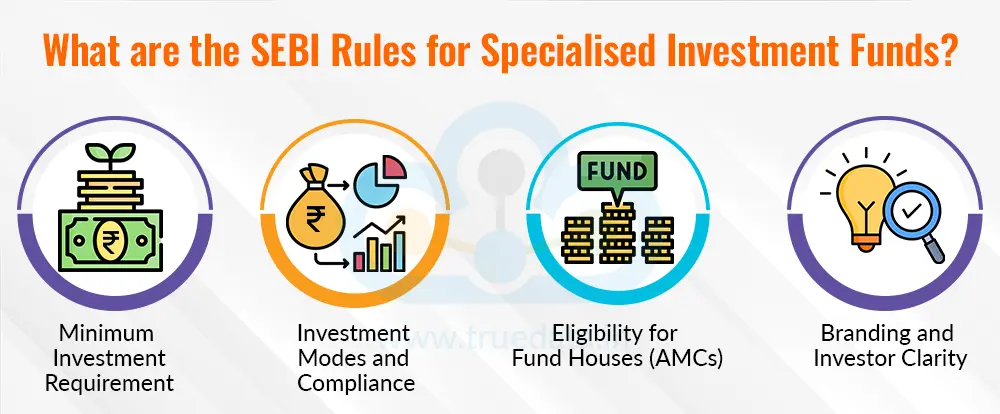
The Securities and Exchange Board of India (SEBI) introduced a new set of rules in 2025 to govern Specialised Investment Funds (SIFs). These rules are designed to ensure that both fund managers and investors meet certain eligibility standards, maintaining transparency and investor protection while allowing more advanced investment strategies.

Minimum Investment Requirement

Under Regulation 49X(1) of SEBI’s Mutual Fund Regulations, the minimum investment in SIFs is Rs. 10,00,000 per investor. Further, 

  • This limit applies at the PAN level across all SIF strategies offered by the same Asset Management Company (AMC), and it is not scheme-specific.

  • The Rs. 10,00,000 threshold only applies to SIFs and does not include investments in regular mutual fund schemes of the same AMC.

  • Accredited investors (those who meet SEBI’s higher income or net-worth standards) are exempt from this minimum investment rule.

Investment Modes and Compliance

Investors can participate in SIFs through Systematic Investment Plan (SIP), Systematic Withdrawal Plan (SWP), or Systematic Transfer Plan (STP). However, the total commitment across all these modes must meet the Rs. 10,00,000 minimum, unless the investor is accredited. SEBI requires daily monitoring of this threshold. 

  • If the investment value falls below Rs. 10,00,000 due to market fluctuations, it is treated as a passive breach and not a violation.

  • If the drop occurs because of active redemption or transfer, the AMC may require the investor to exit the SIF.

Eligibility for Fund Houses (AMCs)

To launch and manage a Specialised Investment Fund, an AMC must meet certain experience and credibility requirements. 

  • The AMC should have been operational for at least 3 years with an average Assets Under Management (AUM) of Rs. 10,000 crore or more in the past three years.

  • If this condition is not met, the AMC can still qualify if it appoints a Chief Investment Officer (CIO) with at least 10 years of fund management experience, who has managed an average AUM of Rs. 5,000 crore, and a second fund manager with at least 3 years of experience handling Rs. 500 crore or more.

  • The AMC and its sponsors must have a clean regulatory record with no SEBI actions or penalties in the last three years.

Branding and Investor Clarity

SEBI requires each SIF to have a distinct brand identity, separate from the AMC’s regular mutual fund schemes. This helps investors clearly differentiate high-strategy SIFs from standard mutual funds, even if the AMC name is used for recognition or trust.

What are the Types of Investment Strategies Allowed Under SIFs?

What are the Types of Investment Strategies Allowed Under SIFs

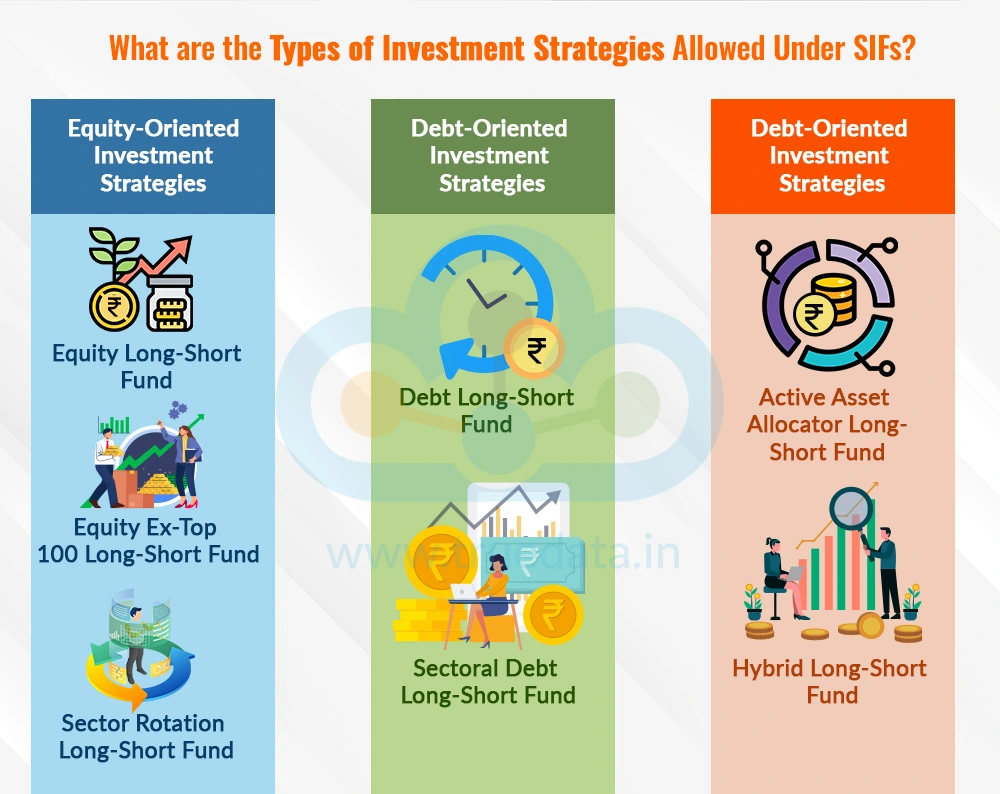
Specialised Investment Funds (SIFs) offer investors an opportunity to participate in professionally managed, flexible investment strategies that go beyond traditional mutual funds. Depending on the fund’s structure, an SIF can be open-ended, closed-ended, or an interval scheme, with the subscription and redemption frequency clearly defined in its offer document. SIF investment strategies fall under three main categories, i.e., Equity-Oriented, Debt-Oriented, and Hybrid Strategies, each designed with specific asset allocation limits and short exposure rules as per SEBI guidelines. These strategies allow fund managers to aim for higher returns by managing investments more actively while still staying within SEBI’s risk control framework.

Equity-Oriented Investment Strategies

Equity-Oriented SIFs focus mainly on listed equities and equity-related instruments. These funds have the flexibility to take short positions (up to 25%) using unhedged derivatives, allowing fund managers to generate returns in both rising and falling markets. Redemptions under this category can happen daily or at a lower frequency as decided by the Asset Management Company (AMC).

  • Equity Long-Short Fund

    • Equity Allocation - Minimum 80% of the portfolio in equities and equity-related instruments.

    • Short Exposure - Up to 25% using unhedged derivatives.

    • Strategy Focus - Generate returns by taking long positions in undervalued stocks and short positions in overvalued ones.

    • Structure - Open-ended or interval fund.

This strategy suits investors who seek long-term capital growth with an appetite for moderate-to-high market risk.

  • Equity Ex-Top 100 Long-Short Fund

    • Equity Allocation - At least 65% in stocks outside the top 100 by market capitalisation.

    • Short Exposure - Limited to 25% via unhedged equity and equity-related derivatives.

    • Strategy Focus - Capture opportunities in mid-cap and small-cap companies that are often undervalued or under-researched.

    • Structure - Open-ended or interval fund.

This strategy is ideal for investors looking to diversify beyond large-cap stocks and willing to accept higher volatility for greater return potential.

  • Sector Rotation Long-Short Fund

    • Equity Allocation - Minimum 80% invested across a maximum of four sectors.

    • Short Exposure - Up to 25% at the sector level using unhedged derivatives.

    • Strategy Focus - Tactical rotation between sectors based on market outlook, investing in sectors expected to perform well and shorting those likely to underperform.

    • Structure - Open-ended or interval fund.

This strategy works well for investors who want focused exposure to changing economic trends and sectoral opportunities.

Debt-Oriented Investment Strategies

Debt-Oriented SIFs are designed for investors seeking steady income with moderate risk, while still benefiting from active management. These funds invest in various fixed-income securities such as bonds, debentures, and money market instruments. They can also take short positions through exchange-traded debt derivatives to manage interest rate and credit risks. Redemptions are typically allowed weekly or at a lower frequency, as determined by the AMC.

  • Debt Long-Short Fund

    • Core Investments - Across a range of debt instruments with varying maturities and credit ratings.

    • Short Exposure - Through exchange-traded debt derivatives.

    • Strategy Focus - Generate returns by actively managing duration and interest rate exposure, going long when interest rates are expected to fall and short when they may rise.

    • Structure - Interval fund.

This fund is suitable for investors looking for income stability with a slightly higher return potential than traditional debt funds.

  • Sectoral Debt Long-Short Fund

    • Portfolio Allocation - Investments in debt instruments from at least two sectors, with no more than 75% exposure to any single sector.

    • Short Exposure - Up to 25% via unhedged debt derivatives within specific sectors.

    • Strategy Focus - Relative value investing, i.e., identifying sectors where debt instruments are undervalued while shorting overvalued ones.

    • Structure - Interval fund.

This fund suits investors who prefer debt exposure but want an actively managed, sector-diversified approach to enhance returns.

Hybrid Investment Strategies

Hybrid SIFs combine equity, debt, and alternative assets such as Real Estate Investment Trusts (REITs), InvITs, and commodity-linked derivatives into one dynamic portfolio. These strategies aim to balance growth and stability by actively adjusting allocations across asset classes. Redemptions are allowed twice a week or at a lower frequency, depending on the AMC’s policy.

  • Active Asset Allocator Long-Short Fund

    • Asset Coverage - Equity, debt, derivatives, REITs/InvITs, and commodities.

    • Short Exposure - Up to 25% across instruments.

    • Strategy Focus - Dynamic asset rebalancing, i.e., increasing exposure to growth assets (like equity) when markets rise, and shifting to defensive assets (like debt or commodities) in volatile periods.

    • Structure - Interval fund.

This fund is ideal for investors who want diversification across multiple asset classes with active risk management.

  • Hybrid Long-Short Fund

    • Equity Allocation - Minimum 25%

    • Debt Allocation - Minimum 25%

    • Short Exposure - Up to 25% across equity and debt via unhedged derivatives.

    • Strategy Focus - Maintain a balanced risk-return profile, using tactical short positions to protect against market downturns.

    • Structure - Interval fund.

This fund suits investors looking for a balanced portfolio that can perform well in different market cycles.

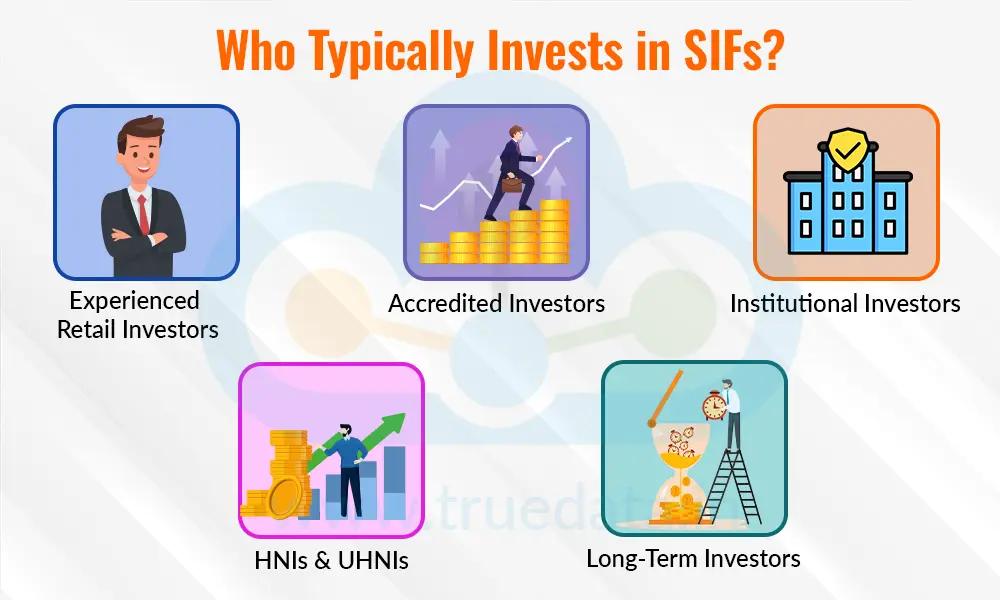
Who Typically Invests in SIFs?

Who Typically Invests in SIFs

SIFs are a unique investment option that is aimed at bridging the gap between the mutual funds, PMS and AIFs. They are designed for investors who want to take advantage of advanced investment strategies and aim for higher long-term growth than traditional mutual funds. The target investors for SIFs include,

  • Investors who can invest a minimum of Rs. 10,00,000 in SIFs.

  • Accredited investors are those who meet SEBI’s higher income or net-worth criteria.

  • Institutional and Non-Individual investors (like Insurance companies, Corporates and partnership firms, etc.) who can use SIFs to diversify their investment portfolios and access professionally managed long-short strategies.

  • HNIs and UHNIs who want to diversify beyond mutual funds and fixed deposits and have the financial capacity and risk tolerance for dynamic, higher-return investments.

  • Investors with long-term investment horizons (5 to 10 years).

How do SIFs Differ from Traditional Mutual Funds?

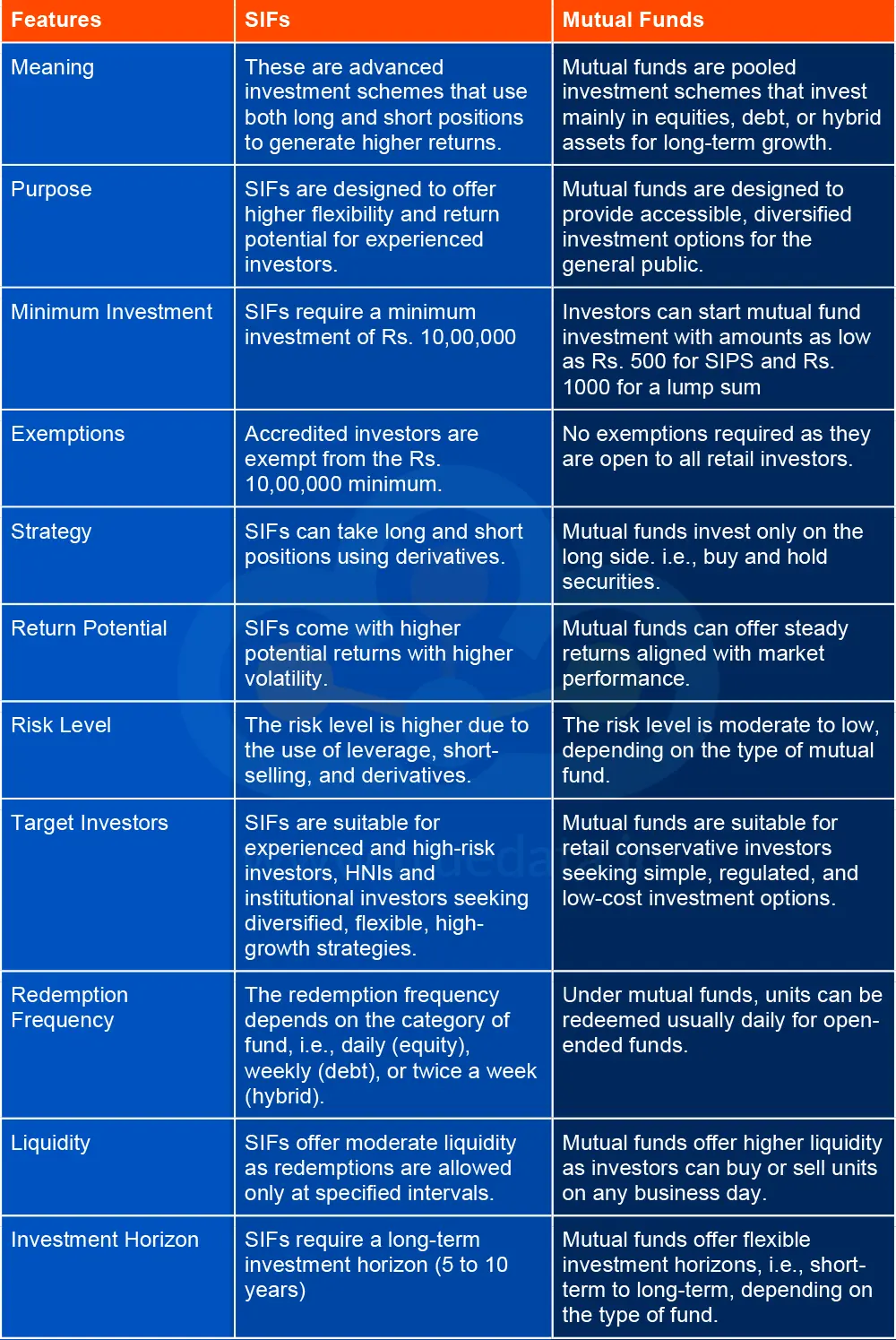
Both SIFs and mutual funds are regulated by SEBI and managed by professional fund managers. However, they differ in their structure, strategy, risk level, and investor eligibility. The key differences between SIFs and mutual funds are mentioned hereunder. 

how-do-sifs-differ-from-traditional-mutual-fund

Features

SIFs

Mutual Funds

Meaning

These are advanced investment schemes that use both long and short positions to generate higher returns.

Mutual funds are pooled investment schemes that invest mainly in equities, debt, or hybrid assets for long-term growth.

Purpose

SIFs are designed to offer higher flexibility and return potential for experienced investors.

Mutual funds are designed to provide accessible, diversified investment options for the general public.

Minimum Investment 

SIFs require a minimum investment of Rs. 10,00,000

Investors can start mutual fund investment with amounts as low as Rs. 500 for SIPS and Rs. 1000 for a lump sum 

Exemptions

Accredited investors are exempt from the Rs. 10,00,000 minimum.

No exemptions required as they are open to all retail investors.

Strategy

SIFs can take long and short positions using derivatives.

Mutual funds invest only on the long side. i.e., buy and hold securities.

Return Potential

SIFs come with higher potential returns with higher volatility.

Mutual funds can offer steady returns aligned with market performance.

Risk Level

The risk level is higher due to the use of leverage, short-selling, and derivatives. 

The risk level is moderate to low, depending on the type of mutual fund.

Target Investors

SIFs are suitable for experienced and high-risk investors, HNIs and institutional investors seeking diversified, flexible, high-growth strategies.

Mutual funds are suitable for retail conservative investors seeking simple, regulated, and low-cost investment options.

Redemption Frequency

The redemption frequency depends on the category of fund, i.e., daily (equity), weekly (debt), or twice a week (hybrid).

Under mutual funds, units can be redeemed usually daily for open-ended funds.

Liquidity

SIFs offer moderate liquidity as redemptions are allowed only at specified intervals.

Mutual funds offer higher liquidity as investors can buy or sell units on any business day.

Investment Horizon

SIFs require a long-term investment horizon (5 to 10 years)

Mutual funds offer flexible investment horizons, i.e., short-term to long-term, depending on the type of fund.  

What are the Pros and Cons of Investing in SIFs?

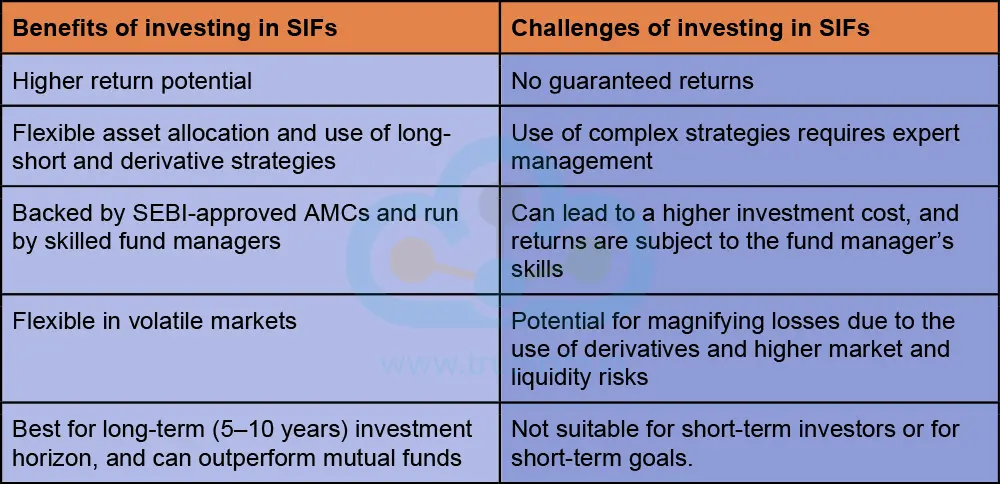
After understanding the key details of SIFs and the core differences between them and mutual funds, let us now understand the benefits and challenges of investment in this unique instrument. 

What are the Pros and Cons of Investing in SIFs

Benefits of investing in SIFs

Challenges of investing in SIFs

Higher return potential

No guaranteed returns 

Flexible asset allocation and use of long-short and derivative strategies

Use of complex strategies requires expert management 

Backed by SEBI-approved AMCs and run by skilled fund managers 

Can lead to a higher investment cost, and returns are subject to the fund manager’s skills 

Flexible in volatile markets

Potential for magnifying losses due to the use of derivatives and higher market and liquidity risks 

Best for long-term (5–10 years) investment horizon, and can outperform mutual funds

Not suitable for short-term investors or for short-term goals.

Conclusion

Specialised Investment Funds (SIFs) are a new-age investment option introduced by SEBI in 2025 to bridge the gap between mutual funds and portfolio management services (PMS). They give investors access to advanced long-short and multi-asset strategies, offering the potential for higher returns along with professional management and regulatory safety. With a minimum investment of Rs. 10,00,000, SIFs are ideal for experienced and high-net-worth investors who can take moderate to high risks and aim for long-term wealth creation. While they offer flexibility, diversification, and growth opportunities, they also come with higher complexity and risk than regular mutual funds. Overall, SIFs can be a strong addition to a strategic investment portfolio for those seeking to balance growth, diversification, and innovation in their investments.

This article sheds light on a new investment option that serves as a bridge between mutual funds and high-end PMS. Under SEBI supervision, this new investment option aims to cater for the needs of the growing HNI population in India and create niche portfolios. Let us know your thoughts on the topic or if you need further information on the same, and we will address it. 

Till Then, Happy Reading!


Read More: Can Algorithms Beat Human Fund Managers? - Know all about Quant Based Mutual Funds

Frequently Asked Questions

SIFs are taxed in the same way as mutual funds in India. Investors have to pay capital gains tax when they redeem their units, based on how long the investments are held by the investors. STCG is taxed at 20 while LTCG is taxed at 12.5.

A Specialised Investment Fund (SIF) can invest in a mix of assets such as equities, debt instruments, derivatives, REITs, InvITs, and even commodity-linked derivatives. This allows the fund to diversify across different markets and balance risk and return effectively.

Yes, SIFs are regulated by SEBI, which ensures strong investor protection through strict rules on fund management, transparency, and risk control. AMCs must follow SEBI’s guidelines to safeguard investors’ interests and maintain fair market practices.

SIFs usually charge management fees, similar to mutual funds, which cover the cost of professional fund management. Some may also include performance-based fees, depending on how well the fund performs compared to its benchmarks.

Investors can evaluate a SIF based on their risk tolerance, investment goals, time horizon, and ability to invest at least Rs. 10,00,000. It is best suited for investors seeking higher returns and who can handle short-term market ups and downs for long-term growth.
Marisha Bhatt

Marisha Bhatt is a financial content writer @TrueData.

She writes with the sole aim of simplifying complex financial concepts and jargon while attempting to clarify technical and fundamental analysis concepts of the stock markets. The ultimate goal is to spread vital knowledge and benefit the maximum audience. Her Chartered Accountant background acts as the knowledge base to help clarify crucial concepts and create a sound investment portfolio.

8 Comments
B
Bawas
· November 25, 2025

Mam please add credit risk in SIPs, i want to know more

·
Marisha Bhatt Author
Bawas · November 27, 2025

Credit risk in SIPs mainly comes from debt funds. You can check the fund’s credit quality in its factsheet or from the AMFI/AMC official website, as well as from broker websites providing such details on mutual funds, to see how safe the bonds are. We hope this resolves your query. You can reach us at support@truedata.in if you need further details on the topic.

·
N
Nazeem
· November 27, 2025

very informative

·
Meyhar Singh
Nazeem · November 27, 2025

Thank you so much! Glad you found it informative

·
M
Mohith
· November 28, 2025

I am your Tumblr follower. I was inspired by your blog articles

·
Marisha Bhatt Author
Mohith · December 02, 2025

Thank you so much! It means a lot to know our posts inspired you. Stay tuned for more interesting content on TrueData!

·
V
Vinod
· December 01, 2025

Good read

·
Marisha Bhatt Author
Vinod · December 02, 2025

Thank you for appreciating our work Sir!

·

Related Articles

SEE ALL
Mutual Funds
Mutual Funds
How to Complain About Mutual Funds?

Mutual fund investments have simplified greatly with just a tap on your smartpho...

Mutual Funds
Mutual Funds
How to Complain About Mutual Funds?

Mutual fund investments have simplified greatly with just a tap on your smartpho...

Investing / Trading
Investing / Trading
Stocks or mutual funds? Which is better?

Introduction For the longest time, investment in stock markets was thought to b...