
Have you seen a stock rising for quite some time and then suddenly pausing or reversing at certain levels? It happens due to the simple demand and supply dynamics. Price and volume are two sides of the same coin when it comes to trading. While price tells ‘what’ is happening to a stock, volume gives answers to ‘why’ for the events. Thus, ignoring volume can be a fatal flaw in the trading plan. So, how to read a volume profile, and what does it say? Get answers to these questions and more in this blog, and refine your trading journey.
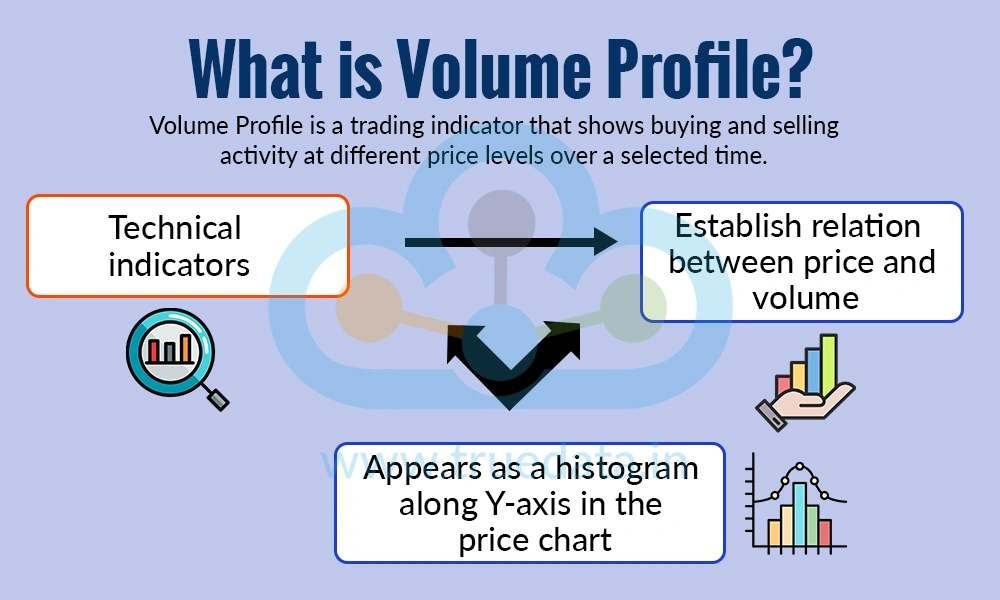
Volume Profile is a trading tool or indicator that highlights the levels of buying and selling at different price levels of a stock over a specific period of time. Volume profile displays this data sideways on the price axis, unlike normal volume bars that appear at the bottom of a chart and show total volume for each day or candle. This helps traders identify the price levels with the maximum trading activity. These levels often act as strong support or resistance, as many buyers and sellers are active there. Volume profile indicator helps investors find the optimum price level that buyers are willing to pay, and the sellers are willing to sell at, as well as the levels where prices are likely to react again. Thus, it can be a useful tool for identifying crucial price zones in stocks or indices like the Nifty or Sensex, thereby aiding in making better entry and exit decisions.
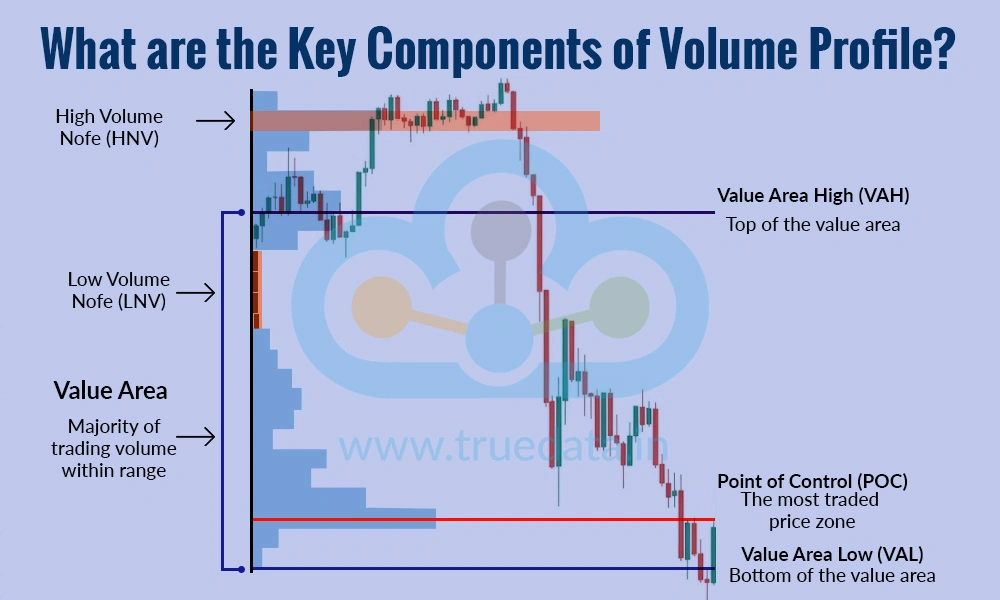
The key components of the volume profile indicator include,
Point of Control (POC) - The Point of Control (POC) refers to the price level which records the highest amount of trading volume that has taken place during a given period. This implies that it indicates the optimum price level at which the buyers and sellers showed the most interest. This becomes an important level as it often acts as a strong support and resistance. Eventually, prices tend to return to the POC, as it represents a ‘fair value’ area where the market was most comfortable trading the stock or the commodity.
Value Area (VA) - The Value Area is the price range which records around 70% of the total trading volume that has occurred during the given period of time. Thus, it shows the price range in which the majority of market participants agreed on the price. When the price stays within this range, the market is considered balanced. However, if the price moves outside the value area, it may indicate a potential breakout or new trend.
Value Area High (VAH) - Value Area High (VAH) represents the upper boundary of the value area (VA), i.e., it indicates the highest price within the 70% volume range. This level often acts as resistance, hence, the prices may struggle to move above it unless there is strong buying interest.
Value Area Low (VAL) - Value Area Low (VAL) is at the opposite end of the Value Area High (VAH), i,e., the lower boundary of the value area and represents the lowest price within the 70% volume range. While the VAH acts as the resistance, the VAL often acts as support, where prices may find buying interest and bounce back.
High Volume Nodes (HVNs) - Another important component of the volume profile indicator is the High Volume Nodes (HVNs). These are the price levels where a large amount of trading activity has taken place, and the volume profile seems thick or wide. Such levels indicate strong interest from both buyers and sellers, and prices tend to spend more time around these zones. HVNs often act as support or resistance and are seen as areas of fair value.
Low Volume Nodes (LVNs) - Similar to the HVNs, the Low Volume Nodes (LVNs) represent the price levels with little trading activity. They appear as thin areas in the volume profile, and prices tend to move quickly through these zones due to less interest from traders. LVNs often act as areas of quick movement or breakouts.
Volume Profile Shape (Distribution) - The overall shape of the volume profile gives clues about market behaviour. For example, a bell-shaped profile indicates a balanced market, while a skewed or uneven shape may suggest trending conditions or strong buying/selling pressure. Understanding the shape helps investors judge whether the market is stable or likely to move sharply.
Volume profile indicator is one of the primary technical analysis tools used by traders. The importance of this indicator can be explained below.
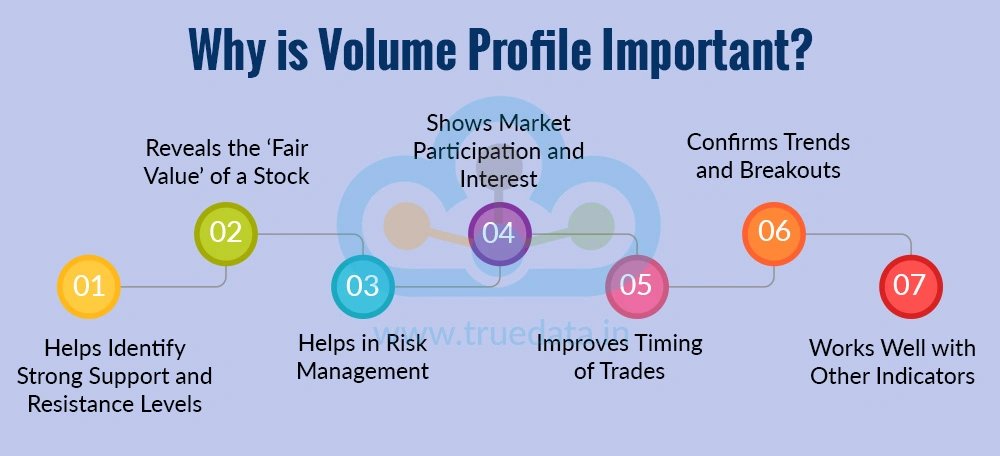
Helps Identify Strong Support and Resistance Levels - Volume Profile shows where the highest trading activity has taken place, which helps identify strong support and resistance levels. Prices often react at these levels because many traders have already bought or sold there. This can be useful in stocks or indices like Nifty and Sensex to plan better entry and exit points.
Reveals the ‘Fair Value’ of a Stock - The levels where the most volume is concentrated (like the Point of Control) indicate where the market believes the stock is fairly valued. When prices move far away from this area, they often tend to come back. This helps investors understand whether a stock is overvalued or undervalued in the short term.
Helps in Risk Management - By identifying important price zones like support, resistance, and low-volume gaps, traders can place better stop-loss and target levels. This improves risk management and helps protect capital, which is especially important in volatile markets.
Shows Market Participation and Interest - Volume Profile clearly shows where buyers and sellers are most active. High-volume areas indicate strong interest, while low-volume areas show less interest. This helps investors understand market behaviour better instead of relying only on price movements.
Improves Timing of Trades - Volume Profile helps in better timing of trades by showing where price is likely to slow down, reverse, or break out. For example, if the price approaches a high-volume area, it may pause or reverse. On the other hand, if it moves through a low-volume area, it may move quickly. This helps traders avoid poor entry points.
Confirms Trends and Breakouts - When price breaks out of a key level along with strong volume at new price zones, it signals strength in the trend. Volume Profile helps confirm whether a breakout is genuine or weak. This reduces the chances of getting trapped in false breakouts, which is a common problem for many traders.
Works Well with Other Indicators - Volume Profile does not need to be used alone. It works very well with other tools like price action, trendlines, and moving averages. Combining it with other methods gives a more complete view of the market and improves decision-making.
The volume profile indicator helps process the price and volume movement of the market and enables traders to make informed portfolio decisions. The use of the volume profile is explained below.
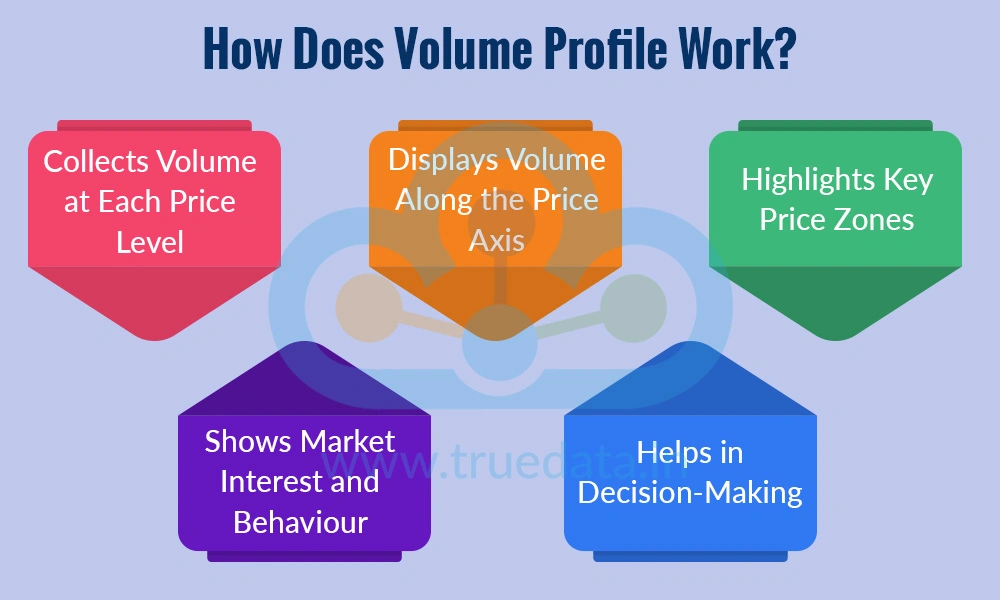
Collects Volume at Each Price Level - Volume Profile works by collecting data on how much trading has happened at different price levels over a selected time period. Instead of just showing total volume for the day, it breaks it down price by price. This helps traders understand where most buying and selling activity takes place.
Displays Volume Along the Price Axis - Unlike traditional charts, where volume is shown at the bottom, Volume Profile displays it sideways on the price axis. This creates a clear visual of which price levels have high or low trading activity, making it easier for traders to spot important zones.
Highlights Key Price Zones - The tool identifies important levels such as the Point of Control (where the most volume occurred) and the Value Area (where most trading happened). These levels act as key reference points for traders to identify support, resistance, and fair value zones.
Shows Market Interest and Behaviour - High-volume areas indicate strong interest from buyers and sellers, so prices often slow down or reverse near these levels. On the other hand, low-volume areas show less interest, so prices tend to move quickly through them. This helps traders understand how the market is behaving.
Helps in Decision-Making - By analysing these volume-based levels, traders can make better decisions about when to enter or exit trades. It also helps them plan stop-loss and target levels more effectively, improving overall trading discipline.
There are multiple types of volume profiles that help traders understand the market movement effectively. These types include,
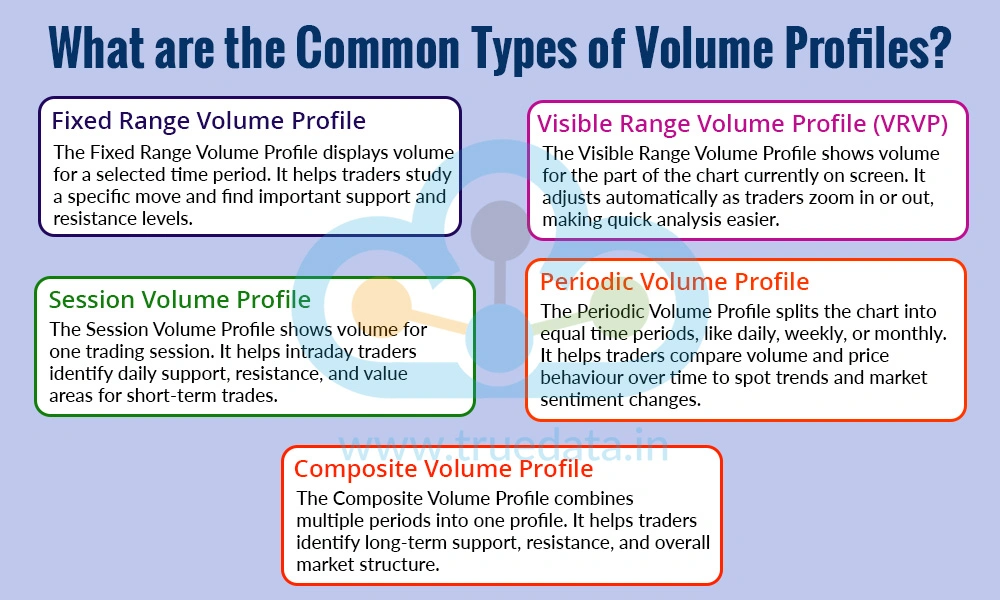
Fixed Range Volume Profile - The Fixed Range Volume Profile shows volume data for a specific period chosen by the trader, such as a few days, weeks, or a particular price move. This type is used by traders to analyse a particular trend or event, like a rally or a correction. It helps them understand where the most trading activity happened within that selected range and identify key support and resistance levels.
Visible Range Volume Profile (VRVP) - The Visible Range Volume Profile displays volume based on what is currently visible on the chart screen. As traders zoom in or out, the volume profile automatically adjusts. This makes it very useful for quick analysis, as traders can instantly see important volume levels for the current view without selecting a fixed time period.
Session Volume Profile - The Session Volume Profile shows volume distribution for a single trading session, such as one trading day. It is commonly used by intraday traders who want to understand daily market behaviour. Analysing each session helps traders identify daily support, resistance, and value areas to plan short-term trades.
Periodic Volume Profile - The Periodic Volume Profile divides the chart into equal time periods, such as daily, weekly, or monthly profiles. Each period has its own volume distribution. Traders use this to compare how volume and price behaviour change over time, helping them spot trends and shifts in market sentiment across different timeframes.
Composite Volume Profile - The Composite Volume Profile combines multiple sessions or periods into one larger profile. It gives a broader view of where the most trading activity has occurred over a longer duration. Traders use this type to identify long-term support and resistance zones and understand the overall market structure.
Volume Profile helps traders understand who is in control, i.e., buyers, sellers, or neither. Observing the shift of price and volume together can help traders identify market conditions and adjust their trading strategy accordingly.
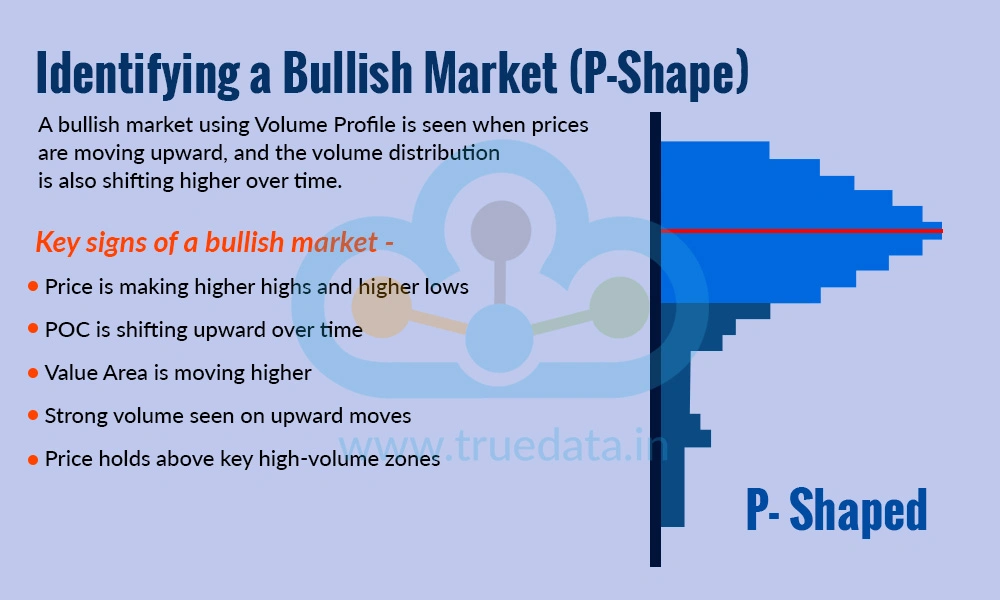
A bullish market using Volume Profile is seen when prices are moving upward, and the volume distribution is also shifting higher over time. This means buyers are willing to pay higher prices, indicating strength in the trend. The Point of Control (POC) and Value Area also tend to move upward, indicating that the stock's fair value is increasing. Traders observe that in such conditions, price often finds support near the Value Area Low (VAL) or previous high-volume zones and continues moving higher. Furthermore, breakouts above the Value Area High (VAH) with strong volume can confirm bullish strength.
Key signs of a bullish market -
Price is making higher highs and higher lows
POC is shifting upward over time
Value Area is moving higher
Strong volume seen on upward moves
Price holds above key high-volume zones
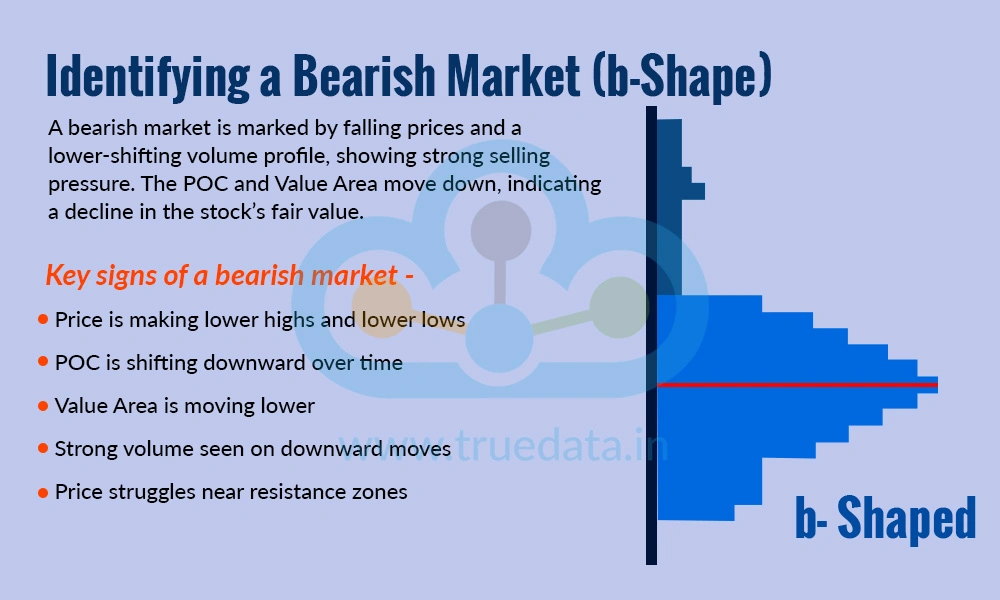
A bearish market is identified when prices are consistently moving downward, and the volume profile shifts lower. This shows that sellers are in control and are willing to sell at lower prices. The POC and Value Area move downward, indicating a drop in the perceived stock’s fair value. Traders notice that prices often encounter resistance near the Value Area High (VAH) or previous high-volume zones and then continue to fall. Breakdowns below Value Area Low (VAL) with strong volume confirm bearish momentum.
Key signs of a bearish market -
Price is making lower highs and lower lows
POC is shifting downward over time
Value Area is moving lower
Strong volume seen on downward moves
Price struggles near resistance zones
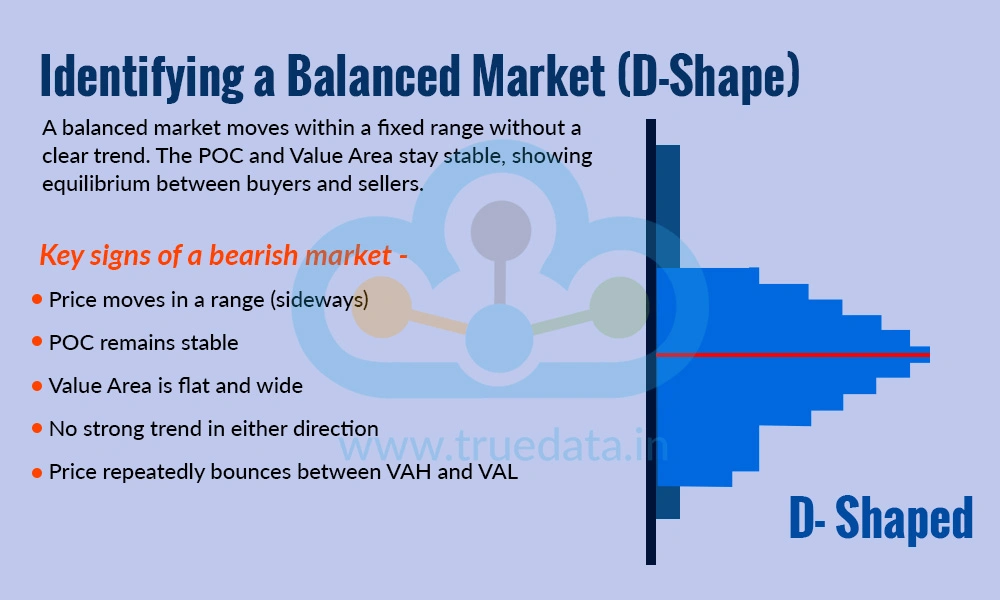
A balanced market is seen when prices move within a range but do not show a clear upward or downward trend. This appears as a bell-shaped volume profile with a wide distribution, where most of the trading happens within a fixed range. The POC stays relatively stable, and the Value Area does not shift much. Traders understand that in such markets, buyers and sellers are in equilibrium. Prices tend to move between support (VAL) and resistance (VAH), and breakouts are less reliable unless supported by strong volume.
Key signs of a balanced market -
Price moves in a range (sideways)
POC remains stable
Value Area is flat and wide
No strong trend in either direction
Price repeatedly bounces between VAH and VAL
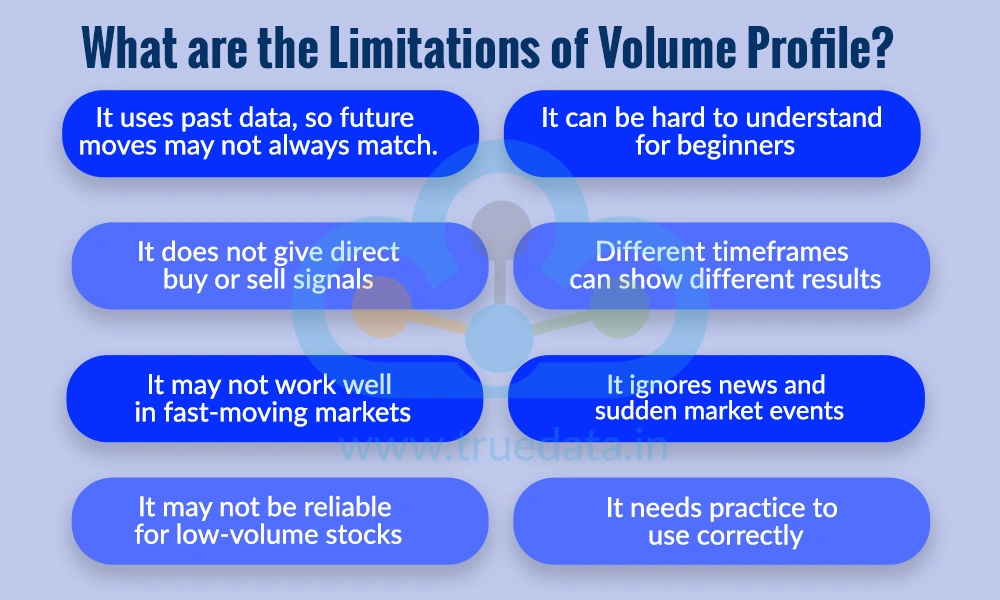
Similar to any other technical analysis tool, the volume profile indicator is not foolproof and comes with a few limitations. These limitations include,
It is based on past data, so it may not always predict future moves
It can be hard to understand for beginners
It does not give direct buy or sell signals
Different timeframes can show different results
It may not work well in fast-moving markets
It ignores news and sudden market events
It may not be reliable for low-volume stocks
It needs practice to use correctly
Volume Profile is a powerful tool that helps traders understand where the most trading activity has taken place and identify important price levels like support, resistance, and fair value. It not only shows what the price is doing but also explains why it is happening by highlighting the behaviour of buyers and sellers. However, since it is based on past data and does not give direct signals, it works best when combined with other tools and with proper practice.
This article explains a critical concept in trading and how to use it to build a successful portfolio. Let us know your thoughts on the topic or if you need further information on the same, and we will address it soon.
Till then, Happy Reading!

Marisha Bhatt is a financial content writer @TrueData.
She writes with the sole aim of simplifying complex financial concepts and jargon while attempting to clarify technical and fundamental analysis concepts of the stock markets. The ultimate goal is to spread vital knowledge and benefit the maximum audience. Her Chartered Accountant background acts as the knowledge base to help clarify crucial concepts and create a sound investment portfolio.
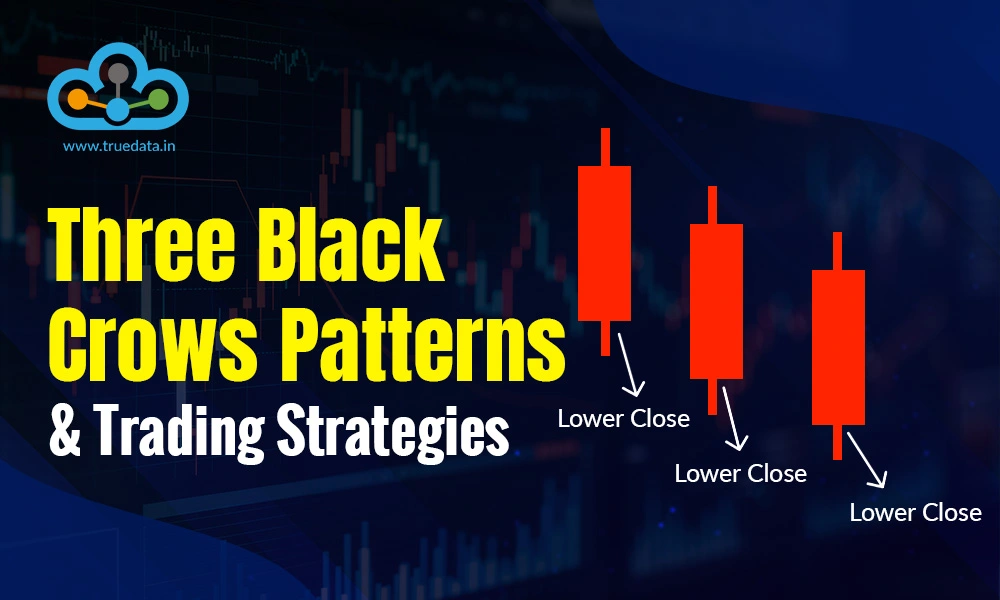
The red and green candlesticks on a chart may look like chaos at first glance. B...
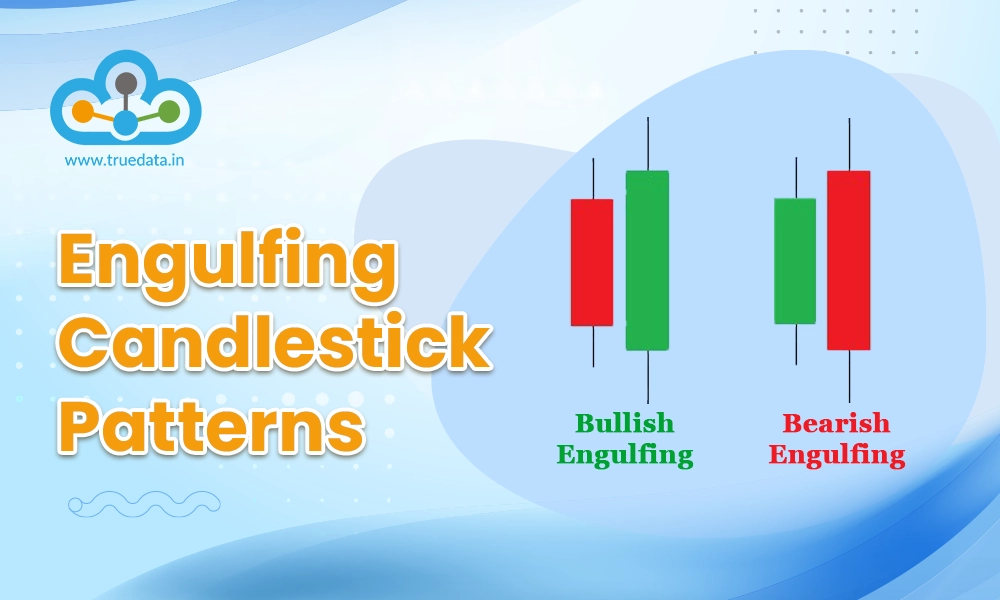
Candlestick patterns are among the most basic and common tools traders use to cr...

Global uncertainty often spills over into financial markets. In times when geopo...
