Corporate Data

What is a Fund Flow Statement?

Marisha Bhatt · 19 Mar 2026 · 11 mins read · 0 Comments

what-is-fund-flow-statement

We all understand the importance of tracking money in a business, which is why the cash flow statement often gets analysed in depth. But what if focusing only on cash gives us an incomplete picture? What about understanding where the company’s funds truly come from, how they are being deployed, and whether the business is strengthening its financial position or quietly stretching its resources? That is where the Fund Flow Statement comes into the picture. Let us take a step further into the fundamental analysis of the company by exploring the Fund Flow Statement and what it tells us beyond the usual cash flow statement. 

What is a Fund Flow Statement?

what-is-fund-flow-statement

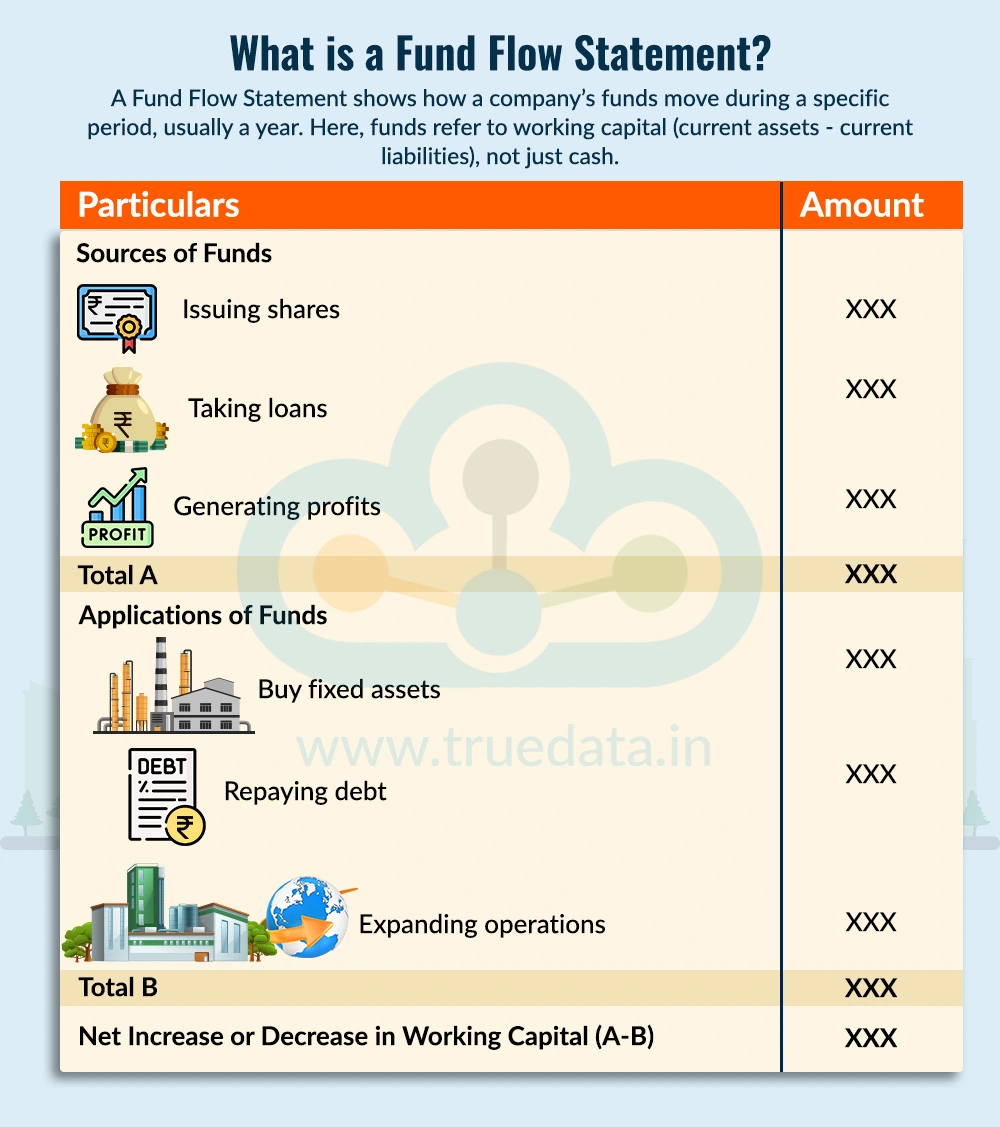
A Fund Flow Statement is a financial statement that shows how a company’s funds have moved during a specific period, usually a year. Here, the word ‘funds’ does not mean just cash, but working capital (the difference between current assets and current liabilities). This statement explains where the company raised its funds from, such as issuing shares, taking loans, or generating profits, and how those funds were used, like buying fixed assets, repaying debt, or expanding operations. In simple terms, it helps investors understand whether the company is strengthening its financial position by using funds wisely or stretching itself by relying heavily on borrowings. The Fund Flow Statement is useful for investors as it gives a broader view of financial movement beyond just profits or cash, helping assess long-term financial stability and management decisions.

How is a Fund Flow Statement Prepared?

The Companies Act, 2013, and SEBI (LODR) Regulations require companies to disclose audited financial statements (Balance Sheet, P&L, Cash Flow, etc.) in annual reports. Still, a Fund Flow Statement is not legally mandated like the cash flow statement. It is considered an analytical tool for understanding internal fund movements, frequently used in financial analysis rather than statutory reporting. 

A Fund Flow Statement explains the movement of funds (i.e., changes in working capital) between two balance sheet dates and shows where the funds came from and where they were used over a period. It helps investors see how business decisions affect long-term financial health. The preparation of the Fund Flow Statement requires calculating the changes in working capital, operating funds, and finally preparing the Fund Flow Statement. This process is explained below. 

Step 1 - Calculating Changes in Working Capital

Working capital refers to the funds in the Fund Flow Statement. While the cash flow statement focuses on the movement of actual cash, the Fund Flow Statement focuses on the organisation’s funds as a whole. The prime reasons for changes in the funds can be attributed to the changes in working capital, thus emphasising the focus on working capital management. The changes in working capital can be interpreted as follows.

step-1-calculating-changes-in-working-capital

Particulars

Previous Year

Current Year

Increase

Decrease

Current Assets 

Cash in Hand

XXX

XXX

Inventory

XXX

XXX

Debtors

XXX

XXX

Bills Receivables

XXX

XXX

Total Current Assets (A)

XXX

XXX

Current Liabilities

Creditors

XXX

XXX

Bills Payable

XXX

XXX

Short-term Liabilities

XXX

XXX

Total Current Liabilities (B)

XXX

XXX

Working Capital (A-B)

XXX

XXX

Net Changes in Working Capital

Step 2 - Calculating Funds from Operations

Step 2 - Calculating Funds from Operations

The next step is to calculate the statement of funds from operations, starting with the current year's post-tax profit. Non-cash expenses such as depreciation, loss due to asset sale, should be added back to the net profit while reducing any non-cash, non-current and non-operating expenses. This will give a true picture of the funds from operations in the current year, reflecting the changes between the two balance sheet dates or profit and loss statements

Step 3 - Preparing Fund Flow Statement

The final step is the preparation of the Fund Flow Statement after identifying the sources and uses of funds. The examples of the sources and uses of funds in a Fund Flow Statement include, 

  • Sources of Funds - These are amounts coming into the business from outside operations and are available for use.

    • Issue of shares

    • Public or rights issue

    • Long-term borrowings (bank loans or debentures)

    • Sale of fixed assets

  • Applications (Uses) of Funds - These are where the funds were used or show how the funds were spent.

    • Purchase of fixed assets

    • Repayment of loans

    • Dividend payments

    • Increase in working capital

Format of the Fund Flow Statement

step-3-preparing-fund-flow-statement

Sources of Funds

Amount (Rs.)

Application of Funds

Amount (Rs.)

Funds from Operations

XX

Purchase of Machinery

XX

Issue of Shares

XX

Dividend Paid

XX

Long-Term Loan

XX

Increase in Working Capital

XX

Sale of Fixed Assets

XX

Loan Repayment

XX

Total Sources

XX

Total Uses

XX

In a correctly prepared Fund Flow Statement, Total Sources = Total Uses. This confirms that every rupee raised has been accounted for in its application.

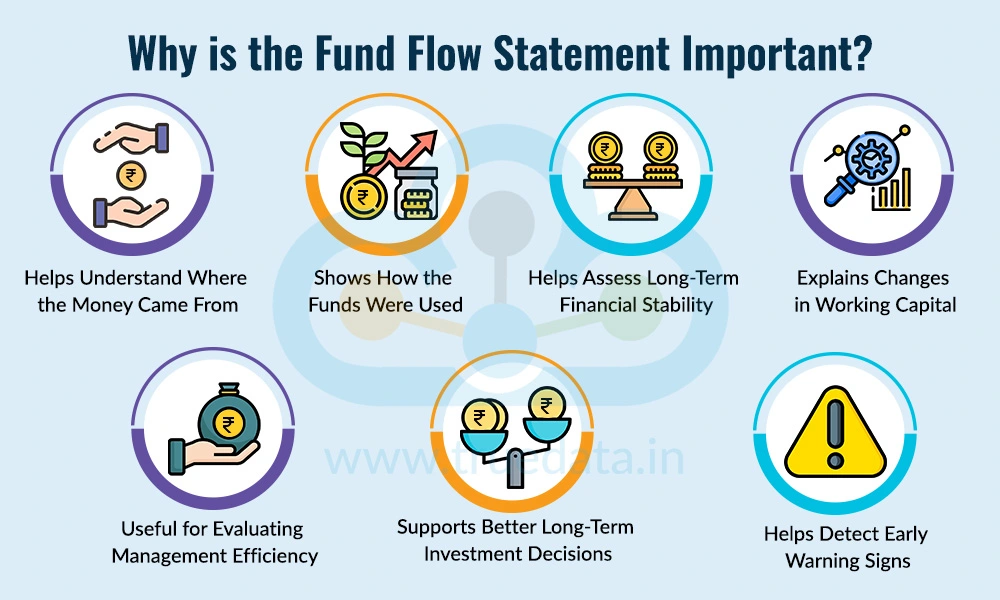
Why is the Fund Flow Statement Important?

Why is the Fund Flow Statement Important

The Fund Flow Statement may not be as popular as the Balance Sheet or Cash Flow Statement, but it plays a very important role in understanding a company’s real financial movement. While profit shows performance and cash flow shows liquidity, the Fund Flow Statement explains how financial resources move within the business. The importance of the Fund Flow Statement is explained below.

Helps Understand Where the Money Came From

A company may show good profits in its P&L statement, but that does not automatically mean it has strong financial backing. The Fund Flow Statement clearly shows whether the company generated funds internally through operations or raised funds externally by issuing shares or taking loans. For example, if a company is expanding but most of the funds are coming from loans instead of business profits, it increases financial risk. On the other hand, if growth is funded mainly through operational profits, it shows financial strength. This distinction is very important for investors as companies with high debt can face pressure when interest rates rise or economic conditions slow down.

Shows How the Funds Were Used

It is not enough to know where the funds came from. Investors must also know how those funds were used. The Fund Flow Statement explains whether the company used funds for productive purposes, such as buying machinery, expanding factories, or reducing debt. If funds are used for creating assets, it usually indicates long-term growth planning. However, if large funds are used to repay old loans or cover operational shortages, it may indicate financial stress. This helps in understanding whether management decisions are creating long-term value or just managing short-term problems.

Helps Assess Long-Term Financial Stability

The Fund Flow Statement highlights movements in long-term funds such as loans and share capital. This helps investors understand whether the company is becoming financially stronger or more dependent on borrowed money. If a company consistently increases debt without increasing profits, it may struggle in the future. However, if it repays loans regularly and funds expansion through internal profits, it reflects stability. Many companies rely heavily on bank loans for expansion in our country. Therefore, tracking long-term fund movements helps investors evaluate financial risk and solvency.

Explains Changes in Working Capital

Working capital is the money required to run day-to-day operations. It includes items like inventory, debtors (money to be received), and creditors (money to be paid). The Fund Flow Statement explains why working capital has increased or decreased during the year. If working capital increases, it means more money is blocked in business operations. This may indicate growth, but it could also mean slow payment collection from customers. On the other hand, a sharp decrease in working capital may temporarily improve liquidity but could signal a slowdown in business. Understanding working capital trends is very important for investors, especially in sectors such as manufacturing and FMCG, as it directly affects liquidity and efficiency.

Useful for Evaluating Management Efficiency

The management's approach to handling funds says a lot about its financial discipline. The Fund Flow Statement shows whether management is using funds carefully or aggressively. For example, if a company raises funds and invests them in productive assets that generate revenue, it shows smart decision-making. However, if funds are raised frequently to cover operational gaps or increasing expenses, it may indicate poor planning. Investors often focus on management quality before investing, and the Fund Flow Statement provides another practical way to assess that quality.

Supports Better Long-Term Investment Decisions

Investing is not just about short-term profits, especially for long-term investors. It is about sustainability and stability. The Fund Flow Statement provides a deeper understanding of whether growth is genuine and financially supported. It helps address the following key questions effectively,

  • Is the company growing healthily?

  • Is it financially disciplined?

  • Can it sustain expansion without excessive borrowing?

Thus, by analysing fund movements, investors can make more informed and confident decisions.

Helps Detect Early Warning Signs

Sometimes, a company may report rising profits but still face financial trouble. The Fund Flow Statement can reveal hidden problems. For example, a rapid increase in debt, a large increase in receivables (customers not paying on time), frequent sale of assets to generate funds, etc. These can be early warning signals. Thus, identifying such signs early can protect investors from potential losses.

What are the Limitations of Using the Fund Flow Statement?

What are the Limitations of Using the Fund Flow Statement

The Fund Flow Statement primarily sheds light on the management quality and working capital management. However, there are a few limitations that should not be ignored. These limitations include,

  • Does Not Focus on Actual Cash - The Fund Flow Statement shows changes in working capital, not actual cash movement. So, a company may appear financially stable here but still face cash shortages.

  • Not Mandatory Under Companies Act, 2013 - Unlike the Cash Flow Statement, companies do not need to publish a Fund Flow Statement. So, it may not always be available in annual reports.

  • Based on Historical Data - It only shows past financial movements. It does not predict future performance or future financial problems.

  • Ignores Short-Term Cash Position - It does not clearly indicate whether the company has sufficient cash to meet immediate expenses like salaries, interest, or supplier payments.

  • Can Be Misleading if Working Capital Changes Are Seasonal - Some industries, like retail or agriculture, have seasonal fluctuations. Temporary changes in inventory or receivables may give a wrong impression.

  • Does Not Show Profitability Directly - A company may show strong fund movement, but may not be earning high profits. So, it cannot replace the Profit & Loss Statement.

  • Complex for Small Investors - It requires an understanding of working capital adjustments and accounting entries, which may be difficult for beginners.

  • Does Not Highlight Market Risks - It focuses only on internal financial movement. It does not consider external factors such as competition, economic slowdown, or regulatory changes.

  • Less Useful in Modern Reporting - Since the Cash Flow Statement gives more direct information about liquidity, many analysts prefer it over the Fund Flow Statement.

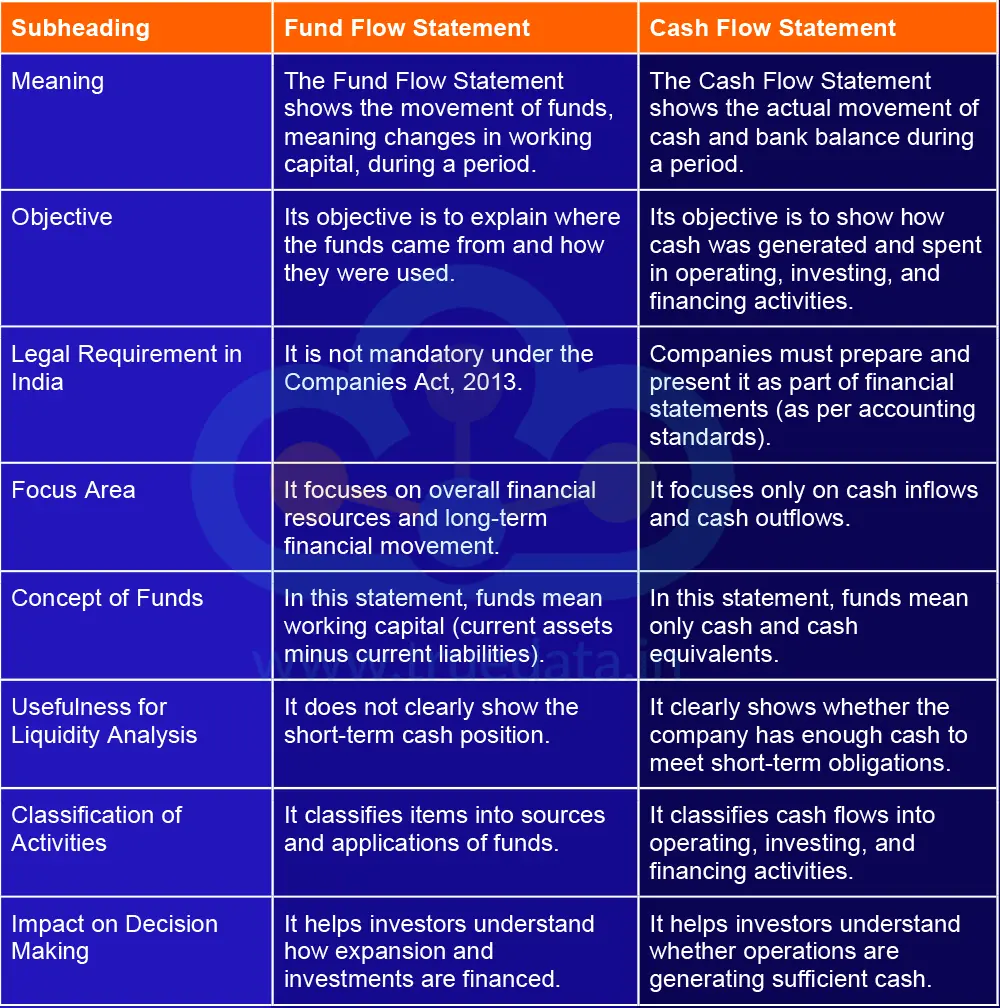
What are the Differences Between the Fund Flow Statement and the Cash Flow Statement?

Cash flow statement is an integral part of the financial statements, and the Fund Flow Statement is an extension of a company’s financial analysis. The key differences between the two are explained below.

What are the Differences Between the Fund Flow Statement and the Cash Flow Statement

Subheading

Fund Flow Statement

Cash Flow Statement

Meaning

The Fund Flow Statement shows the movement of funds, meaning changes in working capital, during a period.

The Cash Flow Statement shows the actual movement of cash and bank balance during a period.

Objective

Its objective is to explain where the funds came from and how they were used.

Its objective is to show how cash was generated and spent in operating, investing, and financing activities.

Legal Requirement in India

It is not mandatory under the Companies Act, 2013.

Companies must prepare and present it as part of financial statements (as per accounting standards).

Focus Area

It focuses on overall financial resources and long-term financial movement.

It focuses only on cash inflows and cash outflows.

Concept of Funds

In this statement, funds mean working capital (current assets minus current liabilities).

In this statement, funds mean only cash and cash equivalents.

Usefulness for Liquidity Analysis

It does not clearly show the short-term cash position.

It clearly shows whether the company has enough cash to meet short-term obligations.

Classification of Activities

It classifies items into sources and applications of funds.

It classifies cash flows into operating, investing, and financing activities.

Impact on Decision Making

It helps investors understand how expansion and investments are financed.

It helps investors understand whether operations are generating sufficient cash.

Conclusion

The Fund Flow Statement helps investors understand how a company manages its overall financial resources during a year. It shows where the funds came from and how they were used, particularly regarding working capital and long-term investments. While it does not replace the cash flow statement, it gives a broader picture of financial planning and capital management. The Fund Flow Statement can thus be a useful additional tool in fundamental analysis for investors who want to go beyond profits to assess the financial stability and growth quality. 

This article is an extension of a company’s analytical statements. We hope this helps our readers understand a company’s financials in a better light. Let us know your thoughts on the topic or if you need further information on the same, and we will address it soon. 

Till then, Happy Reading!


Read More: Impact of Accounting Policy Changes on Financial Ratios

Frequently Asked Questions

A Fund Flow Statement is prepared to understand where a company’s funds came from and how they were used during a period. It helps investors see how working capital and long-term resources are managed beyond just profits and cash.

The main components of a Fund Flow Statement are Sources of Funds and Application (Use) of Funds, along with a Statement of Changes in Working Capital. Together, they show where the company’s funds came from and how those funds were used during the year.

Restricted funds are money that can be used only for a specific purpose, such as a government grant meant only for a particular project. On the other hand, unrestricted funds are money that the company can use freely for any business need, like paying expenses or investing in growth.

No, the Fund Flow Statement is not mandatory under the Companies Act, 2013. Companies in India are required to prepare a Cash Flow Statement, but a Fund Flow Statement is prepared only for internal analysis or a deeper financial study.

In a Fund Flow Statement, depreciation is added back to net profit while calculating funds from operations because it is a non-cash expense. It reduces accounting profit, but it does not involve any actual outflow of funds.

The Fund Flow Statement does not clearly show the exact liquidity position of a company because it focuses on changes in working capital, not actual cash. For checking short-term liquidity and cash availability, the Cash Flow Statement is more useful.

The Fund Flow Statement is more useful when investors want to understand long-term financial changes, such as how expansion is funded or how working capital has shifted over time. It helps in analysing capital structure and overall financial management beyond just cash movement.
Marisha Bhatt

Marisha Bhatt is a financial content writer @TrueData.

She writes with the sole aim of simplifying complex financial concepts and jargon while attempting to clarify technical and fundamental analysis concepts of the stock markets. The ultimate goal is to spread vital knowledge and benefit the maximum audience. Her Chartered Accountant background acts as the knowledge base to help clarify crucial concepts and create a sound investment portfolio.

0 Comments

Related Articles

SEE ALL
Corporate Data
Corporate Data
Investing Smarter: The Power of Corporate Data and Market Sentiment Analysis

Thestock market never stands still, and prices swing constantly with every new h...

Corporate Data
Corporate Data
How to Read Cash Flow Statements?

Net profits in the P&L statement are usually a sign of a healthy company. Ho...

Corporate Data
Corporate Data
Profit and Loss Statement - Revenue

Theprofit and loss statement is the second part of the company's financial state...