Global markets have been highly volatile since the beginning of 2026, and emerging markets like India have also seen sharp ups and downs. However, experienced investors know that market corrections often create opportunities for long-term wealth creation. If you are an NRI wondering whether you can take advantage of these opportunities by investing in Indian mutual funds, the answer is yes! From understanding eligibility and account requirements to knowing the key rules and regulations, this blog will help you understand how NRIs can start investing in mutual funds in India with confidence.

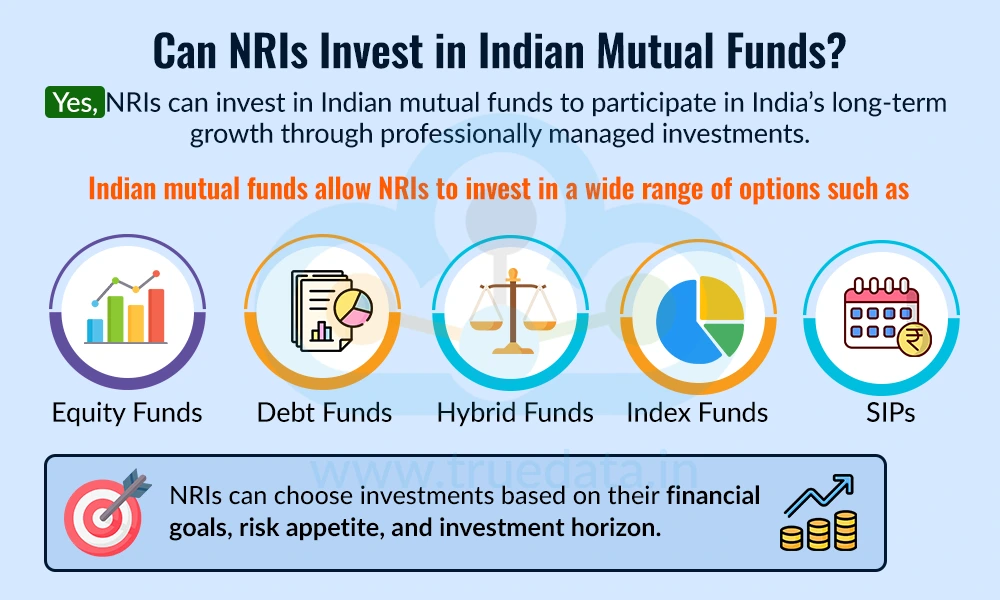
NRIs can invest in Indian mutual funds, and many choose this route to participate in India’s long-term growth story while staying connected to the country’s financial markets. Whether working abroad, running a business overseas, or planning to return to India in the future, mutual funds can offer a convenient and professionally managed way to build wealth. Indian mutual funds allow NRIs to invest in a wide range of options such as equity funds, debt funds, hybrid funds, index funds, and SIPs (Systematic Investment Plans). NRIs can choose investments based on their financial goals, risk appetite, and investment horizon.

The investment activities of Non-Resident Indians (NRIs) in India are regulated by the Foreign Exchange Management Act (FEMA), along with guidelines issued by the Reserve Bank of India (RBI) and the Securities and Exchange Board of India (SEBI). These regulations are designed to ensure that foreign currency transactions and investments are carried out through proper banking channels and remain compliant with Indian financial laws.
For NRIs planning to invest in Indian mutual funds, understanding these regulations is important because they determine the type of bank accounts that can be used, how investments can be made, and how money can be transferred back overseas. Following these rules properly helps investors avoid legal, banking, or taxation issues later.
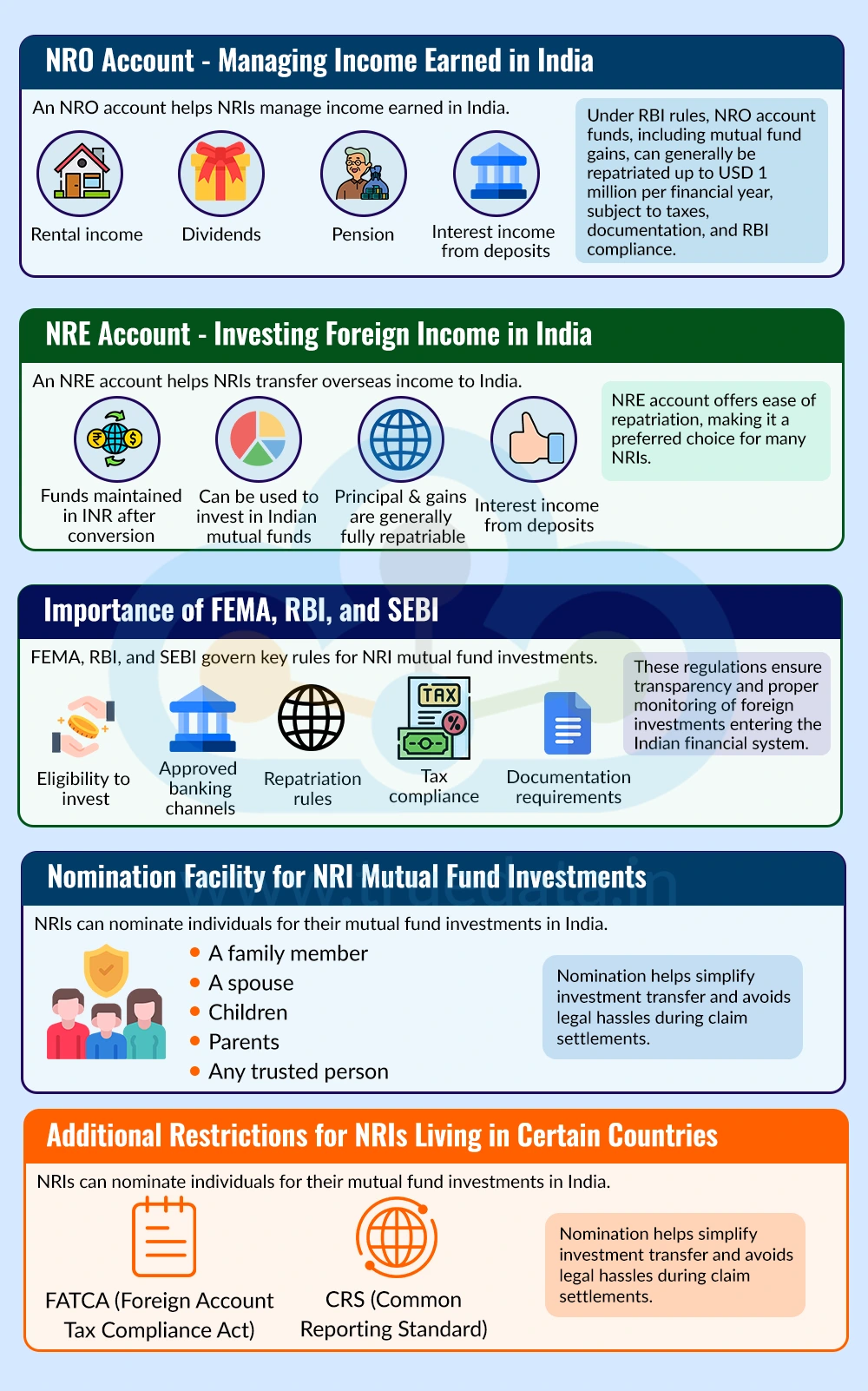
A Non-Resident Ordinary (NRO) account is mainly used by NRIs to manage income earned within India. This may include,
Rental income
Pension
Interest income from deposits
Funds held in an NRO account can be used to invest in Indian mutual funds. This account is commonly used by NRIs who continue to earn income from assets or investments located in India. Repatriation refers to transferring money from India back to the investor’s country of residence. Under RBI regulations, funds from an NRO account, including mutual fund redemption proceeds and capital gains, can generally be repatriated up to USD 1 million per financial year. However, this transfer is subject to,
Applicable taxes
Proper documentation
RBI compliance requirements
Due to these limits and procedures, NRIs should plan large overseas fund transfers carefully when investing through an NRO account.
A Non-Resident External (NRE) account is designed for NRIs who want to transfer income earned outside India into the Indian banking system. Funds deposited into this account are maintained in Indian rupees after conversion from foreign currency. NRIs can also use NRE account funds to invest in Indian mutual funds. One of the biggest advantages of an NRE account is the ease of repatriation. The original investment amount and the profits or gains earned are generally fully and freely repatriable outside India, subject to prevailing regulations. Due to this flexibility, many NRIs prefer using NRE accounts for mutual fund investments, especially if they may need to transfer money abroad in the future without major restrictions.
The rules framed under FEMA, RBI, and SEBI govern several important aspects of NRI mutual fund investing, including
Eligibility to invest
Approved banking channels
Repatriation rules
Tax compliance
Documentation requirements
These regulations ensure transparency and proper monitoring of foreign investments entering the Indian financial system. Staying compliant with these rules is essential for smooth investing and hassle-free fund transfers later.
NRIs are allowed to nominate individuals for their mutual fund investments in India. A nominee can be any of the following,
A family member
A spouse
Children
Parents
Any trusted person
The nomination facility plays an important role in financial planning because it helps simplify the transfer of investments in case of unforeseen situations. Keeping nomination details updated is equally important, especially after major life events such as marriage, relocation, or changes in family structure. Proper nomination can help family members avoid lengthy legal procedures during claim settlements.
NRIs residing in certain countries, particularly the United States and Canada, may face additional compliance requirements while investing in Indian mutual funds. This is mainly due to international reporting regulations such as,
FATCA (Foreign Account Tax Compliance Act)
CRS (Common Reporting Standard)
These regulations require financial institutions to maintain detailed reporting standards for overseas investors. Due to the higher compliance burden and reporting requirements,
Some Indian mutual fund companies may not accept investments from NRIs based in these countries
Some may allow investments only in selected schemes
Others may require additional declarations and documentation before processing investments
As a result, NRIs should always verify whether the mutual fund company accepts investors from their country of residence before starting the investment process.

An NRI (Non-Resident Indian) is an Indian citizen who lives outside India for employment, business, education, or other purposes, indicating a long-term stay abroad. Under FEMA and the Income Tax Act, an individual is generally considered an NRI if they do not stay in India for 182 days or more during the financial year and do not meet certain additional residency conditions. NRI status is important because it determines the rules, taxation, and reporting requirements applicable to mutual fund investments in India. The following categories of persons are qualified to invest in mutual funds in India.
NRIs (Non-Resident Indians) - Indian citizens living outside India for employment, business, education, or other purposes can invest in Indian mutual funds as NRIs. These persons should have a valid PAN and KYC and can invest through NRE/NRO accounts. However, some mutual fund companies may restrict investments from NRIs residing in certain countries, such as the USA or Canada, due to additional compliance rules like FATCA reporting.
OCIs (Overseas Citizens of India) - Individuals holding OCI status are generally allowed to invest in Indian mutual funds after completing KYC verification, providing a passport and overseas address proof, and linking eligible bank accounts.
PIOs (Persons of Indian Origin) - PIOs may also qualify to invest in Indian mutual funds, depending on applicable regulations and documentation requirements like a valid PAN card, KYC compliance and investing through NRE or NRO bank account.

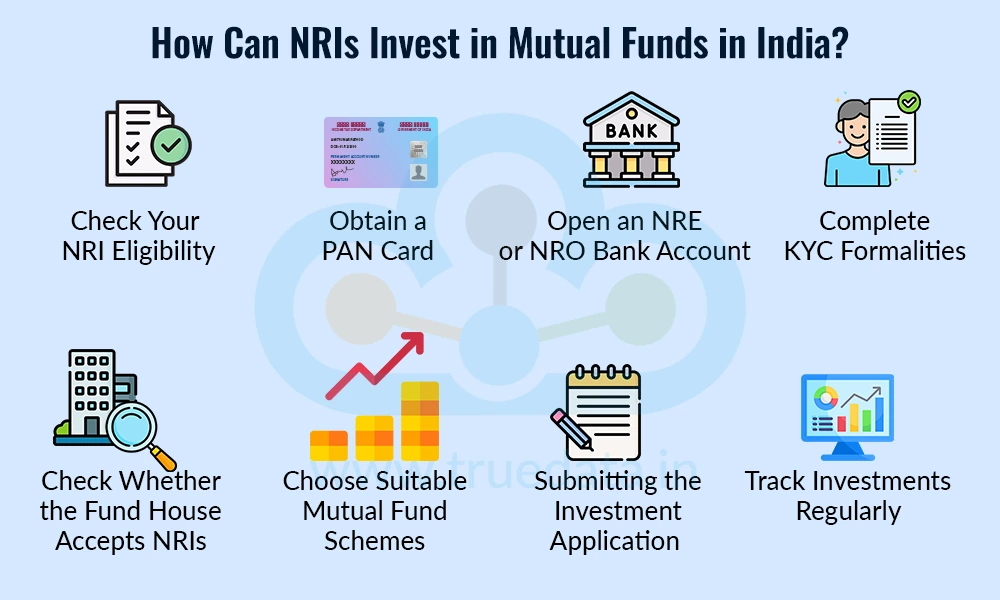
Investing in Indian mutual funds as an NRI is a fairly simple process when the required banking, KYC, and regulatory formalities are completed properly. The steps include,
Check Your NRI Eligibility - First, confirm your residential status as an NRI, OCI, or PIO under FEMA and Income Tax rules. This determines the applicable investment and taxation rules.
Obtain a PAN Card - A PAN card is mandatory for investing in Indian mutual funds, as without a PAN card, mutual fund investments cannot usually be processed. It is required for
KYC verification
Investment transactions
Tax reporting
Open an NRE or NRO Bank Account - NRIs must invest through approved bank accounts, such as
NRE (Non-Resident External) account - Used for income earned abroad and fully repatriable.
NRO (Non-Resident Ordinary) account - Used for income earned in India, subject to repatriation limits and documentation
Complete KYC Formalities - KYC (Know Your Customer) completion is compulsory before investing, and some mutual fund companies may also require video KYC or in-person verification. NRIs may need to submit,
Passport copy
PAN card
Overseas address proof
Photograph
Bank account details
Check Whether the Fund House Accepts NRIs - Some mutual fund companies may have restrictions for NRIs residing in countries like the United States and Canada. This is mainly due to FATCA and compliance requirements. NRIs should confirm eligibility before investing.
Choose Suitable Mutual Fund Schemes - NRIs can invest in different types of mutual funds based on their financial goals, investment horizon and risk appetite. While NRIs can invest through SIPs (Systematic Investment Plans or lump sum investments), SIPs help investors invest regularly and manage market volatility over time. Eligible funds include,
Equity funds
Debt funds
Hybrid funds
Index funds
Submitting the Investment Application - The application must include bank details, KYC information, and FATCA declarations where applicable. Investments can usually be made,
Online through mutual fund websites or apps
Through registered distributors
Via investment platforms
Power of Attorney (PoA), i.e., entrusting the investment process to a trusted person by appointing a resident Indian as a PoA to invest on their behalf.
Track Investments Regularly - After investing, NRIs should regularly monitor the fund performance, portfolio allocation, tax implications and currency exchange impact. Periodic review helps ensure investments remain aligned with financial goals.
The taxation on returns earned by NRIs is explained in the table below.

For NRIs looking to stay financially connected with India, mutual funds can offer a simple and flexible investment avenue. With the right understanding of banking requirements, tax rules, compliance procedures, and investment options, NRIs can manage their investments efficiently from anywhere in the world. A well-planned approach focused on long-term goals, proper diversification, and disciplined investing can help NRIs make the most of India’s evolving economic opportunities while building a stronger financial future.
This article highlights the mutual fund investment process for NRIs, making it easily accessible to them. Let us know your thoughts on the topic or if you need further information on the same, and we will address it soon.
TIll then, Happy Reading!
Read More: How to Read a Mutual Fund Factsheet?
Mutual fund investments have simplified greatly with just a tap on your smartpho...
Introduction For the longest time, investment in stock markets was thought to b...