The New Tax Bill 2025, also known as the Income Tax Act 2025, came into effect on 1st April 2025. While we have already explored its key highlights in our previous blog, there is more to the story. Several additional changes will come into play effective from 1st April 2026. Some of which may seem small but can have a real impact on taxpayers. For example, updates to commonly used forms like Form 16 and Form 15G/15H are part of these changes. Curious to know about these new changes and how it affects you? Check out this blog where we break down all the important updates effective from 1st April 2026 in a simple and easy-to-understand way.

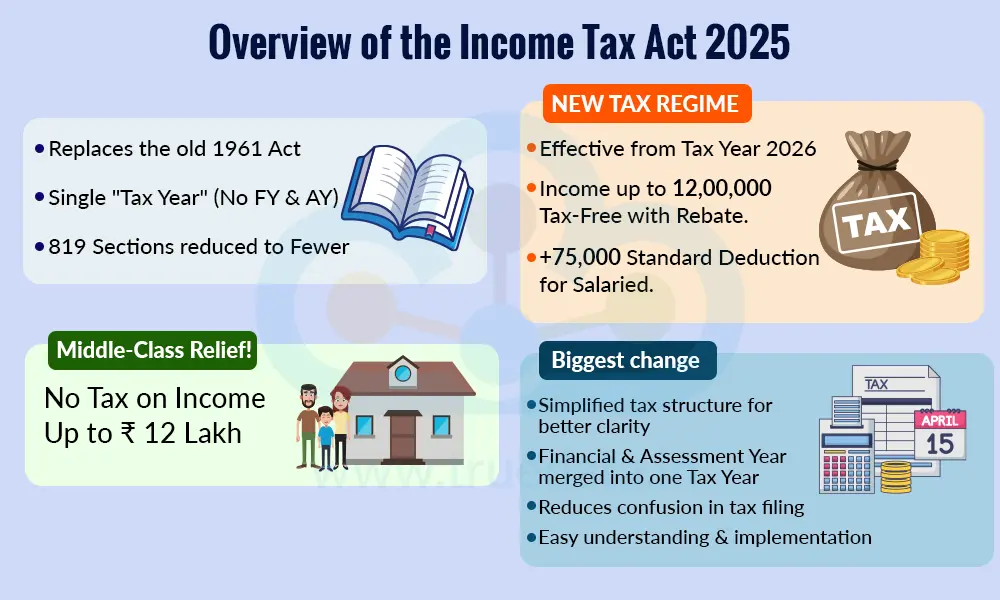
The earlier law, the Income Tax Act 1961, had become very long and complicated over time due to many amendments added over 60 years. It had around 819 sections and 47 chapters, making it quite comprehensive and cumbersome to understand. The new version of the Act, Income Tax Act 2025, presents a more concise, easier-to-read and understand law where the outdated and unnecessary provisions are removed. The biggest change is the alignment of the ‘Financial Year’ and ‘Assessment Year’ into a single ‘Tax Year’, thereby removing any confusion in the use and implementation of the Act and its provisions. The slab rates in the new tax regime, which is now the default regime, take effect in the Tax Year 2026. Income up to Rs. 12,00,000 is effectively tax-free (with rebate) under the new tax regime, and salaried individuals get an additional Rs. 75,000 as standard deduction. This is a major relief compared to earlier limits. It means a middle-class taxpayer earning around Rs. 12,00,000 may not have to pay any tax, which was not possible under the older system.

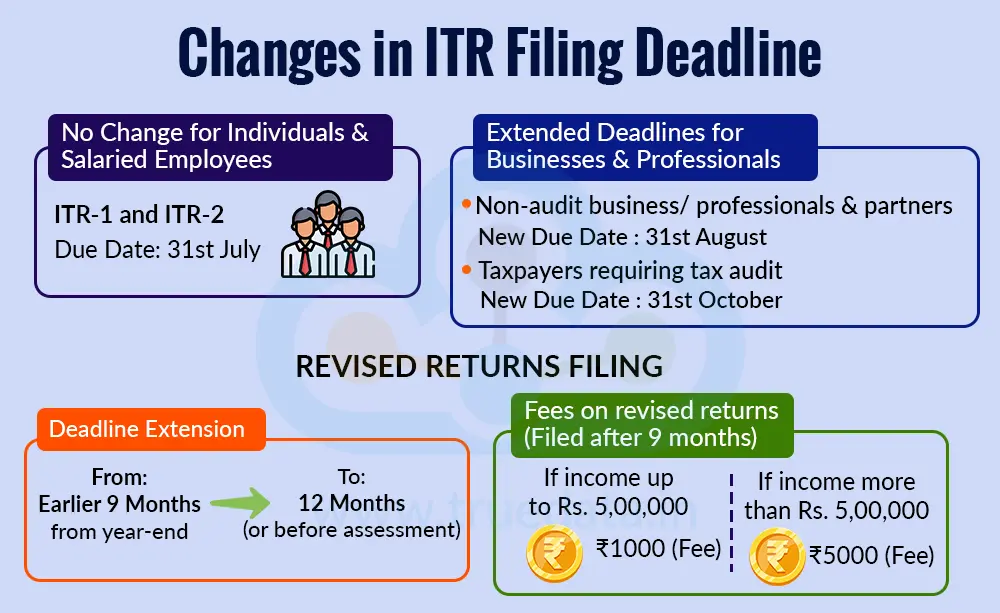
The government aims to make return filing more structured and realistic by slightly adjusting deadlines for different types of taxpayers. Earlier, many taxpayers, especially businesses and professionals, faced practical difficulties in meeting deadlines due to audit requirements, data collection, and reconciliation issues. The revised timelines are designed to give more breathing space where needed (like audited cases), while also encouraging timely filing through better alignment with TDS statements and financial reporting. While there is no change for the salaried employees or individual taxpayers filing ITR return under ITR-1 and ITR-2, the due date for non-audit business/professional taxpayers and partners of non-audit firms is extended from 31st July to 31st August. Similarly, the deadline for assessees requiring a tax audit is 31st October. The proposed new changes also apply to filing revised returns where the deadline is extended from the earlier 9 months from the end of the relevant year to 12 months from the end of the relevant year (or before assessment). However, a fee will be charged on revised returns filed after 9 months as follows,
If the taxpayer’s income is up to Rs. 5,00,000 - Rs 1,000
If the taxpayer’s income is more than Rs. 5,00,000 - Rs 5,000
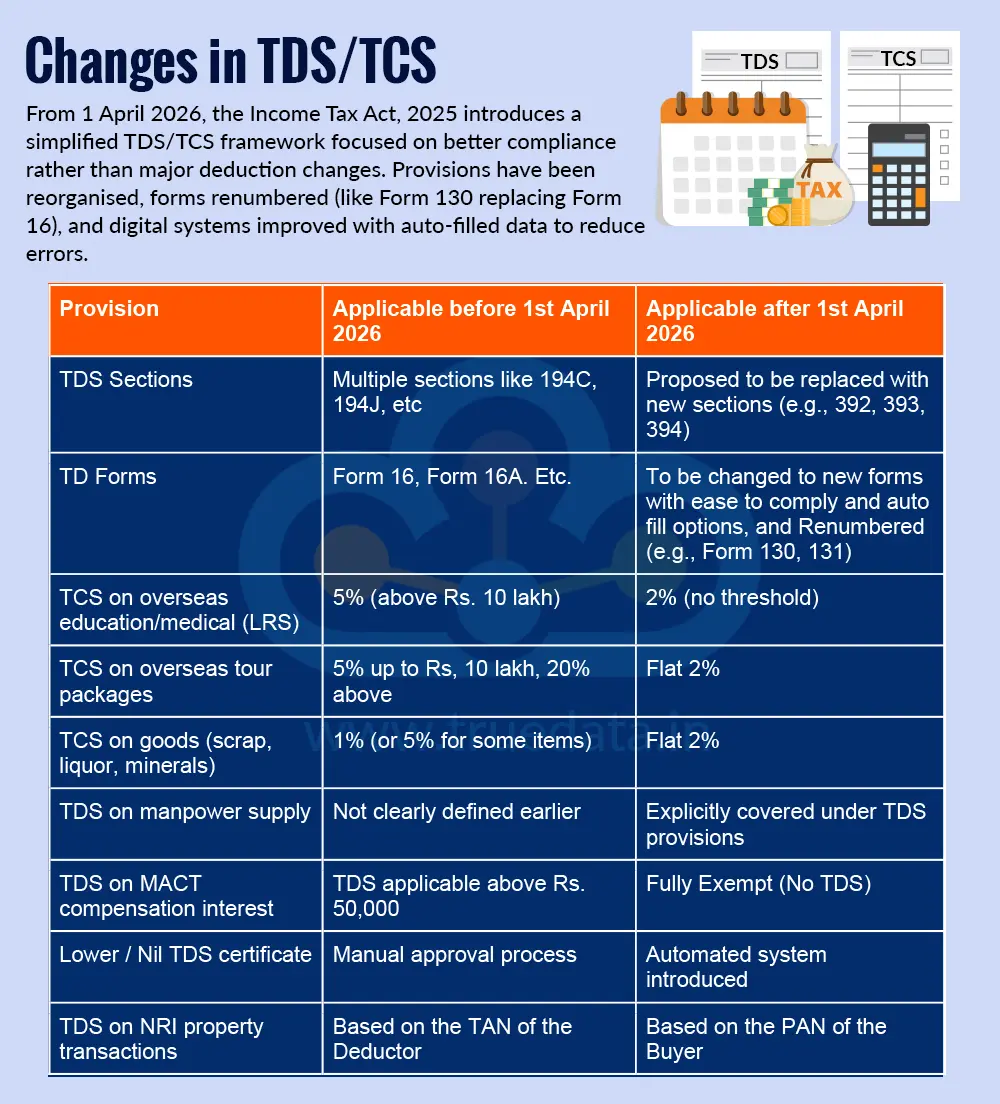
From 1 April 2026, the new framework under the Income Tax Act, 2025 and Rules, 2026 brings structural changes to TDS/TCS, mainly focusing on simplification, renumbering, and better compliance, rather than completely changing how tax is deducted or collected. The government has reorganised TDS/TCS provisions into new sections and introduced renumbered forms (like Form 130 replacing Form 16), along with improved digital systems and auto-filled data to reduce errors.
At the same time, there are some important changes in rates and thresholds, especially under TCS. The government has rationalised rates to reduce confusion and ease cash flow for taxpayers, for example, lowering TCS on overseas education and medical remittances. Overall, the aim is to make compliance simpler, more transparent, and less burdensome, while improving tracking of transactions and reducing disputes.
The key changes in TDS/TCS rules include,

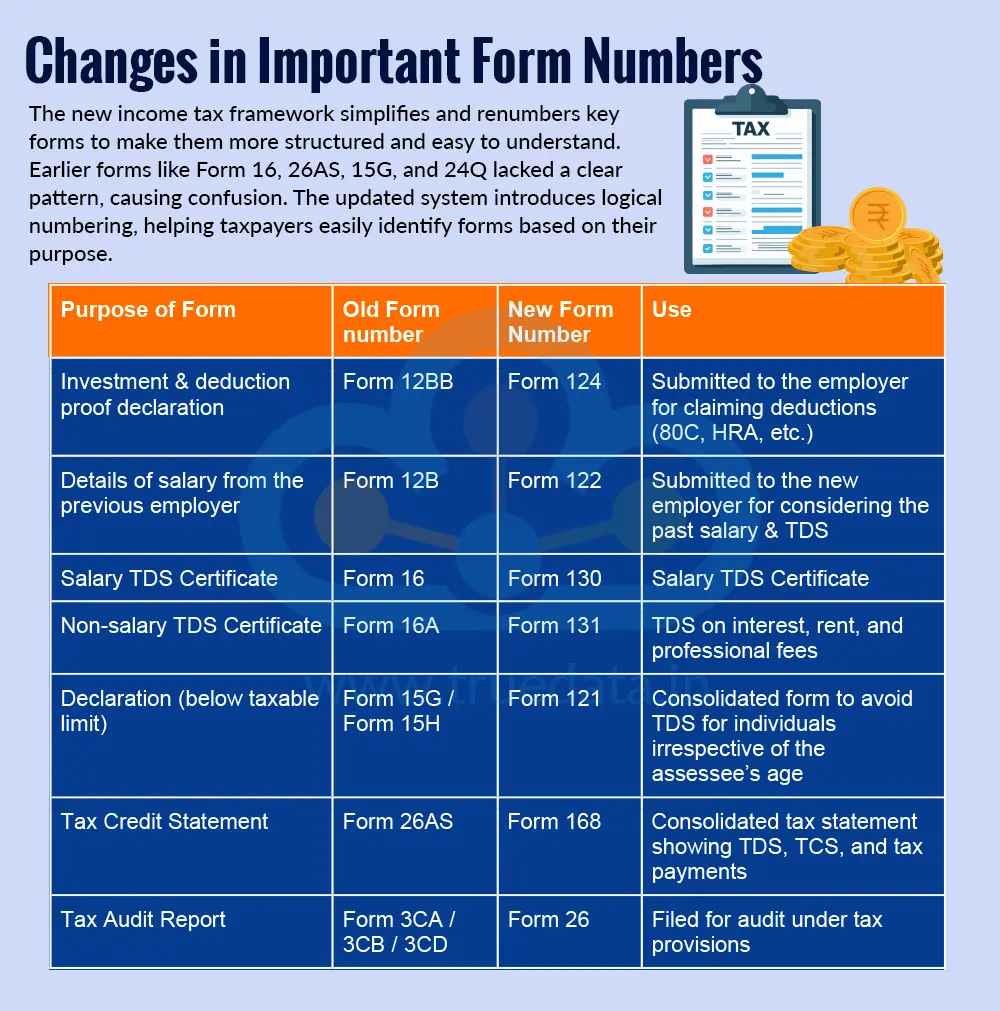
One of the key proposed changes in the new income tax framework is the renumbering and simplification of important forms used by taxpayers and deductors. Earlier, forms like Form 16, 26AS, 15G, 24Q, etc., had developed over time without a clear pattern, which often created confusion, especially for new taxpayers. The new system aims to introduce a more logical and structured numbering series, making it easier to identify forms based on their purpose. Along with renumbering, the total number of forms is also proposed to be reduced, and their format is improved so that details like salary, TDS, and tax credits match better with income tax returns. This helps in reducing errors, avoiding mismatches, and minimising tax notices, making compliance simpler and more user-friendly for everyone.
Here is a brief summary of the changes in a few key forms

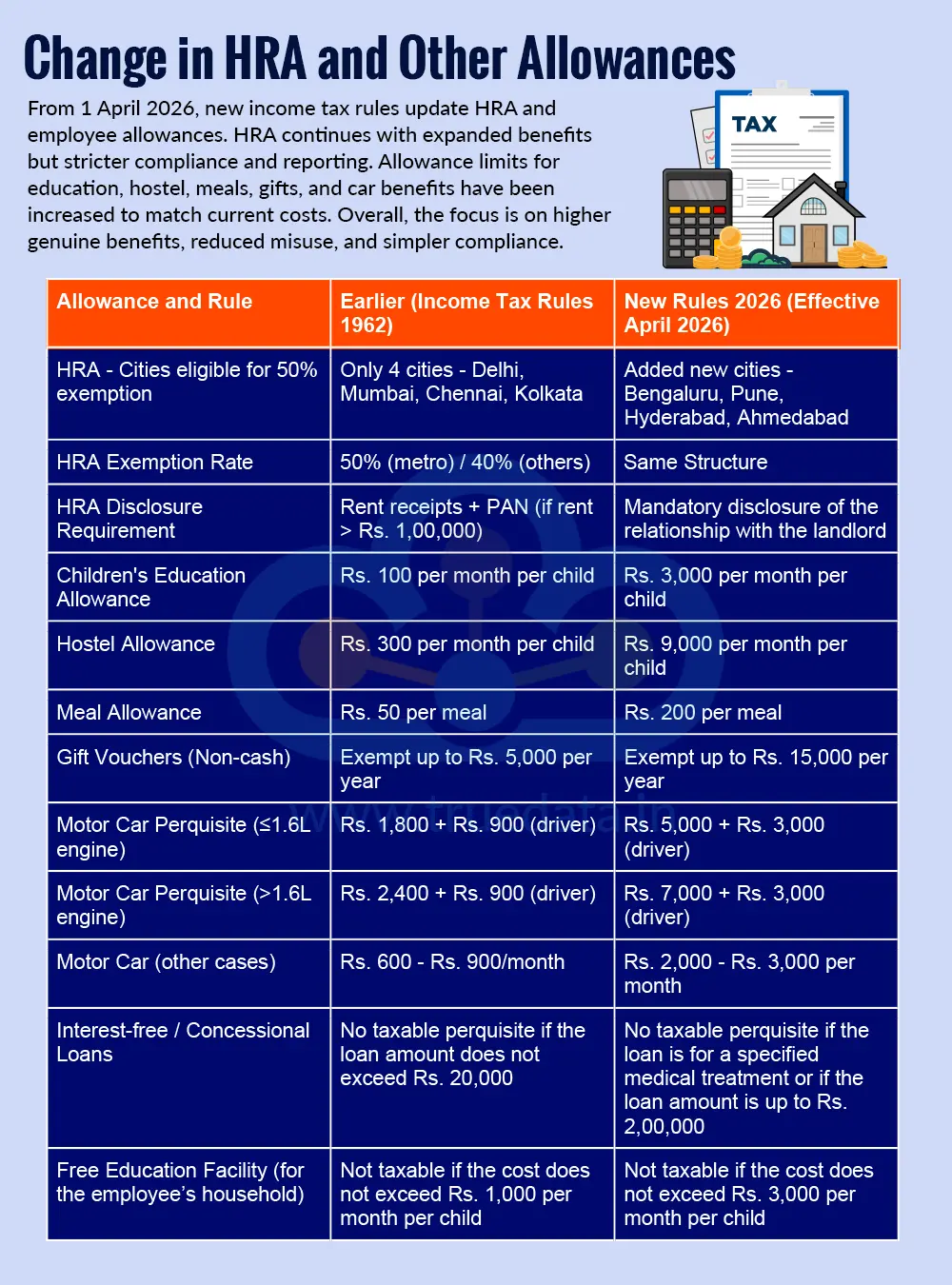
The new income tax rules, effective from 1 April 2026, bring important updates to HRA and several employee allowances. The government has not removed HRA, but has expanded its benefits and tightened compliance rules. At the same time, many other allowances like children’s education, hostel, meals, gifts, and car benefits have seen significant increases in exemption limits, making them more realistic with current costs.
Another major shift is stricter reporting requirements, especially for HRA claims. Taxpayers now also need to provide more details to prevent misuse (like fake rent paid to relatives). Overall, the changes aim to increase genuine tax benefits while reducing misuse and simplifying compliance.
The key changes in allowances are tabled below.

Presumptive taxation is a simple way for small businesses and professionals to pay tax without maintaining detailed books of accounts. Under the Income Tax Act, 1961, schemes like Section 44AD (for businesses), 44ADA (for professionals), and 44AE (for transporters) allow taxpayers to declare income at a fixed percentage of turnover and avoid audits and heavy compliance.
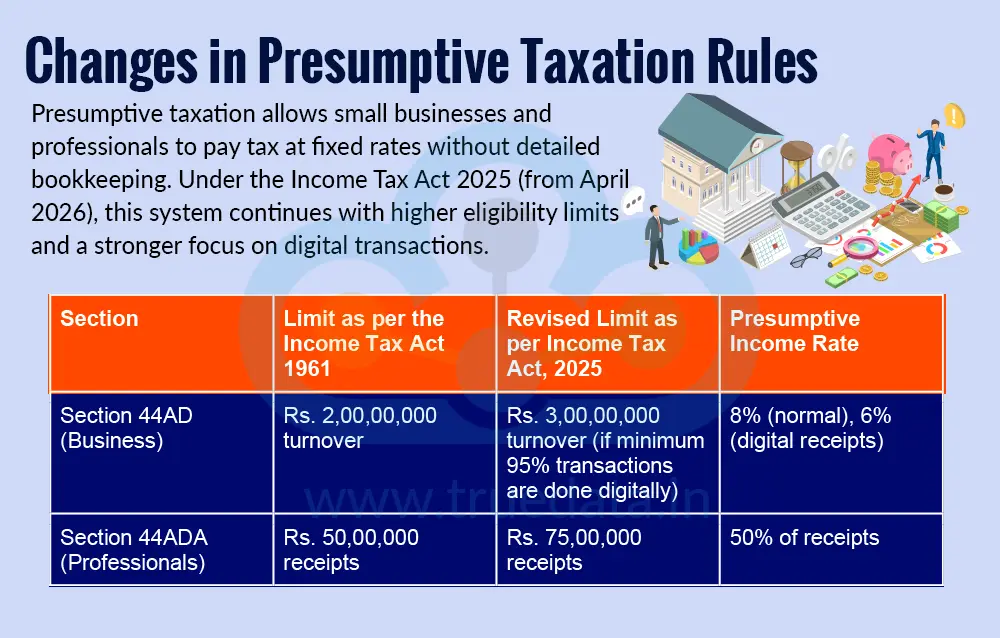
Under the proposed framework of the Income Tax Act 2025 (applicable from April 2026), the structure of presumptive taxation continues, but with revised thresholds and a stronger push toward digital transactions. The government aims to increase eligibility limits, allowing more small taxpayers to benefit from simplified taxation. At the same time, conditions related to cash transactions remain important, ensuring that businesses adopting digital modes get higher limits. Overall, the changes are designed to expand coverage, reduce compliance burden, and encourage transparency.
The changes in the presumptive taxation as per the Income Tax Act 2025 and applicable rules are,

The overhaul of the erstwhile Income Tax Act, 1961, was long overdue due to the volume and complexity of the provisions and rules thereunder. With the new Income Tax Act, 2025, the government aims to provide simplicity in understanding and compliance. These are a few key changes of the new Act that come into effect from 1st April 2026. Moreover, there are many other significant changes proposed under the Budget 2026 that will be enforced too. We have discussed them in detail in our blog on Budget 2026 highlights. A comprehensive reading of these two blogs can give taxpayers a complete idea of the key details under the Income Tax Act 2025.
This article explains the important changes in taxation provisions and rules that will have a direct impact on taxpayers across the country. Let us know your thoughts on the topic or if you need further information on the same, and we will address it soon.
Till then, Happy Reading!
Read More: Understanding the Impact of GST Reforms on Consumption Funds
Taxation is one of the key points to consider while making any career or investm...
We saw a string of layoffs in the past year and early this year. What do you do ...
Remember the first time you tried riding a bicycle? The thrill of moving forward...